January 8th, 2026 | 07:10 CET
Gold rush without toxins: Why Newmont and Equinox are under pressure, and RZOLV Technologies could become the key stock of the new super cycle
Gold is back on the big stage. Driven by geopolitical hot spots, structural weakness in the US dollar, and the insatiable appetite of central banks, the precious metal is racing from one all-time high to the next. But while prices are rising, the situation for mine operators is deteriorating: dependence on highly toxic cyanide is becoming more and more of a problem. Environmental regulations are becoming stricter, approval procedures are dragging on for decades, and social resistance is blocking billion-dollar projects. The technology company RZOLV Technologies is positioning itself in this area of tension between record prices and ecological dead ends. While industry giants such as Newmont and Equinox Gold are looking for ways to secure their production in a sustainable manner, RZOLV is providing the long-awaited technological answer: gold extraction that does not require any toxic chemicals and thus has the potential to reshuffle the cards in global mining.
time to read: 3 minutes | Author: Nico Popp
ISIN: NEWMONT CORP. DL 1_60 | US6516391066 , EQUINOX GOLD CORP. NEW | CA29446Y5020 , RZOLV TECHNOLOGIES INC | CA76091C1032
Table of contents:
Author

Nico Popp
At home in Southern Germany, the passionate stock exchange expert has been accompanying the capital markets for about twenty years. With a soft spot for smaller companies, he is constantly on the lookout for exciting investment stories.
Tag cloud
Shares cloud
Gold on a record chase: Wall Street sounds the charge
Those who still had doubts about the start of a new supercycle have been proven wrong by the latest forecasts from leading analysts. Goldman Sachs, traditionally rather cautious, has named the yellow metal the top commodity trade of 2026, citing massive physical demand from Asia and fears of a US debt crisis. For producers such as Newmont and Equinox Gold, these are dream conditions, as every dollar of price increase is reflected almost unabated in free cash flow.
The balance sheets of the major producers are healthier than they have been for a long time, and dividends are flowing. However, the market often values these profits at a discount. Investors know that the good years can quickly come to an end if environmental disasters or the withdrawal of social operating licenses paralyze operations. This is precisely where the Sword of Damocles hangs over the industry: in order to meet projected demand, new, often lower-grade deposits must be developed, which traditionally means the use of even more chemicals and even larger tailings ponds.
The toxic legacy: Why cyanide is becoming an existential threat
For over a century, cyanide leaching has been the gold standard in industry. The process is efficient and cheap, but it has one major drawback: sodium cyanide is one of the most powerful poisons in the world. A single accident, such as the dam breach in Baia Mare in 2000 or more recent incidents in South America, is enough to poison entire river systems and destroy a company's reputation forever. For corporations such as Newmont and Equinox Gold, obtaining approval for new projects is becoming increasingly difficult, as more and more jurisdictions, from Montana in the US to entire provinces in Argentina and Europe, are simply banning the use of cyanide.
This regulatory straitjacket means that huge gold deposits have to remain in the ground because they cannot be approved using conventional methods. These are referred to as "stranded assets" – deposits that exist on paper but cannot be economically or legally mined. The industry is caught in an innovation trap: it has to deliver, but can hardly use the only method it has mastered on a large scale. Pressure from institutional investors such as BlackRock, which apply strict ESG criteria, further exacerbates the situation. Anyone building new mines today must prove that they are not leaving behind an ecological time bomb.
RZOLV Technologies: The "Intel Inside" moment for mining
This is precisely where RZOLV Technologies comes into play. The Company is not a traditional mining operator that digs holes and moves rock, but a technology provider. RZOLV has developed a process for extracting precious metals and critical minerals from ore – completely free of cyanide. The technology is based on a proprietary lye that is biodegradable and works in closed cycles.
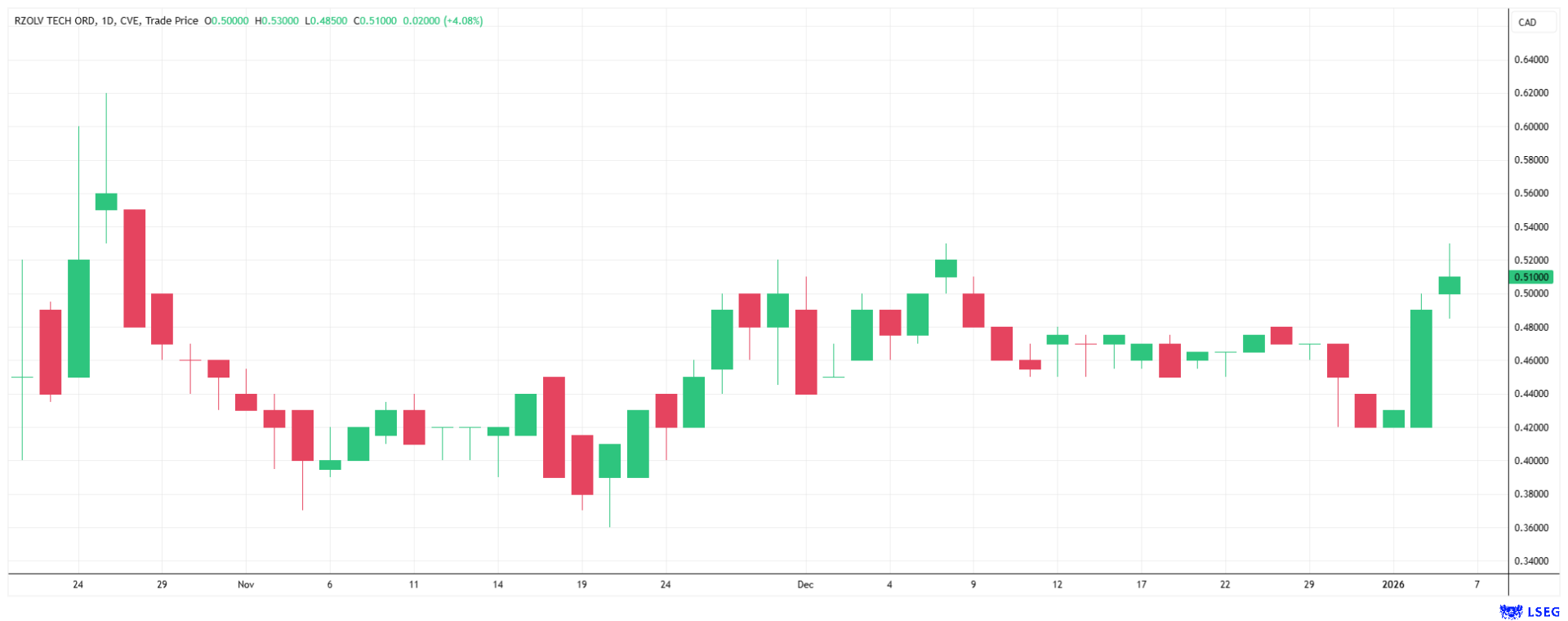
What sounds like a niche to the layman is a revolution for industry. Tests have shown that RZOLV's technology is not only environmentally friendly, but often even delivers a higher yield than traditional cyanide leaching. RZOLV appears to have developed a promising alternative that the research departments of the majors have been struggling with for decades. The Company positions itself as a partner, not a competitor. It provides the technology that could enable a corporation to finally bring a mine that has been "stranded" due to environmental regulations into production.
Stranded Assets: How worthless rock can turn into billions
RZOLV's business model is particularly attractive to investors because it is highly scalable and requires little capital commitment. **Instead of investing billions in building its own mines, RZOLV plans to license its technology to producers. This prospect makes the Company one of the most exciting bets in the current gold supercycle. RZOLV operates far removed from the operational risk of a single mine, but is compatible with many companies in industry.
Watch YouTube videoConflict of interest
Pursuant to §85 of the German Securities Trading Act (WpHG), we point out that Apaton Finance GmbH as well as partners, authors or employees of Apaton Finance GmbH (hereinafter referred to as "Relevant Persons") may hold shares or other financial instruments of the aforementioned companies in the future or may bet on rising or falling prices and thus a conflict of interest may arise in the future. The Relevant Persons reserve the right to buy or sell shares or other financial instruments of the Company at any time (hereinafter each a "Transaction"). Transactions may, under certain circumstances, influence the respective price of the shares or other financial instruments of the Company.
In addition, Apaton Finance GmbH is active in the context of the preparation and publication of the reporting in paid contractual relationships.
For this reason, there is a concrete conflict of interest.
The above information on existing conflicts of interest applies to all types and forms of publication used by Apaton Finance GmbH for publications on companies.
Risk notice
Apaton Finance GmbH offers editors, agencies and companies the opportunity to publish commentaries, interviews, summaries, news and the like on news.financial. These contents are exclusively for the information of the readers and do not represent any call to action or recommendations, neither explicitly nor implicitly they are to be understood as an assurance of possible price developments. The contents do not replace individual expert investment advice and do not constitute an offer to sell the discussed share(s) or other financial instruments, nor an invitation to buy or sell such.
The content is expressly not a financial analysis, but a journalistic or advertising text. Readers or users who make investment decisions or carry out transactions on the basis of the information provided here do so entirely at their own risk. No contractual relationship is established between Apaton Finance GmbH and its readers or the users of its offers, as our information only refers to the company and not to the investment decision of the reader or user.
The acquisition of financial instruments involves high risks, which can lead to the total loss of the invested capital. The information published by Apaton Finance GmbH and its authors is based on careful research. Nevertheless, no liability is assumed for financial losses or a content-related guarantee for the topicality, correctness, appropriateness and completeness of the content provided here. Please also note our Terms of use.