July 31st, 2026 | 07:10 CEST
Forget Hydrogen: Mercedes-Benz, Strategic Resources, and Rio Tinto Show Where the Real Money Lies
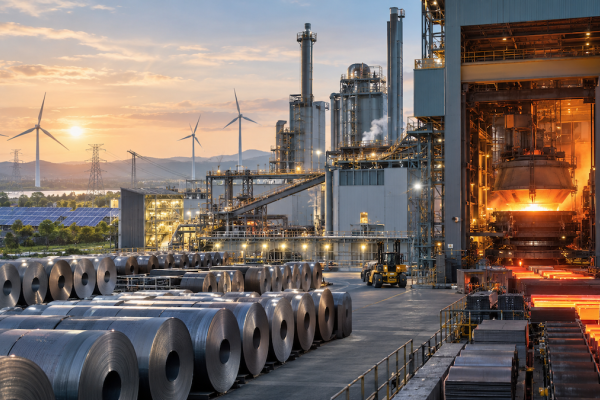
The steel industry is undergoing its most profound transformation since the blast furnace era. Steel production generates more greenhouse gases than global air and maritime traffic combined. While other sectors are already driving their own transformations, the steel industry's transition is still in its infancy. But it is precisely this delay that holds enormous potential. With the EU CO₂ border adjustment mechanism set to take effect in 2026 and rising permit prices, early investments in hydrogen-based processes will secure future market advantages. The crucial question is no longer whether, but who will control the scarce resources of green production. As an automotive giant, Mercedes-Benz secures the off-take; Strategic Resources enables direct reduction with vanadium-rich ore; and Rio Tinto is reshaping the global raw materials base through the Simandou project.
time to read: 5 minutes | Author: Armin Schulz
ISIN: STRATEGIC RESOURCES INC | CA86277X4093 | TSXV: SR , MERCEDES-BENZ GROUP AG | DE0007100000 , RIO TINTO PLC LS-_10 | GB0007188757
Table of contents:
Author

Armin Schulz
Born in Mönchengladbach, he studied business administration in the Netherlands. In the course of his studies he came into contact with the stock exchange for the first time. He has more than 25 years of experience in stock market business.
Tag cloud
Shares cloud
Mercedes-Benz: Between Green Steel and China Risk
Mercedes-Benz is systematically driving forward the transformation of its steel supply chain. Through six European partners, including Salzgitter, thyssenkrupp, and H2 Green Steel, the group secures over 200,000 metric tons of CO₂-reduced material annually. This covers about one-third of the group's total European demand. In addition, the Stuttgart-based company has taken a stake in the Swedish startup H2GS. While competitors are still hesitating, Mercedes-Benz is securing long-term purchase agreements and access to technology. The 20–30% additional costs are becoming increasingly competitive as CO₂ prices rise. For investors, this means that Mercedes-Benz is building a genuine competitive advantage.
The second-quarter figures paint a mixed picture. Group revenue fell slightly to EUR 32.1 billion, but EBIT improved to EUR 1.5 billion. Free cash flow reached EUR 1.1 billion. The passenger vehicle division is struggling with a return of 4.0%, which is at the lower end of the annual forecast. The price war in China and model changes are weighing on results. In contrast, the vans segment surprised on the upside with a 10.2% return, as did the financial services segment with a 70% increase in EBIT. Net liquidity remains comfortably high at EUR 30.4 billion, despite dividend payments of EUR 5 billion in the first half of the year.
The Chinese market remains the biggest challenge. A 30% decline in sales for the quarter and impairment charges of EUR 704 million on equity investments highlight the pressure. The fact that Chinese shareholders hold around 20% of Mercedes shares could, in an extreme case, even lead to trading restrictions in the US. This is a risk that CEO Källenius addressed during the analyst call. Management is responding with a two-pronged strategy. Production is to take place locally in China, while at the same time the US presence is to be expanded with investments of over USD 7 billion. The group has demonstrated the operational strength and financial reserves to weather this transition phase, but remains vulnerable to geopolitical upheavals.
Strategic Resources: Canada's Secret Champion for Green Steel
While the steel industry groans under the pressure of decarbonization, Strategic Resources is working behind the scenes on a solution that goes far beyond simply supplying raw materials. With its BlackRock project in Québec, the company has established a position in North America that is unparalleled. Permits for the mine and processing plant are already in place, and the first pit is designed to last 39 years. However, what makes the project so special only becomes apparent upon closer inspection. The ore deposit yields not only iron but also vanadium and titanium—two raw materials that are increasingly in demand in the energy transition and the defence industry. Currently, there is no primary vanadium mining operation in North America. Strategic Resources could fill this gap.
A 400-km-long rail line connects the mine near Chibougamau to the deep-water port of Port Saguenay. A pelletizing plant with an annual capacity of 1.5 million metric tonnes is being built there. In May 2026, the outstanding responses were submitted to the Québec Ministry of the Environment. A decision is expected in the coming months. If approved, the pelletizing plant can be expanded to 4 million metric tonnes. The connection to the natural gas infrastructure and affordable hydroelectric power not only makes operations lower-emission but also economically attractive. The figures underscore the potential. The net present value after taxes is CAD 1.9 billion, with an internal rate of return of 18.2%. The proven and probable reserves of 127.8 million metric tonnes, with a total resource of 355.5 million metric tonnes, offer prospects that go far beyond those of a typical junior mining project. The Canadian authorities have recognized this. CAD 111 million has already been invested in port infrastructure.
However, the company is not thinking solely in terms of North America. Its listing on the Frankfurt Stock Exchange in April 2026 opened the door to European capital. At the same time, Strategic Resources is moving forward with its Mustavaara project in Finland. In June 2026, the company was accepted as an industrial partner in the EUR 17 million FutSteel research project, which is working with SSAB on fossil-free steel production. This is not only a seal of quality for the vanadium concentrate but also a strategic step toward entering the European market. The memorandum of understanding to establish a Canadian vanadium-to-battery supply chain for the electrification of heavy-duty vehicles also demonstrates that the company is thinking beyond a single direction. The fact that the Province of Québec and Orion Mine Finance are among the major shareholders lends the project additional credibility.
Rio Tinto: The Commodity Giant in Transition
The Anglo-Australian conglomerate Rio Tinto is undergoing a remarkable transformation. While iron ore was long the sole driving force, copper and aluminum are now taking the lead—and doing so at a rapid pace. The half-year results underscore this strategic shift. For the first time, copper and aluminum contributed over 50% to consolidated profit. Copper EBITDA skyrocketed by 84% to USD 5.7 billion, while the iron ore business remained nearly on par at USD 6.8 billion. This is driven by growing demand from AI infrastructure, energy grids, and electric mobility. Net income climbed 47% to USD 6.66 billion. This is the strongest half-year figure since 2022.
Operations are running smoothly, and the productivity drive is paying off. Copper-equivalent production rose by 3%, and the Pilbara region achieved its highest half-year production since 2018. By June, USD 870 million in efficiency gains had been realized; by year-end, the annualized rate is expected to rise to USD 1.8 billion—nearly three times the original target. Free cash flow surged 75% to USD 3.8 billion, creating room for investments and dividends.
Rio Tinto continues to invest heavily in the future. Simandou in Guinea is three-quarters complete, and projects in the lithium business got underway earlier than planned. Capital expenditures remain unchanged at up to USD 11 billion for 2026 and 2027. Shareholders will benefit from an interim dividend of USD 2.11. This represents a 43% increase and is the highest figure in four years. Nevertheless, challenges remain. Two fatalities have weighed on the safety record, and climate targets depend on external factors. Still, the company remains on track.
The steel industry's transformation will not be determined by hydrogen alone, but by control over raw materials and procurement structures. Mercedes-Benz is securing low-carbon steel early on, thereby building a strategic advantage in the supply chain. With its vanadium-rich ore project in Québec, Strategic Resources holds the key to low-emission direct reduction in North America. Rio Tinto is reshaping the global raw materials landscape with Simandou while simultaneously benefiting from strong demand for copper and aluminum. The decisive bet is not solely on technology, but on active positioning along the entire value chain.
Conflict of interest
Pursuant to §85 of the German Securities Trading Act (WpHG), we point out that Apaton Finance GmbH as well as partners, authors or employees of Apaton Finance GmbH (hereinafter referred to as "Relevant Persons") currently hold or hold shares or other financial instruments of the aforementioned companies and speculate on their price developments. In this respect, they intend to sell or acquire shares or other financial instruments of the companies (hereinafter each referred to as a "Transaction"). Transactions may thereby influence the respective price of the shares or other financial instruments of the Company.
In this respect, there is a concrete conflict of interest in the reporting on the companies.
In addition, Apaton Finance GmbH is active in the context of the preparation and publication of the reporting in paid contractual relationships.
For this reason, there is also a concrete conflict of interest.
The above information on existing conflicts of interest applies to all types and forms of publication used by Apaton Finance GmbH for publications on companies.
Risk notice
Apaton Finance GmbH offers editors, agencies and companies the opportunity to publish commentaries, interviews, summaries, news and the like on news.financial. These contents are exclusively for the information of the readers and do not represent any call to action or recommendations, neither explicitly nor implicitly they are to be understood as an assurance of possible price developments. The contents do not replace individual expert investment advice and do not constitute an offer to sell the discussed share(s) or other financial instruments, nor an invitation to buy or sell such.
The content is expressly not a financial analysis, but a journalistic or advertising text. Readers or users who make investment decisions or carry out transactions on the basis of the information provided here do so entirely at their own risk. No contractual relationship is established between Apaton Finance GmbH and its readers or the users of its offers, as our information only refers to the company and not to the investment decision of the reader or user.
The acquisition of financial instruments involves high risks, which can lead to the total loss of the invested capital. The information published by Apaton Finance GmbH and its authors is based on careful research. Nevertheless, no liability is assumed for financial losses or a content-related guarantee for the topicality, correctness, appropriateness and completeness of the content provided here. Please also note our Terms of use.