April 24th, 2026 | 07:40 CEST
Energy Stocks Under Review: Plug Power, Siemens Energy, and the Tech Innovator and Rising Hope HPQ Silicon
The world of clean energy is at a turning point. On one hand, companies like Plug Power continue to struggle with heavy debt burdens and are still searching for a sustainable business model. On the other hand, Siemens Energy is demonstrating that its radical restructuring is beginning to pay off: the energy technology group has recently returned to profitability and stabilized its operations. But while established players are investing billions into restructuring and infrastructure, a technology-driven newcomer is emerging in the form of HPQ Silicon. The company is drawing attention with impressive breakthroughs in battery technology and initial commercial successes in the drone market. While some companies are still refining their systems, the small pioneer from Canada is already delivering tangible results, such as battery cells with capacities of around 7,000 mAh. Find out in this report why HPQ Silicon could be on the verge of a stock price breakout.
time to read: 5 minutes
|
Author:
Mario Hose
ISIN:
PLUG POWER INC. DL-_01 | US72919P2020 , HPQ SILICON INC | CA40444L1031 | TSXV: HPQ , OTCQB: HPQFF , SIEMENS ENERGY AG NA O.N. | DE000ENER6Y0
Table of contents:
Author

Mario Hose
Born and raised in Hannover, Lower Saxony follows social and economic developments around the globe. As a passionate entrepreneur and columnist he explains and compares the most diverse business models as well as markets for interested stock traders.
Tag cloud
Shares cloud
Siemens Energy Delivers, Plug Power Hopes
The renewable energy sector is in flux, and the outlook could not be more different, as the industry is currently undergoing a phase of market development where the wheat is being separated from the chaff. While some players have done their homework and are now reaping the rewards, others are still deeply stuck in the process of self-discovery. The current outlook for the various companies could hardly be more different.
Siemens Energy: The Turnaround Is Real
Unlike many speculative hydrogen players who are still waiting for the big breakthrough, Siemens Energy has recently impressed with compelling facts. The company has emerged from a phase of painful and protracted restructuring, which was marked in particular by massive quality issues at its wind power subsidiary Gamesa. Today, the picture is completely different: Siemens Energy has made the decisive leap back to profitability and is shining with positive results that are sustainably regaining investor confidence.
This success is driven by unprecedented global demand for modern grid technology and stable energy solutions, which are indispensable for the global energy transition. Order books are at record levels, giving management a new, healthy sense of confidence in the market. Siemens Energy thus provides definitive proof that industrial scale and sustainable profitability need not be a contradiction in the green transformation sector, provided that operational management takes a firm hand and consistently optimizes supply chains.
Plug Power: A Risky Race Against Time
A completely different, significantly more precarious picture is emerging at Plug Power. While the competition is already turning a profit, the US hydrogen pioneer continues to carry a massive debt burden of over USD 8 billion, which weighs on its valuation. Investors' hopes currently rest almost exclusively on the radical realignment under CEO Jose Luis Crespo. His strategy aims to steer the company away from small-scale niche applications and toward high-margin industrial major customers.
One focus is on equipping massive data centers with hydrogen-powered emergency generators—a billion-dollar market where the recent USD 132.5 million contract with Stream Data Centers is likely just the beginning. With its ambitious "Project Quantum Leap" program, Plug Power is also attempting to combat its chronic margin weakness by increasingly producing the necessary hydrogen in-house rather than purchasing it at high costs. However, full profitability is not targeted until 2028—an extremely distant horizon given the company's thin financial cushion and high cash burn rate.
For investors, Plug Power thus remains a highly speculative bet for the bold, where any operational setback could have fatal consequences.
From Infrastructure Burden to Innovation Power
While major players like Plug Power and Siemens Energy are still laboring through the restructuring of their billion-dollar operations and trying to reduce their production costs, the market for high-performance materials is already moving forward. It is often the case in economic history that the giants build the roads, but the agile specialists, mostly smaller companies, supply the fuel of the future and occupy niche markets. This is precisely where HPQ Silicon comes in. Where the giants struggle with massive, multi-ton facilities and logistical nightmares, HPQ focuses on the smaller, or microscopic, scale, achieving results that have the potential to transform entire industries.
HPQ Silicon: The Technological Breakthrough
In recent weeks, HPQ Silicon has delivered a news cycle that is hard to beat in terms of both volume and significance. The company laid the groundwork for its current momentum as early as March 2, 2026, with the successful completion of a private placement. A total of 18,181,819 units were issued at a price of CAD 0.165, generating gross proceeds of CAD 3 million for the company. Of particular interest to investors: each unit includes a warrant that can be exercised within 24 months at a price of CAD 0.25. This capital will go directly toward working capital and accelerating the pilot plant for silicon-based battery materials. This is a crucial step away from the lab and toward industrial manufacturing.
The technological superiority of HPQ and its partner Novacium was underscored in April by two major announcements. On April 7, the company reported that its GEN4 21700 cells had achieved an average capacity of over 6,600 mAh, with a peak of 6,696 mAh. This represents a 45% improvement over conventional graphite anodes. Just eight days later, on April 15, this record was broken again. Under extended test conditions, the cells broke through the magic 7,000 mAh barrier, reaching 7,030 mAh. What is even more significant scientifically: even after 70 cycles with a deep discharge to 0.55V, 98% of the capacity was retained. This is a level of stability that would normally destroy conventional cells.
The crowning achievement of this development came on April 22 with the announcement of the first commercial order. A European drone manufacturer in the industrial and defense sectors has ordered an initial battery pack. Drone manufacturers are desperately seeking ways to extend flight time without increasing weight. HPQ's GEN4 cells offer exactly that: maximum energy density with minimal weight. This order is proof that the technology may be ready for the market and that the commercialization phase has officially begun.
Is the Stock Gaining Momentum Now?
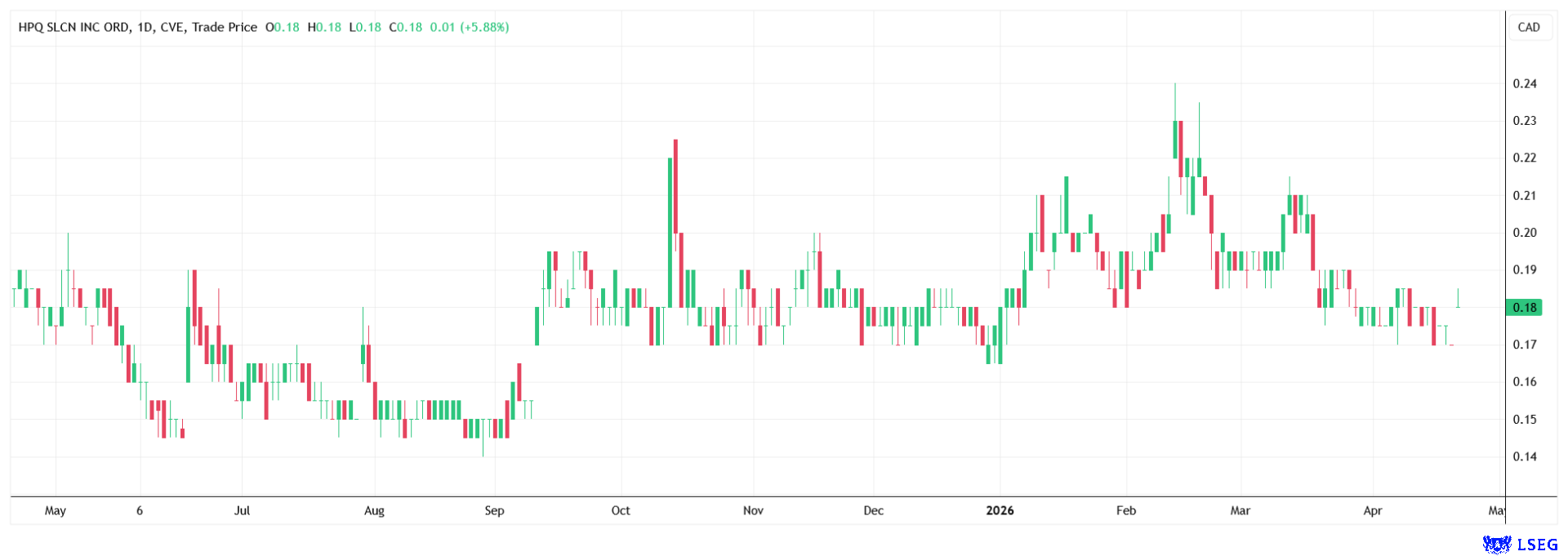
Looking at the big picture, HPQ Silicon resembles a spring being wound tighter and tighter. Following its successful financing in March, the company is financially stable and well-positioned to advance its pilot plant. The technological records set in April have demonstrated that the company is a global leader in its field. The stock is currently trading in the range of CAD 0.17 to CAD 0.18. Given the fundamental progress and the first commercial orders, it seems only a matter of time before the market recognizes this. A first target range would be the previous annual high of CAD 0.24. Should this level be sustainably surpassed, the CAD 0.30 mark comes within reach. Then the warrants from the latest placement could also be exercised. This would give the company additional financial leeway. Overall, a rise toward CAD 0.30 would represent nearly a doubling from current levels. For a company that is just beginning to convert its technology into actual revenue, this is a very realistic prospect.
Conclusion: Between Turnaround and Breakthrough
In summary, the cards in the energy sector are currently being completely reshuffled. While Siemens Energy has made an impressive return to the stage as a restructured heavyweight and has finally cleared the important hurdle of profitability, Plug Power remains a high-risk problem child, yet also offers correspondingly high leverage should its long-term strategy actually pay off by 2028.
In this environment, HPQ Silicon presents itself as an agile technology innovator with a decisive advantage. While the established industry giants are still licking their wounds or laboriously restructuring their massive infrastructure, HPQ can already deliver the innovations the battery market is desperately waiting for. For investors, this scenario offers a clear point of differentiation. While Siemens Energy primarily provides new stability in the portfolio, HPQ Silicon could be the stock to take it to the next level. It is a stock that should definitely be on your watchlist in the coming months due to its combination of technological excellence and emerging commercialization.
Conflict of interest
Pursuant to §85 of the German Securities Trading Act (WpHG), we point out that Apaton Finance GmbH as well as partners, authors or employees of Apaton Finance GmbH (hereinafter referred to as "Relevant Persons") currently hold or hold shares or other financial instruments of the aforementioned companies and speculate on their price developments. In this respect, they intend to sell or acquire shares or other financial instruments of the companies (hereinafter each referred to as a "Transaction"). Transactions may thereby influence the respective price of the shares or other financial instruments of the Company.
In this respect, there is a concrete conflict of interest in the reporting on the companies.
In addition, Apaton Finance GmbH is active in the context of the preparation and publication of the reporting in paid contractual relationships.
For this reason, there is also a concrete conflict of interest.
The above information on existing conflicts of interest applies to all types and forms of publication used by Apaton Finance GmbH for publications on companies.
Risk notice
Apaton Finance GmbH offers editors, agencies and companies the opportunity to publish commentaries, interviews, summaries, news and the like on news.financial. These contents are exclusively for the information of the readers and do not represent any call to action or recommendations, neither explicitly nor implicitly they are to be understood as an assurance of possible price developments. The contents do not replace individual expert investment advice and do not constitute an offer to sell the discussed share(s) or other financial instruments, nor an invitation to buy or sell such.
The content is expressly not a financial analysis, but a journalistic or advertising text. Readers or users who make investment decisions or carry out transactions on the basis of the information provided here do so entirely at their own risk. No contractual relationship is established between Apaton Finance GmbH and its readers or the users of its offers, as our information only refers to the company and not to the investment decision of the reader or user.
The acquisition of financial instruments involves high risks, which can lead to the total loss of the invested capital. The information published by Apaton Finance GmbH and its authors is based on careful research. Nevertheless, no liability is assumed for financial losses or a content-related guarantee for the topicality, correctness, appropriateness and completeness of the content provided here. Please also note our Terms of use.