September 21st, 2026 | 07:15 CEST
E-Mobility in the Grip of Energy Prices! Things Are Heating Up for VW, Porsche, Mercedes, BYD and Phenom Resources
Filling up currently feels like a painful visit to the dentist — but without much hope of a cure! Yet despite all the gloom, there are also winners. Against the backdrop of rising energy prices, European e-mobility has entered a dynamic yet fiercely competitive phase in recent months. The historic price shock at the pump is prompting consumers to rethink their spending while driving a boom in new battery electric vehicle registrations. In Europe, electric vehicles now appear on the horizon as a subsidized solution, while gasoline and diesel prices march from one all-time high to the next. However, the charts so beloved by stock market traders are difficult to apply to gas station products. As the operating costs of internal combustion engines soar, electric vehicles are rapidly gaining appeal as an alternative. This is particularly good news for Chinese automakers, who are pushing into Europe with an aggressive market strategy and challenging the established, traditional brands. Even the import tariffs imposed by Brussels on pure-electric vehicles can barely slow the advance from the Far East. The local automotive industry is thus under unprecedented pressure to transform and compete. Where exactly should investors be looking?
time to read: 6 minutes | Author: André Will-Laudien
ISIN: PHENOM RESOURCES CORP | CA71743P1071 | TSXV: PHNM , VOLKSWAGEN AG VZO O.N. | DE0007664039 , PORSCHE AG | DE000PAG9113 , MERCEDES-BENZ GROUP AG | DE0007100000 , BYD CO. LTD H YC 1 | CNE100000296
Table of contents:
Author

André Will-Laudien
Born in Munich, he first studied economics and graduated in business administration at the Ludwig-Maximilians-University in 1995. As he was involved with the stock market at a very early stage, he now has more than 30 years of experience in the capital markets.
Tag cloud
Shares cloud
VW, Porsche, and Mercedes: The German Auto Industry Feels the Asian Typhoon
The strategic realignment in the global auto market is in full swing, and the long-established German manufacturers are noticeably losing ground. Volkswagen, Porsche, and Mercedes-Benz are under unprecedented pressure to transform, a trend fueled by aggressive technological competition from the Far East. Especially in the once-profitable Chinese market, the established business models of the "Made in Germany" league are being severely shaken. For several years now, domestic premium brands in Asia have also been rapidly losing their former pricing power. Even the exclusive subsidiary Porsche is struggling to find the right path in the electric vehicle market following a massive slump in sales of its former flagship model, the Taycan. To counter the crisis, the group is discontinuing unprofitable models and cutting approximately 5,000 jobs in a socially responsible manner. A dramatic 32% decline in sales in China shows the problems can no longer be solved with old best-sellers. For the parent company, VW, this indecision represents a significant burden, as the Wolfsburg-based automaker is already under enormous margin pressure in the mass market.
The picture is similarly bleak for Stuttgart-based rival Mercedes-Benz, whose most important source of revenue in China is faltering. Recent reports also reveal a drastic sales slump of around 30% for the brand with the star. The passenger vehicle margin shrank to a historic low of about 4% amid aggressive discounting. Management recently had to revise its full-year revenue forecast downward again and implement strict cost-cutting measures. If the company fails to balance drastic cost-cutting with a radical technological overhaul, it risks permanently losing its global market leadership. On the LSEG Refinitiv platform, analysts are extremely skeptical that the German automotive industry can overcome these challenges in the near term. While the badly battered VW preferred shares are said to have at least theoretical upside potential of 37%, Porsche AG shares lack any upside potential. Those who prefer the "Star" can, according to experts, hope for 27% potential. The following applies to all auto stocks: revenue declines, margin pressure, restructuring pressure, and a two- to three-year technology lead in Asia. A tough outlook for the coming years, despite single-digit P/E ratios!
BYD: China Conquers the EU Market for New EV Registrations
The Chinese automotive giant BYD is pushing into the European market with an unprecedented model offensive and shaking up traditional market structures. While established European manufacturers struggle with sales, the Far Eastern conglomerate is recording rapid growth in new electric vehicle registrations. Across all Asian models, its market share in new electric and hybrid vehicle registrations now stands at over 8%. Thanks to an extremely efficient, vertically integrated supply chain, the rising star BYD can offer state-of-the-art battery technology at prices that are virtually unattainable for its Western competitors. Even the punitive tariffs of 17 to 35% imposed by the European Union cannot sustainably curb the Chinese company's expansion drive. Strategically savvy, the company is now increasingly shifting its focus to affordable plug-in hybrids, which are not yet subject to the special tariffs. In addition, BYD is investing heavily in its own production facilities directly in Europe to completely circumvent trade barriers in the long term. With this combination of technological leadership and aggressive pricing, the brand is gaining market share at record speed from Lisbon to Berlin. On the LSEG Refinitiv platform, experts project a 2027 P/E ratio of 9, with EBIT just under EUR 9 billion. However, because of the heavy investment burden, the company is also expected to accumulate over EUR 20 billion in debt by 2029. BYD shares have now erased all of their price gains from the past 5 years and, at around EUR 9 last week, returned to their 2021 level.
Phenom Resources: Gold Discovery with a Vanadium Boost in Nevada
Anyone thinking about electric mobility should also keep an eye on newer battery technologies. From this perspective, the explorer Phenom Resources has two highlights in Nevada: gold and vanadium. The company positions itself as a US-focused gold and green-energy-metal explorer with an unusually broad project pipeline and proprietary processing technology. At the centre of the current news flow is Dobbin, where the company has been conducting a core drilling program since July on a 2.1-kilometre-long and up to 200-meter-wide gold-in-soil anomaly that yields grades of up to 2.73 g/t gold. The geological context is particularly intriguing: The anomaly lies within heavily altered Roberts Mountains carbonates and is accompanied by arsenic geochemistry, structural controls, and rock samples up to 10.4 g/t Au—a pattern Phenom interprets as typical of a Carlin system.
Also noteworthy is the entry of established producer SSR Mining, which initially acquired a 9.9% stake in Phenom and subsequently planned an additional investment of USD 4 million for a 15% stake in the Dobbin project. Phenom has therefore accelerated the originally planned option and has since acquired 100% of Dobbin; a total of USD 2 million in exploration funds and USD 150,000 in cash were invested to complete the acquisition, while a 3% NSR royalty remains with the previous owner. The exploration potential is further bolstered by the fact that approximately 9 million ounces of gold are located in several deposits and mines just 5 to 15 km from the Phenom area. The King Solomon district also brings significant leverage to the portfolio: It features a 9 km² gold-in-soil anomaly with numerous "pathfinder elements" such as Au, Ag, As, Sb, Ba, Hg, and Tl, while historical drilling has long yielded long gold intervals in carbonate rock. Crescent Valley also complements this Carlin story with a Bonanza-style epithermal gold target featuring a quartz vein system approximately 4 km long. In comparison, the South Carlin project encompasses a geophysical target zone 6.4 km long and up to 1.3 km wide.
And that is not all! Phenom has a second strategic pillar: the Carlin Vanadium Project. The resource comprises 303 million pounds of V₂O₅ in the indicated category and an additional 75 million pounds in the inferred category. The near-surface, gently dipping ore body is approximately 35 m thick, 1,800 m long, and 600 m wide, and features drill intersections with up to 1.5% V₂O₅. The concept becomes even more interesting due to the hydrometallurgical vanadium-nickel processing method that has since been developed; Phenom filed a US provisional patent application for this method in July 2026 and, according to its own statements, can recover approximately 80% vanadium and 75% nickel. The company's strategy does not necessarily aim for sole financing by Phenom, but rather for a strategic partner to finance and operate a facility, while Phenom retains a stake through its technology. An additional source of value is the 5% stake in MK Plus, whose vanadium solid-state battery, according to the company's presentation, is said to charge significantly faster and require substantially less vanadium than traditional vanadium redox flow batteries. With a market capitalization of approximately CAD 49 million, the company's valuation remains modest despite its broader investment story; the first drill results are now expected in September and could become the decisive catalyst for a revaluation.
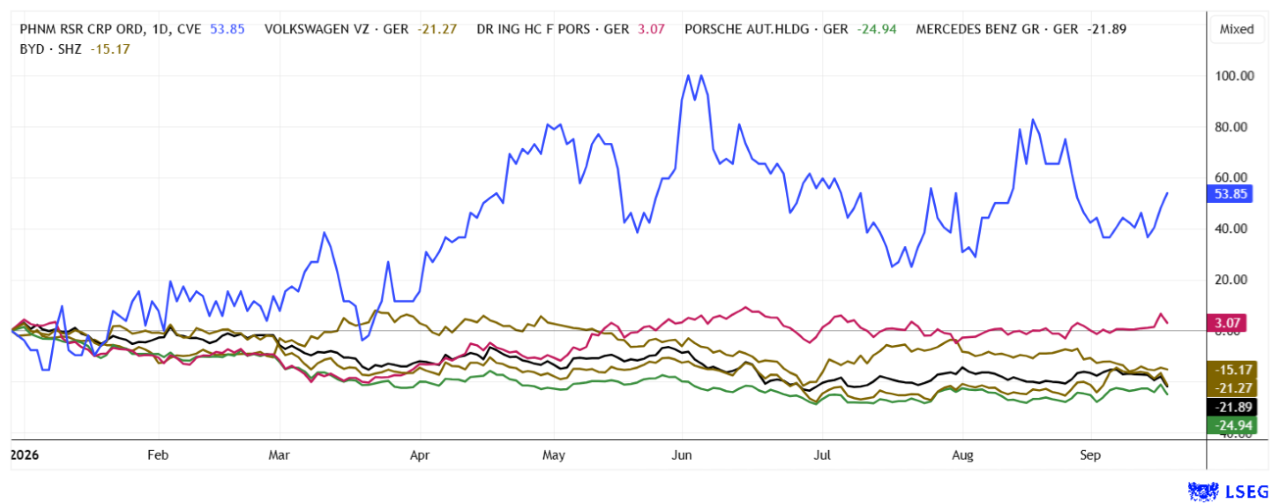
The global automotive sector is undergoing a historic period of upheaval, with traditional European manufacturers noticeably losing pricing power and market share. While VW, Porsche, and Mercedes-Benz are struggling with shrinking margins, sales crises in China, and costly restructuring efforts, agile Asian players like BYD are setting the pace of transformation. Phenom Resources stands out as an interesting and dynamic potential mid-term addition to the US critical-minerals supply chain.
Conflict of interest
Pursuant to §85 of the German Securities Trading Act (WpHG), we point out that Apaton Finance GmbH as well as partners, authors or employees of Apaton Finance GmbH (hereinafter referred to as "Relevant Persons") currently hold or hold shares or other financial instruments of the aforementioned companies and speculate on their price developments. In this respect, they intend to sell or acquire shares or other financial instruments of the companies (hereinafter each referred to as a "Transaction"). Transactions may thereby influence the respective price of the shares or other financial instruments of the Company.
In this respect, there is a concrete conflict of interest in the reporting on the companies.
In addition, Apaton Finance GmbH is active in the context of the preparation and publication of the reporting in paid contractual relationships.
For this reason, there is also a concrete conflict of interest.
The above information on existing conflicts of interest applies to all types and forms of publication used by Apaton Finance GmbH for publications on companies.
Risk notice
Apaton Finance GmbH offers editors, agencies and companies the opportunity to publish commentaries, interviews, summaries, news and the like on news.financial. These contents are exclusively for the information of the readers and do not represent any call to action or recommendations, neither explicitly nor implicitly they are to be understood as an assurance of possible price developments. The contents do not replace individual expert investment advice and do not constitute an offer to sell the discussed share(s) or other financial instruments, nor an invitation to buy or sell such.
The content is expressly not a financial analysis, but a journalistic or advertising text. Readers or users who make investment decisions or carry out transactions on the basis of the information provided here do so entirely at their own risk. No contractual relationship is established between Apaton Finance GmbH and its readers or the users of its offers, as our information only refers to the company and not to the investment decision of the reader or user.
The acquisition of financial instruments involves high risks, which can lead to the total loss of the invested capital. The information published by Apaton Finance GmbH and its authors is based on careful research. Nevertheless, no liability is assumed for financial losses or a content-related guarantee for the topicality, correctness, appropriateness and completeness of the content provided here. Please also note our Terms of use.