Current developments in the Middle East are showing the world, with depressing clarity, how much warfare has changed. Images over the weekend from Dubai, Qatar, and other major cities demonstrate the destructive potential of drones - precise, difficult to defend against, and often deployed with comparatively limited resources. It is evident that drones will not only dominate future battlefields but will also take on an increasing range of civilian applications. Still considered a hidden gem in the emerging drone supercycle is NEO Battery Materials. In South Korea, the company produces high-performance batteries for drones, robots, and electric mobility. In terms of performance metrics, it claims to outperform Chinese competitors significantly.
time to read: 3 minutes | Author: Fabian Lorenz
ISIN: NEO BATTERY MATERIALS LTD | CA62908A1003 | TSXV: NBM , OTC: NBMFF
Table of contents:
Author

Fabian Lorenz
For more than twenty years, the Cologne native has been intensively involved with the stock market, both professionally and privately. He is particularly passionate about national and international small and micro caps.
Tag cloud
Shares cloud
NEO batteries clearly beat Chinese competition
NEO Battery Materials is currently successfully positioning itself as a supplier for the next generation of drone batteries – and recently provided practical proof of this. In a live flight test with a commercial surveillance drone from a South Korean OEM customer, NEO's newly developed NBM Drone Cells achieved an average flight time that was almost twice as long as a comparable Chinese battery. Instead of around 30 minutes, an average flight time of just under 60 minutes was possible under the same conditions. And that was at temperatures of -3 to -5 °C.
The performance leap is driven by the significantly higher energy capacity and energy density of NEO's batteries, rated at 755 Wh and 260 Wh/kg. In addition, they exhibit more stable voltage characteristics, ensuring operational reliability and protection against power drops, even in the low voltage range. At the same time, the battery packs matched the benchmark in terms of discharge rate and current output - meaning they could meet the same thrust/lift requirements, but over a significantly longer duration. In addition, NEO reported efficiency gains, including improved flight time per unit of capacity and per unit of weight. Furthermore, the use of silicon anodes enables noticeably faster charging speeds, which translates into quicker turnaround times and reduced operational downtime in practical applications.
https://youtu.be/PLNIP9FtK58?si=wWN43z0fUa2ksjDn
German company Helsing could also use NEO batteries soon
Following the successful demonstration, the company is working on integrating a battery management system and optimizing materials in order to quickly bring the cells to series production readiness and evaluation by customers and authorities. The goal is clear: to establish itself as a non-Chinese supplier of drone batteries in a rapidly growing market.
Perhaps the German drone specialist Helsing will soon become a NEO customer. The Munich-based company's drones are already in use in Ukraine. Helsing's HX-2 is electrically powered and therefore fundamentally dependent on powerful battery systems. Helsing recently received a boost from Berlin. The Budget Committee approved an initial Bundeswehr order worth around EUR 540 million, which will likely be shared between Helsing and Stark.
Price potential also due to robotics sector
In addition to drones, robots also rely on powerful batteries. NEO Battery Materials is positioning itself in this area too. A strategic technology partnership with South Korean AI logistics robotics company Zio Robot was recently announced. The new partner works closely with Samsung Electronics. The aim is to optimize high-energy lithium-ion cells for Zio's "Mobile Worker" AMR platforms. The robot is designed to move heavy loads of up to 6,000 kg in industrial settings. NEO aims to enable longer runtimes and higher payloads than Chinese-made batteries currently in use by offering higher energy density and better high-current capability. Together, the two partners aim to develop integrated prototypes and test them in real-world production and logistics processes at anchor customers, including Samsung.
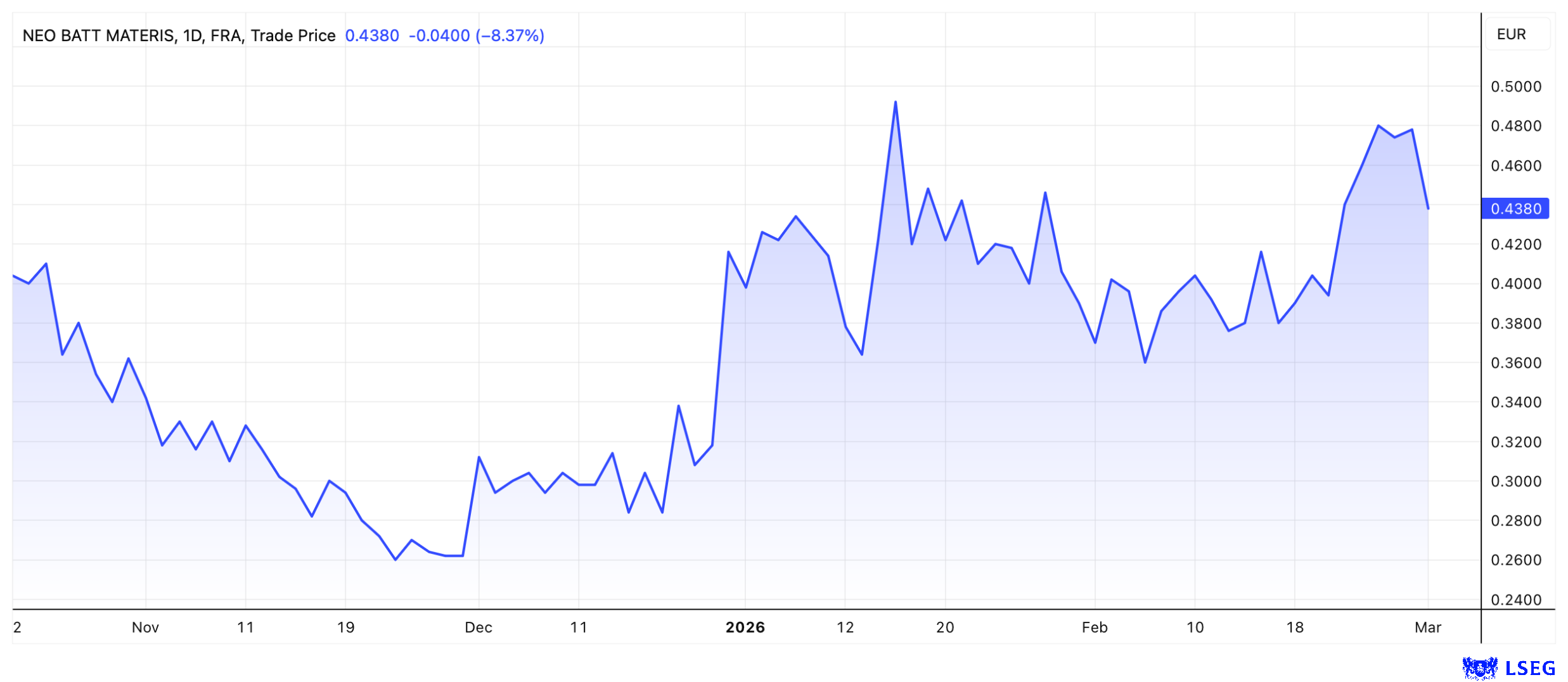
The West needs alternatives to China not only for raw materials, but also for key technologies such as batteries. NEO Battery Materials offers precisely this, leaving the competition behind in terms of technology. At the same time, the company is only valued at approximately CAD 115 million on the stock market. Given its huge potential, this seems anything but expensive. The company has strong partners and concrete orders. For example, an Asian drone manufacturer will use NEO batteries for its cargo drones. At the end of 2025, orders were reported from a North American Fortune 500 automaker and a South Korean Fortune 500 automotive supplier. NEO is also collaborating with the Korea Institute for Defense Industry (KOIDI), making it part of the country's defense industry ecosystem. Therefore, it can only be a matter of time before NEO's share price rises significantly.
Conflict of interest
Pursuant to §85 of the German Securities Trading Act (WpHG), we point out that Apaton Finance GmbH as well as partners, authors or employees of Apaton Finance GmbH (hereinafter referred to as "Relevant Persons") may hold shares or other financial instruments of the aforementioned companies in the future or may bet on rising or falling prices and thus a conflict of interest may arise in the future. The Relevant Persons reserve the right to buy or sell shares or other financial instruments of the Company at any time (hereinafter each a "Transaction"). Transactions may, under certain circumstances, influence the respective price of the shares or other financial instruments of the Company.
In addition, Apaton Finance GmbH is active in the context of the preparation and publication of the reporting in paid contractual relationships.
For this reason, there is a concrete conflict of interest.
The above information on existing conflicts of interest applies to all types and forms of publication used by Apaton Finance GmbH for publications on companies.
Risk notice
Apaton Finance GmbH offers editors, agencies and companies the opportunity to publish commentaries, interviews, summaries, news and the like on news.financial. These contents are exclusively for the information of the readers and do not represent any call to action or recommendations, neither explicitly nor implicitly they are to be understood as an assurance of possible price developments. The contents do not replace individual expert investment advice and do not constitute an offer to sell the discussed share(s) or other financial instruments, nor an invitation to buy or sell such.
The content is expressly not a financial analysis, but a journalistic or advertising text. Readers or users who make investment decisions or carry out transactions on the basis of the information provided here do so entirely at their own risk. No contractual relationship is established between Apaton Finance GmbH and its readers or the users of its offers, as our information only refers to the company and not to the investment decision of the reader or user.
The acquisition of financial instruments involves high risks, which can lead to the total loss of the invested capital. The information published by Apaton Finance GmbH and its authors is based on careful research. Nevertheless, no liability is assumed for financial losses or a content-related guarantee for the topicality, correctness, appropriateness and completeness of the content provided here. Please also note our Terms of use.