March 20th, 2026 | 08:25 CET
Decarbonization of Heavy Industry: Challenges for thyssenkrupp and BASF – CHAR Technologies as a Solution Provider
Heavy industry faces technological hurdles in the race to meet climate targets. The full implementation of the EU Carbon Border Adjustment Mechanism (CBAM) in January of this year is exacerbating the economic conditions. Decarbonizing the steel and chemical industries is proving complex, as these sectors require carbon not only as an energy source but also as an essential reducing agent and raw material. While European corporations like thyssenkrupp are focusing on hydrogen-based direct reduction plants, dependence on coke in existing blast furnaces persists. BASF is simultaneously advancing chemical recycling through pyrolysis oils, but faces scaling hurdles. This bottleneck brings the beginning of the recycling chain into focus: without the massive use of biochar as a substitute for metallurgical coal, the goals can hardly be achieved. CHAR Technologies is closing this supply gap with its high-temperature pyrolysis technology, has secured ArcelorMittal as an investor, and is positioning itself as a supplier to industry.
time to read: 3 minutes | Author: Nico Popp
ISIN: THYSSENKRUPP AG O.N. | DE0007500001 , BASF SE NA O.N. | DE000BASF111 , CHAR Technologies Ltd. | CA15957L1040 | TSXV: YES
Table of contents:
Author

Nico Popp
At home in Southern Germany, the passionate stock exchange expert has been accompanying the capital markets for about twenty years. With a soft spot for smaller companies, he is constantly on the lookout for exciting investment stories.
Tag cloud
Shares cloud
thyssenkrupp Hits Technological Limits
thyssenkrupp is undergoing an operational realignment in the first quarter of fiscal year 2025/2026. Although the Group reported an increase in adjusted EBIT to EUR 211 million, the Steel Europe segment simultaneously posted an adjusted EBIT loss of EUR 187 million. The Group's order intake fell by 38% to EUR 7.7 billion. A core challenge for the steel division lies in the physics of blast furnace operations. The strategy calls for the construction of hydrogen-based plants for the production of sponge iron. In a traditional blast furnace, however, coke serves not only as a fuel but also performs a sort of supporting function for the ore and enables gas permeation. Hydrogen can be used in the chemical reduction process, but it lacks mechanical stability. Hydrogen injection rates are therefore technically limited. Without a solid, biogenic carbon substitute that replicates both the chemical and physical functions of coke, thyssenkrupp remains dependent on fossil coal.
BASF Pushes for a Circular Economy – With Scaling Challenges
With the ChemCycling project, BASF aims to convert plastic waste into pyrolysis oil through pyrolysis and use this as a raw material within its own production network. In the 2025 fiscal year, the chemical company reported a 2.8% decline in revenue to EUR 59.7 billion and EBITDA before special items of EUR 6.6 billion. One operational goal is to process 250,000 metric tons of recycled and waste-based raw materials annually in the plants starting in 2025. To achieve this volume, a decentralized infrastructure of pyrolysis plants is required, as transporting bulky plastic waste over long distances is uneconomical. The challenge lies in the fact that these decentralized plants must operate energy-autonomously so as not to lose the CO2 benefits through the use of external energy sources. Furthermore, the complex purification of pyrolysis oil to remove impurities remains a cost-intensive process that is currently still hindering the widespread adoption of BASF's technology in industry.
CHAR Technologies Provides the Solution for Heavy Industry
This is where an innovative Canadian company comes into play: CHAR Technologies positions itself as a developer and operator of plants that bridge this technological gap. The company uses a proprietary high-temperature pyrolysis process that operates at over 800 °C in an oxygen-free environment. This process converts organic waste such as wood residues into hydrogen-rich synthesis gas as well as CleanFyre biochar, which has a constant carbon content of over 85% and high mechanical strength. This biochar serves as a direct substitute for metallurgical coal. In January of this year, CHAR began the project phase at its Thorold production facility, which has a capacity of 5,000 tons of biochar per year. Concurrently, the company plans to build a plant with a capacity of 50,000 tons per year as part of the Espanola project. The strategic relevance of the technology is evident in ArcelorMittal's investment. In 2023, the steel group invested CAD 6.6 million for a 12.5% stake in CHAR Technologies to secure rights for trials at the Dofasco plant.
CHAR Technologies: Regulatory Pressure Creates Investment Opportunities
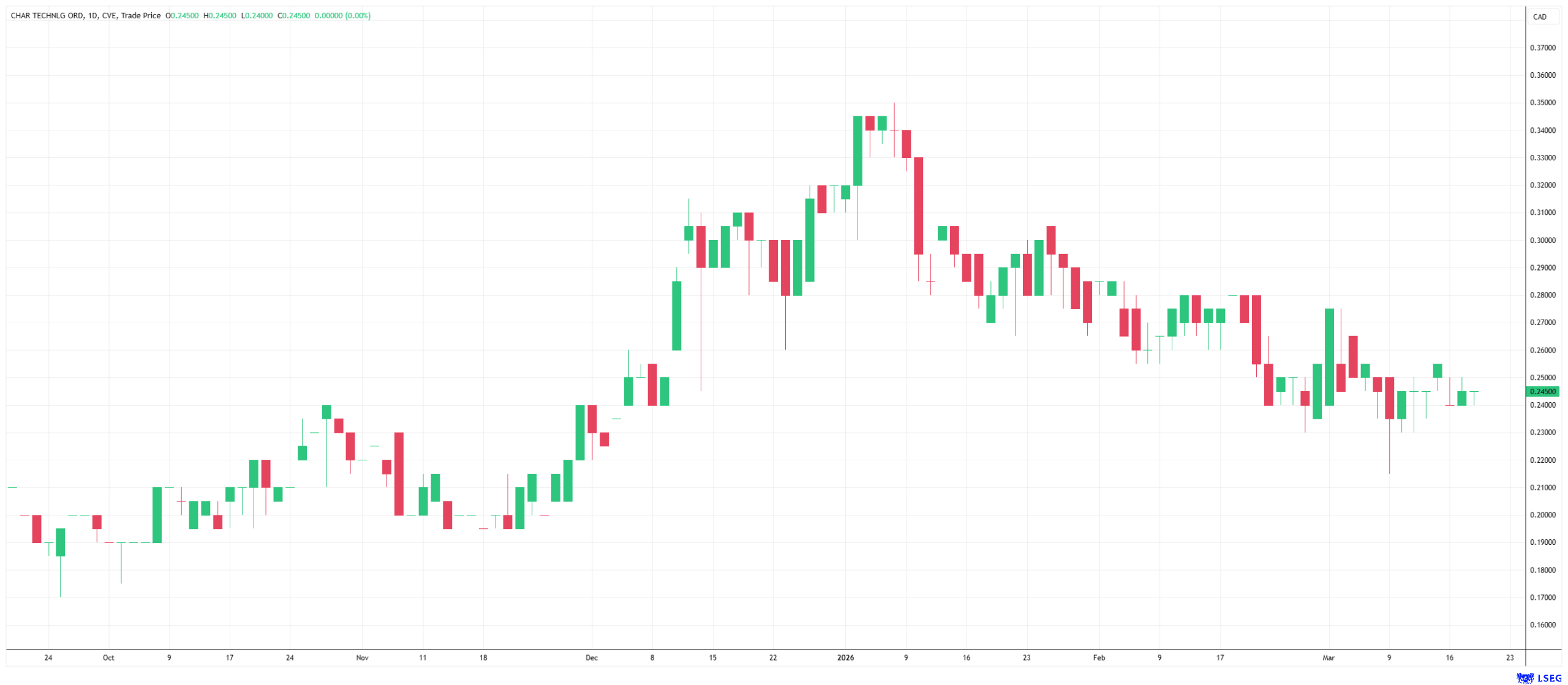
For investors, the focus is shifting from pure-play conglomerates to suppliers of critical raw and basic materials. The introduction of the European CBAM and EU emission allowance prices exceeding EUR 100/t make the use of biogenic carbon an economic necessity for producers in Europe. With its system, CHAR Technologies provides a plant that can operate energy self-sufficiently by using a portion of the produced synthesis gas to heat the reactor, thereby meeting the industry's requirements. In fiscal year 2025, CHAR improved its gross profit by 34.6% to over CAD 850,000 and recorded a profit from joint venture investments of CAD 4.1 million. Platforms such as Tradingview.com estimate the average price target for the stock at CAD 0.55, which, at the current level of around CAD 0.25, represents a theoretical doubling. The low market capitalization of around CAD 33 million does not reflect the company's potential. Investors will find here a stock that is likely to benefit from rising cost pressures related to CO2 emissions.
Watch YouTube videoConflict of interest
Pursuant to §85 of the German Securities Trading Act (WpHG), we point out that Apaton Finance GmbH as well as partners, authors or employees of Apaton Finance GmbH (hereinafter referred to as "Relevant Persons") may hold shares or other financial instruments of the aforementioned companies in the future or may bet on rising or falling prices and thus a conflict of interest may arise in the future. The Relevant Persons reserve the right to buy or sell shares or other financial instruments of the Company at any time (hereinafter each a "Transaction"). Transactions may, under certain circumstances, influence the respective price of the shares or other financial instruments of the Company.
In addition, Apaton Finance GmbH is active in the context of the preparation and publication of the reporting in paid contractual relationships.
For this reason, there is a concrete conflict of interest.
The above information on existing conflicts of interest applies to all types and forms of publication used by Apaton Finance GmbH for publications on companies.
Risk notice
Apaton Finance GmbH offers editors, agencies and companies the opportunity to publish commentaries, interviews, summaries, news and the like on news.financial. These contents are exclusively for the information of the readers and do not represent any call to action or recommendations, neither explicitly nor implicitly they are to be understood as an assurance of possible price developments. The contents do not replace individual expert investment advice and do not constitute an offer to sell the discussed share(s) or other financial instruments, nor an invitation to buy or sell such.
The content is expressly not a financial analysis, but a journalistic or advertising text. Readers or users who make investment decisions or carry out transactions on the basis of the information provided here do so entirely at their own risk. No contractual relationship is established between Apaton Finance GmbH and its readers or the users of its offers, as our information only refers to the company and not to the investment decision of the reader or user.
The acquisition of financial instruments involves high risks, which can lead to the total loss of the invested capital. The information published by Apaton Finance GmbH and its authors is based on careful research. Nevertheless, no liability is assumed for financial losses or a content-related guarantee for the topicality, correctness, appropriateness and completeness of the content provided here. Please also note our Terms of use.