August 14th, 2026 | 07:35 CEST
Data Centers and Nuclear Energy: Microsoft Invests, NexGen Plans to Mine Uranium, Standard Uranium Holds Promise
Electricity has to keep flowing — especially in the age of AI. Data centers are being built around the world, but these facilities require enormous amounts of electricity. They also cannot simply wait for the sun to shine or the wind to blow. So what is the solution? Alongside gas-fired power plants, nuclear power is increasingly making a comeback. It is climate-neutral and capable of providing reliable baseload power. We take a closer look at three companies involved in supplying energy for data centers and highlight potential opportunities for investors.
time to read: 3 minutes | Author: Nico Popp
ISIN: STANDARD URANIUM LTD. | CA85422Q8487 | TSXV: STND , OTCQB: STTDF , MICROSOFT DL-_00000625 | US5949181045 , NEXGEN ENERGY LTD | CA65340P1062
Table of contents:
Author

Nico Popp
At home in Southern Germany, the passionate stock exchange expert has been accompanying the capital markets for about twenty years. With a soft spot for smaller companies, he is constantly on the lookout for exciting investment stories.
Tag cloud
Shares cloud
Microsoft Needs Baseload Power
Those who want to shape the digital future must provide energy. Although Microsoft posted record revenue of USD 331.8 billion in fiscal year 2026 and boosted net income to USD 133.7 billion, the expansion of its Azure infrastructure continues to consume vast amounts of capital. In the fourth quarter alone, over USD 40 billion was invested, while total spending for the calendar year reached USD 175 billion. Microsoft management already anticipates additional spending of around USD 50 billion for the first quarter of the coming fiscal year. To ensure sufficient power for its data centers, Microsoft secured the full capacity of the 835-MW Three Mile Island Unit 1 reactor through a 20-year contract. At the same time, the company is investing in fusion energy and digitalization solutions for small modular reactors. Microsoft understands that without energy, there can be no growth.
Up-and-Coming Uranium Producer NexGen Receives Key Permits
Demand from Big Tech is also driving interest in uranium companies. NexGen achieved a breakthrough in March of this year, securing final approval for shaft construction and the development of its Rook I project. With the Arrow deposit, the Canadian company holds reserves of 257 million pounds of uranium, a significant portion of which has grades as high as 15.9%. Estimated investment costs total CAD 2.2 billion. With cash and cash equivalents of approximately CAD 756 million, NexGen is moving into the construction phase in the coming weeks, with the goal of producing up to 30 million pounds of uranium annually starting in 2029/2030. NexGen has already signed offtake agreements for 5 million pounds of uranium with US utilities.
Standard Uranium: Major Presence in the Patterson Lake District
Uranium explorer Standard Uranium operates in a promising niche. The company holds a comprehensive project portfolio totaling over 234,700 acres in Canada's Athabasca Basin. Its flagship project is Davidson River, which spans 30,737 hectares and lies just 25 km west of NexGen's Arrow deposit. The local geology points to high-grade ore bodies. Instead of raising fresh capital regularly, management employs a well-thought-out "generator" model that relies on cooperation partners. These partners undertake exploration work on adjacent properties in exchange for project interests, allowing Standard Uranium to remain flexible without ceding too many rights. The company prefers to direct its own funds toward the Davidson River project, where a drilling program covering 8,000 to 10,000 m began in the spring of 2026 and was subsequently expanded.
Partnerships as Value Drivers
In addition to Davidson River, the subsidiary projects are also making progress. On the Corvo and Rocas properties, joint venture partners Aventis and Collective Metals had already drilled approximately 3,419 m by early 2026, and initial results are already available. The 19,603-hectare Sun-Dog project, which reverted to full ownership by Standard Uranium at the end of 2025, can also be re-awarded to strategic partners once survey work is completed. Thanks to fresh capital from capital-raising efforts in August 2026 totalling CAD 964,700, as well as a strategic investment agreement worth CAD 3 million, the company is financially well-positioned to carry out multiple drilling programs simultaneously within a single calendar year. This is likely to generate news flow.
Standard Uranium on Industry Experts' Radar
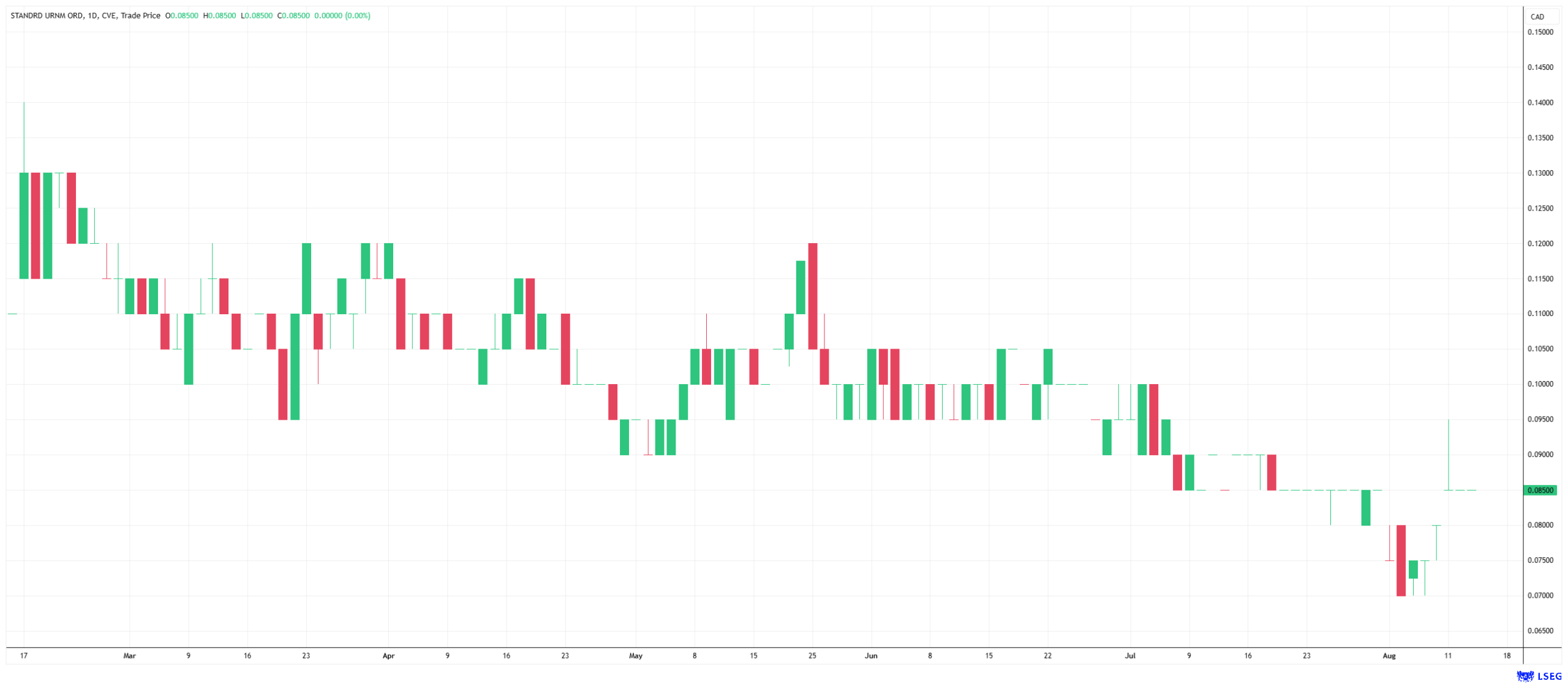
Standard Uranium's stock has barely gained momentum over the past six months. This is likely due, in part, to the project's relatively early stage. However, if forecasts for future energy demand translate into higher demand for uranium and Standard Uranium makes progress at Davidson River and its ancillary projects, Standard Uranium's stock could also attract more attention. The company operates in the world's most exciting uranium region, which also poses virtually no geopolitical risks. Since the smart generator model promises progress with limited risks, Standard Uranium also has several irons in the fire and is likely to generate more news flow than comparable small-cap stocks. The stock is a clear candidate for the watchlist. Uranium has a bright future, and Standard Uranium is a promising bet on it.
Watch YouTube videoConflict of interest
Pursuant to §85 of the German Securities Trading Act (WpHG), we point out that Apaton Finance GmbH as well as partners, authors or employees of Apaton Finance GmbH (hereinafter referred to as "Relevant Persons") may hold shares or other financial instruments of the aforementioned companies in the future or may bet on rising or falling prices and thus a conflict of interest may arise in the future. The Relevant Persons reserve the right to buy or sell shares or other financial instruments of the Company at any time (hereinafter each a "Transaction"). Transactions may, under certain circumstances, influence the respective price of the shares or other financial instruments of the Company.
In addition, Apaton Finance GmbH is active in the context of the preparation and publication of the reporting in paid contractual relationships.
For this reason, there is a concrete conflict of interest.
The above information on existing conflicts of interest applies to all types and forms of publication used by Apaton Finance GmbH for publications on companies.
Risk notice
Apaton Finance GmbH offers editors, agencies and companies the opportunity to publish commentaries, interviews, summaries, news and the like on news.financial. These contents are exclusively for the information of the readers and do not represent any call to action or recommendations, neither explicitly nor implicitly they are to be understood as an assurance of possible price developments. The contents do not replace individual expert investment advice and do not constitute an offer to sell the discussed share(s) or other financial instruments, nor an invitation to buy or sell such.
The content is expressly not a financial analysis, but a journalistic or advertising text. Readers or users who make investment decisions or carry out transactions on the basis of the information provided here do so entirely at their own risk. No contractual relationship is established between Apaton Finance GmbH and its readers or the users of its offers, as our information only refers to the company and not to the investment decision of the reader or user.
The acquisition of financial instruments involves high risks, which can lead to the total loss of the invested capital. The information published by Apaton Finance GmbH and its authors is based on careful research. Nevertheless, no liability is assumed for financial losses or a content-related guarantee for the topicality, correctness, appropriateness and completeness of the content provided here. Please also note our Terms of use.