April 20th, 2026 | 08:30 CEST
Costs, Costs, Costs: Can High Oil Prices Benefit dynaCERT?
Elevated energy prices resulting from the US war of aggression in the Persian Gulf are driving up transportation costs across many industries. Logistics providers in particular are exposed to rising diesel prices. If the conflict drags on much longer, shortages could soon arise in Europe as well. In this environment, dynaCERT's technology can quickly provide relief for logistics providers by reducing fuel consumption and operating costs—an angle that is still under the radar of many investors. But persistently high energy prices are likely to soon shift the focus to this innovative tech company.
time to read: 4 minutes
|
Author:
Tarik Dede
ISIN:
DYNACERT INC | CA26780A1084 | TSX: DYA , OTCQB: DYFSF
Table of contents:
Author

Tarik Dede
Even as a high school student in northern Germany, he developed a strong interest in the “Neuer Markt” and the dynamics of the equity markets. Small- and mid-cap companies were at the center of his focus from the very beginning. After completing his training as a certified bank clerk, he deepened his economic expertise through formal studies in economics as well as through various positions within Frankfurt’s financial sector. Today, he has been actively involved in the capital markets for more than 25 years, both professionally and as a private investor.
Tag cloud
Shares cloud
When diesel costs more than EUR 2.50 per liter on the highway, it is not just Easter vacationers heading to the North Sea who groan, but also truckers who are currently transporting machinery, food, or packages across the country or even across Europe. The average diesel price in Germany has increased from around EUR 1.72-1.75 per liter to as much as EUR 2.30 since the war began in late February 2026, reports the ADAC. On the highways, prices were often another 20 cents higher. This represents an increase of over 30% at times. Since the Strait of Hormuz was closed again by the Iranians after being open for just one day on Saturday, logistics companies will likely have to reckon with higher fuel prices for some time to come. Following the ceasefire that lasted only a few days, there are once again signs of impending conflict.
dynaCERT: Save Fuel The Smart Way
The Canadian company has developed a solution that can immediately reduce the fuel consumption of trucks and heavy-duty diesel vehicles. The patented HydraGEN technology works as follows: If you imagine a diesel engine as a campfire, the wood (the diesel) never burns completely cleanly—it produces soot, thick smoke, and unburned residues. This is exactly where the technology comes in: At its core is a small box, about the size of a suitcase. This box uses the vehicle's electricity to break down ordinary, distilled water into its components: hydrogen and oxygen. This happens while driving, which is why large hydrogen tanks aren't necessary. The fresh hydrogen is fed directly into the engine, where it mixes with the diesel. Hydrogen burns extremely quickly and at high temperatures. In our campfire analogy, it acts like a turbo blower: the diesel burns much faster, more evenly, and more completely. This results in three major advantages: emissions of soot and pollutants are drastically reduced. Studies by TÜV Nord and the PIT Group show that, for example, nitrogen oxide emissions are reduced by up to 88%, and particulate matter emissions by 55% to 75%. Fuel consumption also decreases. Depending on the vehicle, the company estimates diesel savings of 6% to 19%. In practice, trucking companies expect savings of around 10%. In the long term, the more uniform combustion in the engine also ensures a longer service life.
Revenues Are Growing Strongly
dynaCERT is already on a growth trajectory. In 2025, revenues are expected to have reached approximately CAD 12 million. Analysts at GBC Research anticipate that revenue will rise to around CAD 21 million this year, an increase of approximately 75%. Earnings are expected to rise to CAD 0.01 per share. This would put the P/E ratio below 13. However, the latest GBC study was published in the fall—well before the war began and at a time of low fuel prices. These factors, therefore, offer significant upside potential.
Built On Multiple Pillars
The Canadian company has several revenue and profit levers. On the one hand, the hardware—the "suitcase"—is sold directly. Sales of these electrolysis units to freight carriers form the core business. In addition to traditional logistics providers, the target market also includes mining companies (haul trucks), the oil and gas industry, and operators of stationary diesel generators. For a standard truck, the investment cost of CAD 8,000 to 10,000 can potentially be recouped within a year or less. In addition, however, dynaCERT has two aces up its sleeve. First, data on fuel consumption and emissions are collected in real time. The company is therefore planning a subscription model (SaaS - Software-as-a-Service), under which customers would pay for detailed analysis of their savings and ongoing fleet monitoring.
Second, the huge market for emissions credits awaits the company. This could become the company's potentially most lucrative revenue stream. The so-called HydraLytica data precisely documents how many tons a truck has saved. dynaCERT can bundle these savings and sell them as CO₂ credits on the international market to companies that need to offset their own emissions. As of now, a revenue-sharing model is planned, which would benefit not only dynaCERT but also the customer. This, in turn, would make the hydrogen units even more attractive.
Analysts See High Upside Potential
Over time, dynaCERT's stock should benefit from high energy costs and the advantages of its product. In July 2024, the stock briefly traded at CAD 0.25. Currently, the price stands at CAD 0.11, which corresponds to a market capitalization of approximately EUR 36 million. Analyst Cosmin Filker of GBC Research rated the stock "Buy" in September 2025 and set a price target of CAD 0.75 (approximately EUR 0.48). That would translate to roughly seven times the current price. Filker sees expansion into Texas and Mexico through a major order from Hydrofuel Technologies as the key drivers.
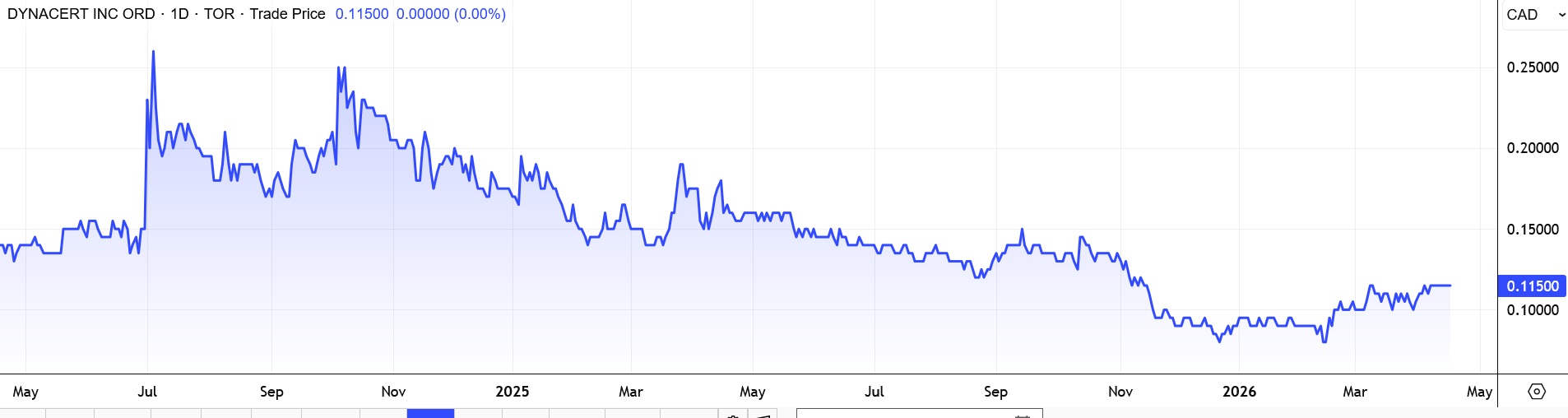
With dynaCERT, investors are backing a small but smart company that can make a substantial contribution to reducing customers' diesel consumption costs. High energy prices, which analysts say will remain elevated for an extended period even if a ceasefire is immediately declared in the Gulf, give dynaCERT a further competitive advantage that could boost the share price in the short term.
Conflict of interest
Pursuant to §85 of the German Securities Trading Act (WpHG), we point out that Apaton Finance GmbH as well as partners, authors or employees of Apaton Finance GmbH (hereinafter referred to as "Relevant Persons") may hold shares or other financial instruments of the aforementioned companies in the future or may bet on rising or falling prices and thus a conflict of interest may arise in the future. The Relevant Persons reserve the right to buy or sell shares or other financial instruments of the Company at any time (hereinafter each a "Transaction"). Transactions may, under certain circumstances, influence the respective price of the shares or other financial instruments of the Company.
In addition, Apaton Finance GmbH is active in the context of the preparation and publication of the reporting in paid contractual relationships.
For this reason, there is a concrete conflict of interest.
The above information on existing conflicts of interest applies to all types and forms of publication used by Apaton Finance GmbH for publications on companies.
Risk notice
Apaton Finance GmbH offers editors, agencies and companies the opportunity to publish commentaries, interviews, summaries, news and the like on news.financial. These contents are exclusively for the information of the readers and do not represent any call to action or recommendations, neither explicitly nor implicitly they are to be understood as an assurance of possible price developments. The contents do not replace individual expert investment advice and do not constitute an offer to sell the discussed share(s) or other financial instruments, nor an invitation to buy or sell such.
The content is expressly not a financial analysis, but a journalistic or advertising text. Readers or users who make investment decisions or carry out transactions on the basis of the information provided here do so entirely at their own risk. No contractual relationship is established between Apaton Finance GmbH and its readers or the users of its offers, as our information only refers to the company and not to the investment decision of the reader or user.
The acquisition of financial instruments involves high risks, which can lead to the total loss of the invested capital. The information published by Apaton Finance GmbH and its authors is based on careful research. Nevertheless, no liability is assumed for financial losses or a content-related guarantee for the topicality, correctness, appropriateness and completeness of the content provided here. Please also note our Terms of use.