May 12th, 2026 | 07:30 CEST
China's Stranglehold and the Achilles' Heel of Military Build-Up: The Thriller Involving Rheinmetall, RENK, and Antimony Resources
Created and published on behalf of Antimony Resources Corp.
The world is arming itself, and on the stock market, the big names in the defence industry celebrated an unprecedented rally. But recently, things have been going downhill for Rheinmetall & Co. on the stock market! Behind the gleaming facades of factory buildings and the impressive order books of Rheinmetall and RENK lies an uncomfortable truth. The massive production of ammunition and high-performance propulsion systems also depends on an almost forgotten raw material that China controls almost single-handedly. Antimony is the secret link that determines victory or defeat in industrial logistics. While industry giants search for stable sources, a Canadian exploration company is emerging that could close a strategic gap in the West. It is a game with extremely high stakes, where geopolitics, military necessity, and enormous profit opportunities collide head-on. When might share prices for Rheinmetall & Co. start rising again?
time to read: 6 minutes | Author: Matthias Schomber
ISIN: ANTIMONY RESOURCES CORP | CA0369271014 | CSE: ATMY , OTCQB: ATMYF , RHEINMETALL AG | DE0007030009 , RENK AG O.N. | DE000RENK730
Table of contents:
Author

Matthias Schomber
Raised in Giessen, Hesse, Matthias Schomber discovered his passion for the financial markets as early as the 1990s—at a time when stock trading was still largely the domain of true, die-hard traders. After completing his banking apprenticeship, he worked for a private bank there and witnessed the rise and fall of the Neuer Markt firsthand on the trading floor of the Frankfurt Stock Exchange, drawing lessons from the experience that continue to shape his thinking as a trader, author, and trading system developer to this day.
Tag cloud
Shares cloud
RENK and Rheinmetall Under Pressure
When discussing European defence capabilities, two names almost inevitably come up: RENK and Rheinmetall, and possibly Hensoldt or TKMS as well. These companies form the backbone of Germany's defence industry and our armed forces. Rheinmetall, the Düsseldorf-based defence contractor, is currently in an extreme phase of expansion, the likes of which have likely never been seen before in the Federal Republic's recent history. RENK is in a similar situation.
Rheinmetall and RENK have one more thing in common. Both require raw materials for their manufacture, because every modern projectile and every infrared sensor system requires specialized materials that are not readily available at the corner supermarket.
Enormous forces also act on RENK's gearboxes, which can only be managed using special, wear-resistant alloys. This is where materials science comes into play—a field that is often underestimated. RENK and Rheinmetall must keep their supply chains under control. If a single component in the alloy is missing, production grinds to a halt, no matter how full the order books may be. Both companies are prime examples of the current defence boom, yet they share a dangerous dependence on global raw material flows, which are increasingly being used as a political weapon.
Rheinmetall: Strong Margin, Weak Revenue – CEO Buys Shares
Rheinmetall clearly missed analyst revenue expectations in the first quarter of 2026. Instead of the expected EUR 2.3 billion, only EUR 1.94 billion was recorded, an increase of just 8%. The market reacted mercilessly, with the stock losing nearly 12% over the week. It is currently trading around EUR 1,207, significantly below its price at the start of the year. Yet the earnings side tells a different story. Operating profit climbed 17% to EUR 224 million, and the margin rose to 11.6%. The order backlog grew to a record level of EUR 73 billion, roughly five times annual revenue. CEO Armin Papperger sent a clear signal following the recent price drop: he personally purchased shares worth EUR 500,000. Nevertheless, there are also downsides. Free cash flow turned negative at EUR -285 million, weighed down by massive inventory buildup and investments in new capacity. The annual revenue forecast of EUR 14 to 14.5 billion remains in place. Whether it holds will only be decided over the next three quarters. From a technical perspective, the stock could still correct toward EUR 1,000 before finding a sustainable floor.
RENK: Record orders and yet a stock price plunge! Is the market wrong?
RENK delivered quite solid figures at the start of the year. Order intake and operating profit exceeded analyst consensus. The Vehicle Drives segment served as the key growth driver. Annual targets were confirmed, with the order backlog standing at EUR 6.9 billion, but the stock market showed little interest. The stock fell below EUR 50 at the end of last week, representing a 10% decline on a monthly basis. The share price is now well below its 52-week high of just under EUR 90. The reason lies less with the company itself and more in the downturn affecting the entire defence sector. Rheinmetall's weakness is dragging RENK down with it—nevertheless, management plans to invest EUR 500 million over the next few years. New locations in Poland, India, and the US are also set to follow. Some analysts remain bullish nonetheless. Jefferies, for example, sees a price target of EUR 78, while Berenberg targets EUR 76. That would represent significant upside potential should the entire sector turn. The bottom line: highly exciting!
Why Antimony Could Change the World
The connecting element linking these defence companies to a company in Canada is antimony. This rather unassuming semimetal is simply irreplaceable in modern warfare. It serves as an indispensable hardening agent for lead alloys in armour-piercing ammunition, ensuring that projectiles retain their shape and deliver maximum penetrating power. Without antimony, Rheinmetall's ammunition production in its current form would be virtually unthinkable. But that is just the tip of the iceberg. Antimony is used in infrared sensors, night-vision devices, and precision-targeting optics. It acts as a bridge between heavy steel and state-of-the-art electronics.
On top of that, the geopolitical situation is escalating dramatically. China currently controls about 60-70% of global primary production and dominates the processing sector, accounting for as much as 80%. When Beijing began massively restricting exports of this strategic material in 2024, the markets reacted with panic. The price of a ton of antimony skyrocketed from about USD 13,500 in April 2024 to nearly USD 60,000 at times. For companies like RENK and Rheinmetall, this means not only higher costs but also a matter of supply chain security. If the West does not develop its own sources, the East will dictate the terms of rearmament. In this difficult situation, the attention of buyers and investors is almost inevitably drawn to projects in politically stable regions such as Canada.
Antimony Resources: Responsibility for Western Security
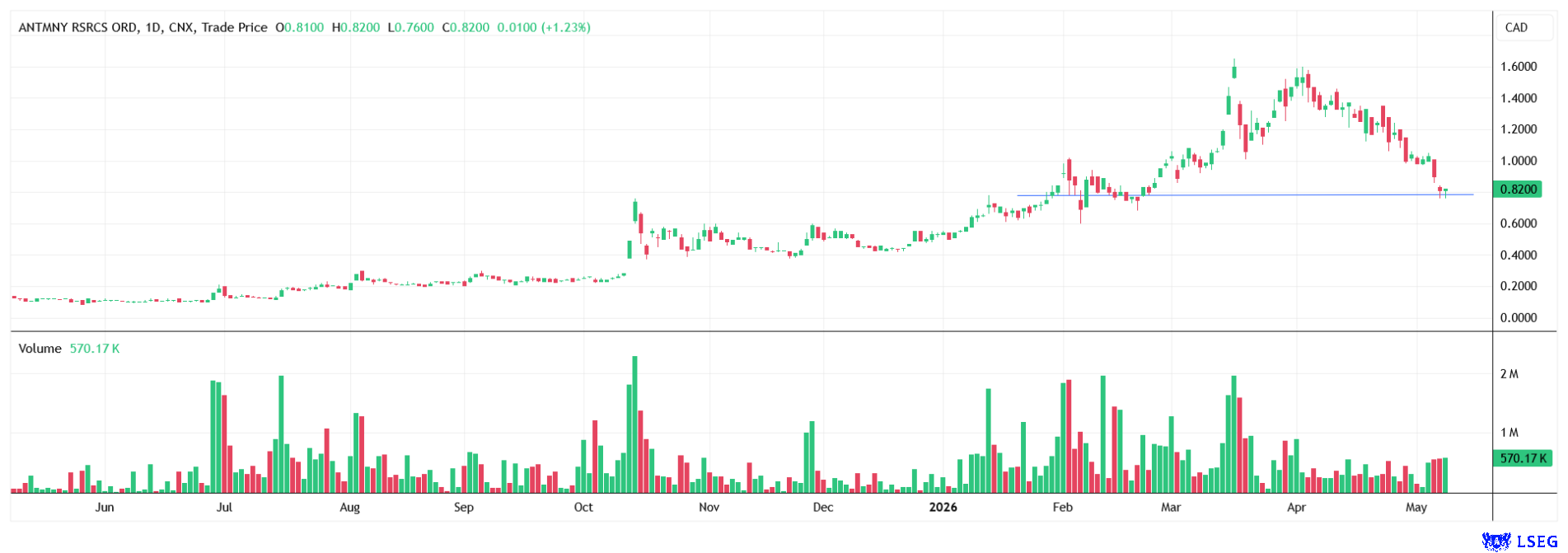
Antimony Resources is fully committed to developing the Bald Hill project in New Brunswick. While the stock recently went through a correction phase and has now found solid horizontal support at around CAD 0.80, or a few cents above that, the team on the ground is working flat out to validate one of North America's highest-grade antimony deposits. The technical data emerging from the drilling over the past few months is quite impressive. We are talking about grades between 3% and 4% antimony over significant thicknesses, which, according to current reports, makes Bald Hill arguably the highest-grade antimony project on the continent.
The latest news highlights the momentum. On April 24, 2026, the company announced that massive stibnite—the most important antimony ore—had once again been intersected. As the drill bit penetrated the ground, it intersected a zone of massive stibnite, thereby confirming its presence. The drill literally cut through the ore, measuring its thickness and antimony grade. Just a few days later, on April 30, the company announced the results of a soil sampling program on the newly acquired "Second Run" claim. The values measured there were, in some places, forty times higher than the normal background level. This suggests that the mineralization extends far beyond what was previously known. CEO James Atkinson highlighted the start of the next major exploration phase on May 7. Over 25,000 m of drilling have already been completed, and work to mitigate project risk is in full swing. From metallurgical studies to environmental impact assessments, no detail is being overlooked in order to initiate the permitting process by the end of 2026 or early 2027.
When looking at the company's current investor presentation and/or official videos, the bigger picture is clear. Antimony Resources is positioning itself not just as just another mining company, but as a strategic guarantor for the Western semiconductor industry and the energy sector. In addition to defence, antimony is also key to molten salt batteries, which could stabilize the energy transition as a stationary energy storage solution. The management team brings decades of experience to the table, which often makes the decisive difference in this early phase of a project. The vision is clear: in two to three years, the material from New Brunswick could end up exactly where it is needed—namely, in the factories of German defence companies.
In summary, we are currently once again dealing with a classic value chain under extreme stress. Rheinmetall and RENK are the flagship companies of a new security consciousness in Europe. They have full order books and a strong market position, but are struggling with the challenge of better securing their supply chains against geopolitical influences. Antimony, the connecting link, is a critical factor often overlooked but crucial to the functionality of the entire chain.
Although Antimony Resources is still in the exploration and development phase, it has a project that stands out due to its location in Canada and its exceptionally high ore grades. The latest news confirms the positive trend of resource expansion. Even though one should always exercise a healthy dose of caution with exploration stocks, the current price level of around CAD 0.80 presents a technically promising starting point. Should the stock break above CAD 1.00, this could signal the start of a revaluation once the market realizes just how indispensable this project is to Western defence.
Conflict of interest
Pursuant to §85 of the German Securities Trading Act (WpHG), we point out that Apaton Finance GmbH as well as partners, authors or employees of Apaton Finance GmbH (hereinafter referred to as "Relevant Persons") may hold shares or other financial instruments of the aforementioned companies in the future or may bet on rising or falling prices and thus a conflict of interest may arise in the future. The Relevant Persons reserve the right to buy or sell shares or other financial instruments of the Company at any time (hereinafter each a "Transaction"). Transactions may, under certain circumstances, influence the respective price of the shares or other financial instruments of the Company.
In addition, Apaton Finance GmbH is active in the context of the preparation and publication of the reporting in paid contractual relationships.
For this reason, there is a concrete conflict of interest.
The above information on existing conflicts of interest applies to all types and forms of publication used by Apaton Finance GmbH for publications on companies.
Risk notice
Apaton Finance GmbH offers editors, agencies and companies the opportunity to publish commentaries, interviews, summaries, news and the like on news.financial. These contents are exclusively for the information of the readers and do not represent any call to action or recommendations, neither explicitly nor implicitly they are to be understood as an assurance of possible price developments. The contents do not replace individual expert investment advice and do not constitute an offer to sell the discussed share(s) or other financial instruments, nor an invitation to buy or sell such.
The content is expressly not a financial analysis, but a journalistic or advertising text. Readers or users who make investment decisions or carry out transactions on the basis of the information provided here do so entirely at their own risk. No contractual relationship is established between Apaton Finance GmbH and its readers or the users of its offers, as our information only refers to the company and not to the investment decision of the reader or user.
The acquisition of financial instruments involves high risks, which can lead to the total loss of the invested capital. The information published by Apaton Finance GmbH and its authors is based on careful research. Nevertheless, no liability is assumed for financial losses or a content-related guarantee for the topicality, correctness, appropriateness and completeness of the content provided here. Please also note our Terms of use.