July 27th, 2026 | 07:35 CEST
China's Export Restrictions: German Industry Must Invest in Raw Materials. How VW and Rheinmetall Respond & Why Aspermont Could Benefit
For decades, raw materials were commodities in the truest sense of the word—interchangeable goods purchased at the lowest possible price. But in recent years, security of supply has evolved from a procurement issue into a decisive factor for the survival of Western industry. Depending on the sector, shortages can threaten entire business models. To reduce the risks posed by geopolitical tensions, volatile commodity prices and increasingly stringent sustainability requirements, industrial companies are taking a much closer look at their raw material supply chains. Some are investing directly in mining projects, while others are forming strategic partnerships. In either case, access to reliable information on mining projects and the conditions across the value chain is essential for assessing supply risks. Aspermont, a specialist provider of mining and commodities intelligence, could be well positioned to benefit from this shift.
time to read: 4 minutes | Author: Nico Popp
ISIN: ASPERMONT LTD. | AU000000ASP3 | ASX: ASP , RHEINMETALL AG | DE0007030009 , VOLKSWAGEN AG VZO O.N. | DE0007664039
Table of contents:
Author

Nico Popp
At home in Southern Germany, the passionate stock exchange expert has been accompanying the capital markets for about twenty years. With a soft spot for smaller companies, he is constantly on the lookout for exciting investment stories.
Tag cloud
Shares cloud
Self-Sufficiency for Defence: Rheinmetall Invests Heavily in Ammunition
Rheinmetall is in the midst of an unprecedented boom in orders. At the end of the first quarter, its order backlog stood at around EUR 73 billion. To fulfill these orders, the group has launched the strategic "Firepower" project, which aims to achieve an annual capacity of 20,000 metric tons of propellant powder in Europe by 2030. A key component of this effort is the subsidiary Nitrochemie Aschau, whose plant area is being expanded from 90 to 110 hectares to increase powder production by 2,500 metric tons. In addition, the company is investing over EUR 500 million in the Rheinmetall Victoria joint venture in Romania to operate a new plant for defence-grade propellants starting in 2028. To prevent critical supply bottlenecks for nitrocellulose, Rheinmetall acquired the long-established manufacturer Hagedorn-NC at its Lingen site. This vertical integration strategy is complemented by a partnership with the Swedish group SSAB regarding the supply of fossil-free steel. The export restrictions imposed by China on Friday on shipments of dual-use goods to Rheinmetall and other EU companies demonstrate that it makes sense for Rheinmetall to become self-sufficient.
Learning the Hard Way: Volkswagen's Rocky Road to Independence
Volkswagen is relying on vertical integration for its transition to electric mobility and has founded the battery subsidiary PowerCo for this purpose. With the start of production at the Salzgitter site in December 2025, a new chapter began for VW. In the first phase, the Salzgitter plant is designed for a capacity of 20 GWh. In addition to Salzgitter, further manufacturing facilities are being built in Valencia and St. Thomas. The prismatic standard cell produced there is expected to be used in up to 80% of all the Group's vehicles in the future. The Ionway joint venture in Poland plans to invest up to EUR 1.7 billion in cathode production. Direct investments, such as in Patriot Battery Metals' Shaakichiuwaanaan lithium project, guarantee offtake rights. However, the failure of the planned acquisition of Brazilian mines through the shell company ACG in 2023 highlights the enormous risks of direct exposure to raw materials. At that time, the price of nickel had plummeted, and the planned purchase of the mines for approximately USD 1 billion was off the table.
From Traditional Publisher to Data Pioneer: Aspermont Excels in Commodities
At a time when more and more industrial companies need to evaluate and analyze commodity projects, market analyses by true professionals, as well as data on mines and mining regions, are becoming increasingly important. Aspermont, a company listed on the stock exchanges in Australia and Frankfurt, has transformed itself from a traditional publishing house into a leading data and analytics provider. With historic media brands such as the Mining Journal, founded in 1835, and Mining Magazine, founded in 1909, the company possesses extensive expertise in the commodities industry. For several years now, the company has been steadily evolving and has since developed a scalable "Anything-as-a-Service" (Xaas) model. Recurring subscription revenue now accounts for between 66% and 72% of total revenue, while average revenue per user has risen from AUD 1,046 in 2020 to AUD 2,493 today.
In 2025, Aspermont launched the AI-driven analytics platform Mining IQ to automatically process mining data. With specialized analytics modules such as World Risk Analytics for assessing geopolitical and operational country risks and the Project Pipeline Index for tracking mining projects, the company provides useful, processed information. The ESG Mining Company Index also offers benchmarks for producers' sustainability performance—since Western industry must always factor ESG into its considerations, this product strikes a chord with potential customers. By utilizing modern data architectures, Aspermont transforms unstructured raw material data into machine-readable actionable insights. In this way, the group helps industrial customers identify risks in their supply chains at an early stage and take well-informed countermeasures.
Aspermont and the Data Treasure Trove: Rio Tinto as a Client
The value of Aspermont's data is demonstrated not least by the company's 2025 partnership with mining giant Rio Tinto. The partnership focuses on the complete digitization of over two centuries of historical archive materials from the Mining Journal and Mining Magazine. Rio Tinto supported this digitization project with a financial contribution of AUD 550,000, in exchange for which the group received an exclusive six-month period of use prior to the market launch. Using artificial intelligence, the historical texts are processed and integrated into the data ecosystem, creating a global knowledge database. This project underscores the company's ability to transform existing knowledge assets into recurring revenue models. According to the company, it relies on a broad customer base in the premium segment, comprising more than 3,000 customers, each of whom generates annual recurring revenue of over AUD 1,000. In addition, the global contact database contains over 8 million entries for executives and decision-makers from the industrial and commodities sectors. The company aims to continue growing and fully leverage its newly established strength.
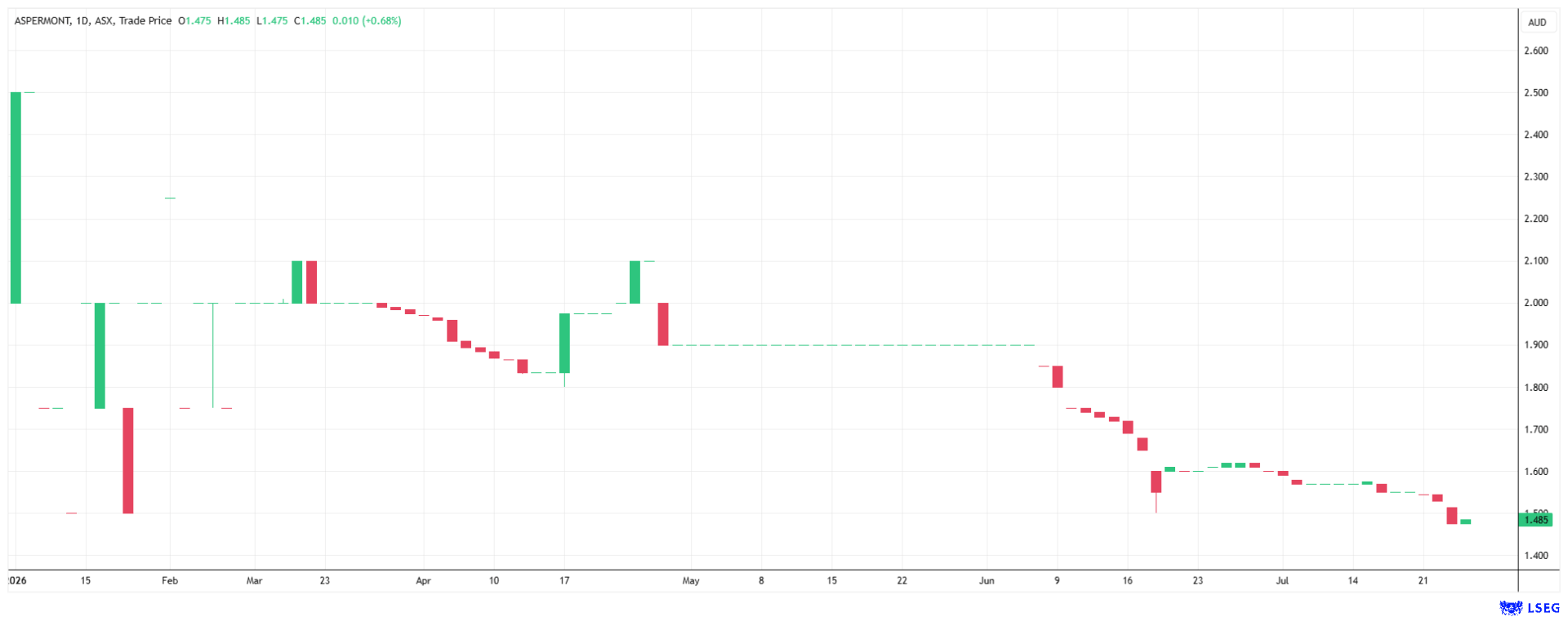
Aspermont's shares have been trading sideways with a slightly negative trend over the past few months. However, the company is well positioned. Its transformation into a platform provider with a recurring revenue share of up to 72% effectively shields the business from the cyclical fluctuations typical of the advertising market. If the company can execute on its strategy and attract additional customers, the shares could offer further upside potential.
Conflict of interest
Pursuant to §85 of the German Securities Trading Act (WpHG), we point out that Apaton Finance GmbH as well as partners, authors or employees of Apaton Finance GmbH (hereinafter referred to as "Relevant Persons") currently hold or hold shares or other financial instruments of the aforementioned companies and speculate on their price developments. In this respect, they intend to sell or acquire shares or other financial instruments of the companies (hereinafter each referred to as a "Transaction"). Transactions may thereby influence the respective price of the shares or other financial instruments of the Company.
In this respect, there is a concrete conflict of interest in the reporting on the companies.
In addition, Apaton Finance GmbH is active in the context of the preparation and publication of the reporting in paid contractual relationships.
For this reason, there is also a concrete conflict of interest.
The above information on existing conflicts of interest applies to all types and forms of publication used by Apaton Finance GmbH for publications on companies.
Risk notice
Apaton Finance GmbH offers editors, agencies and companies the opportunity to publish commentaries, interviews, summaries, news and the like on news.financial. These contents are exclusively for the information of the readers and do not represent any call to action or recommendations, neither explicitly nor implicitly they are to be understood as an assurance of possible price developments. The contents do not replace individual expert investment advice and do not constitute an offer to sell the discussed share(s) or other financial instruments, nor an invitation to buy or sell such.
The content is expressly not a financial analysis, but a journalistic or advertising text. Readers or users who make investment decisions or carry out transactions on the basis of the information provided here do so entirely at their own risk. No contractual relationship is established between Apaton Finance GmbH and its readers or the users of its offers, as our information only refers to the company and not to the investment decision of the reader or user.
The acquisition of financial instruments involves high risks, which can lead to the total loss of the invested capital. The information published by Apaton Finance GmbH and its authors is based on careful research. Nevertheless, no liability is assumed for financial losses or a content-related guarantee for the topicality, correctness, appropriateness and completeness of the content provided here. Please also note our Terms of use.