March 30th, 2026 | 08:30 CEST
A Paradigm Shift in Oncology: Core Stocks Roche & Galderma and the High-Leverage Opportunity in Vidac Pharma
Medical advances affect us all. Oncology is also undergoing a transformation. As conventional immunotherapies for skin cancer increasingly reach their limits, clinical research is shifting its focus to correcting defective tumor metabolism. The Warburg effect, where cancer cells shift energy production to aerobic glycolysis to fuel uncontrolled growth, offers a promising entry point. This dynamic development landscape is exacerbated by an impending patent cliff, which, according to calculations by the consulting firm PwC, threatens industry revenues of USD 104 billion by 2028, as many patents for active ingredients are expiring. Currently, market researchers at Fortune Business Insights estimate the volume of the global oncology market for 2026 at USD 286.36 billion. While pharmaceutical giant Roche secures its market leadership and the Galderma Group dominates standard dermatological care, biotechnology company Vidac Pharma is targeting the metabolic vulnerability of cancer cells with a completely novel mechanism of action, aiming to effectively shut down the cancer.
time to read: 3 minutes | Author: Nico Popp
ISIN: GALDERMA GROUP AG | CH1335392721 , VIDAC PHARMA HOLDING PLC | GB00BM9XQ619
Table of contents:
Author

Nico Popp
At home in Southern Germany, the passionate stock exchange expert has been accompanying the capital markets for about twenty years. With a soft spot for smaller companies, he is constantly on the lookout for exciting investment stories.
Tag cloud
Shares cloud
Roche: Operational Stability and Defensive Strength
The Swiss conglomerate Roche positions itself as a defensive core investment and stands out for its high operational resilience. In fiscal year 2025, the company increased its revenue by 7% on a currency-adjusted basis to CHF 61.5 billion, while consolidated net income climbed to CHF 13.8 billion. To defend its dominance in oncology, management is strategically combining established immunotherapies with new modalities such as antibody-drug conjugates and has recently advanced ten new drugs to the final development phase. Analysts at Morningstar emphasize in their latest studies that Roche faces no immediate patent cliff, which strengthens the company's strategic moat. The continuous increase in the dividend to CHF 9.80 per share now makes the stock an extremely stable anchor for investors in its industry.
Galderma Group: The Growth Champion of Dermatology
As a global pure-play specialist in dermatology, the Galderma Group fits the profile of a true growth champion. In the past year, the group achieved record revenue of USD 5.2 billion, representing a currency-adjusted increase of 17.7%. The growth driver was the Therapeutic Dermatology segment, which grew by over 50%, primarily due to the successful launch of Nemluvio, contributing USD 452 million to revenue. In the field of actinic keratosis, a common precursor to skin cancer, the company dominates standard care through a broad omni-channel presence. For the current year, management expects further revenue growth of up to 20% and a core EBITDA margin of approximately 26%, which exceeds analysts' expectations and underscores its strong market position.
Vidac Pharma: Revolution Through Metabolic Correction
While large corporations defend established markets, Vidac Pharma is emerging as an innovator. With its first-in-class candidate VDA-1102, the company directly targets the Warburg effect by interrupting the fatal interaction between the enzyme hexokinase-2 and the mitochondria. This targeted metabolic correction halts uncontrolled cancer cell growth and restores programmed cell death, sparing healthy tissue. In February of this year, Vidac successfully launched a Phase 2b clinical trial for high-risk patients with actinic keratosis at the renowned Centroderm Institute. Clinical data to date support this potential, with a 40% complete remission rate and an excellent safety profile. Since the targeted enzyme also plays a key role in inflammatory diseases, the company recently launched an in vivo preclinical program for psoriasis.
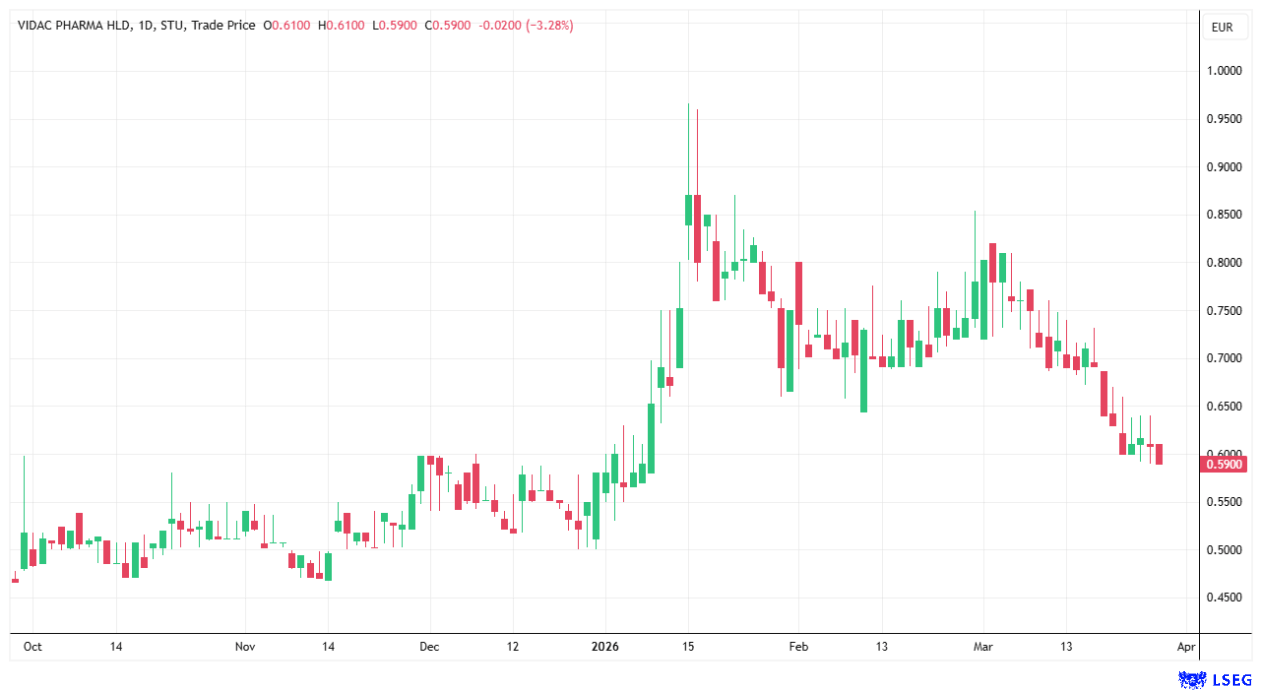
In addition to its lead candidate, VDA-1102, Vidac Pharma is consistently expanding its pipeline. According to internal reports, the company is already developing VDA-1275, a high-affinity successor candidate for the treatment of solid tumors, which is currently in the preclinical phase and preparing for approval of initial clinical trials. In addition, VDA-1102 is also being tested in a Phase 2 study as an intravenous formulation for the systemic treatment of solid tumors and cutaneous T-cell lymphoma. Analysts view this depth of the pipeline as clear evidence that the biotechnology company is not dependent on a single active ingredient, but has created a resilient and scalable platform for metabolic correction in oncology.
Investment Summary: Scaling Meets Disruption
For investors, the entire healthcare sector offers opportunities for returns. Roche and Galderma score points with established business models, high cash flows, and solid market shares, but naturally exhibit more moderate share price growth due to their market capitalization. Vidac Pharma, on the other hand, offers an attractive risk-reward profile at a current valuation of around EUR 40 million, as positive trial results over the course of the year could lead to a revaluation or an acquisition. If the clinical trials are successful, Vidac Pharma's metabolic approach could overcome many of the challenges associated with conventional cancer therapies. In biotechnology in particular, the focus is often on combining multiple therapies. Vidac's technology is particularly well-suited for this purpose.
Watch YouTube videoConflict of interest
Pursuant to §85 of the German Securities Trading Act (WpHG), we point out that Apaton Finance GmbH as well as partners, authors or employees of Apaton Finance GmbH (hereinafter referred to as "Relevant Persons") may hold shares or other financial instruments of the aforementioned companies in the future or may bet on rising or falling prices and thus a conflict of interest may arise in the future. The Relevant Persons reserve the right to buy or sell shares or other financial instruments of the Company at any time (hereinafter each a "Transaction"). Transactions may, under certain circumstances, influence the respective price of the shares or other financial instruments of the Company.
In addition, Apaton Finance GmbH is active in the context of the preparation and publication of the reporting in paid contractual relationships.
For this reason, there is a concrete conflict of interest.
The above information on existing conflicts of interest applies to all types and forms of publication used by Apaton Finance GmbH for publications on companies.
Risk notice
Apaton Finance GmbH offers editors, agencies and companies the opportunity to publish commentaries, interviews, summaries, news and the like on news.financial. These contents are exclusively for the information of the readers and do not represent any call to action or recommendations, neither explicitly nor implicitly they are to be understood as an assurance of possible price developments. The contents do not replace individual expert investment advice and do not constitute an offer to sell the discussed share(s) or other financial instruments, nor an invitation to buy or sell such.
The content is expressly not a financial analysis, but a journalistic or advertising text. Readers or users who make investment decisions or carry out transactions on the basis of the information provided here do so entirely at their own risk. No contractual relationship is established between Apaton Finance GmbH and its readers or the users of its offers, as our information only refers to the company and not to the investment decision of the reader or user.
The acquisition of financial instruments involves high risks, which can lead to the total loss of the invested capital. The information published by Apaton Finance GmbH and its authors is based on careful research. Nevertheless, no liability is assumed for financial losses or a content-related guarantee for the topicality, correctness, appropriateness and completeness of the content provided here. Please also note our Terms of use.