March 6th, 2026 | 07:05 CET
War – Shortages – Capitulation! Nel ASA, American Atomics, Oklo, and Siemens Energy in focus
In an environment where capital markets are already highly strained, another Middle East conflict has emerged at the beginning of March - this time involving Israel, the US, and Iran. Naturally, Hezbollah in Lebanon also stands ready to support its financiers from the Persian state. All of this adds fuel to an already overheated situation that can hardly cool down due to global shortages of energy, weapons, and raw materials. For stock market traders, this environment presents both opportunities and risks, because where there are losers, there are always winners as well. With oil and gas prices 15% higher, alternative energy sources are quickly coming back into focus. Stocks such as Nel ASA, which had already faded somewhat, are thus getting a new lease of life. A particularly strong spotlight is now falling on the nuclear industry, as it is more important than ever. Risk-conscious investors may still want to jump on the moving train.
time to read: 6 minutes | Author: André Will-Laudien
ISIN: NEL ASA NK-_20 | NO0010081235 , AMERICAN ATOMICS INC | CA0240301089 | CSE: NUKE , OKLO INC | US02156V1098 , SIEMENS ENERGY AG NA O.N. | DE000ENER6Y0
Table of contents:
Author

André Will-Laudien
Born in Munich, he first studied economics and graduated in business administration at the Ludwig-Maximilians-University in 1995. As he was involved with the stock market at a very early stage, he now has more than 30 years of experience in the capital markets.
Tag cloud
Shares cloud
American Atomics – Fuel for AI and SMRs from Amazon to Oklo
With the foreseeable conflict in Iran, international attention is once again focused on the nuclear energy sector. While the never-ending dispute over the transparency of Iran's nuclear programs is now being resolved by military action, investors are already looking beyond their own horizons in search of Western opportunities, as fossil fuels rose in price by around 15% within 48 hours. From an industrial perspective, such volatility is difficult to cope with, and a stable supply of nuclear energy is emerging as a Western alternative that would also offer great advantages to misguided European energy policy.
In this market environment, American Atomics Inc. is pursuing a strategy that goes beyond traditional exploration models and aims to build a vertically integrated value chain in the North American uranium sector. The business model aims to cover all steps from exploration and mining to processing, conversion, and potential enrichment. This approach also addresses a strategic issue in US energy policy: reducing dependence on foreign uranium supplies and strengthening domestic supply chains. For investors, this positioning opens up the prospect of participating not only in potential resource successes but also in infrastructure values along the entire fuel cycle.
Geologically, the company is focused on the historic Lisbon Valley district in the state of Utah, a region with significant historical uranium production. Within this area, the Big Indian Uranium Project is developing an exploration strategy on the eastern side of the structure, which has been little explored to date, while previous mining activities took place primarily in the west. Historically, approximately 78 million pounds of U₃O₈ have been produced in the district, underscoring the geological potential of the region. Initial indications suggest that known mineralization trends may continue in the new target areas. Using modern exploration methods, the company is attempting to systematically confirm these structures and thus lay the foundation for a future resource definition. At the same time, the company is working to address the downstream part of the value chain. In cooperation with CVMR Inc., the development of a modular uranium mill is being explored, which could potentially enable more flexible and faster implementation times compared to traditional large-scale facilities. A key technological focus is on the prospect of producing HALEU fuel, which is particularly needed for the next generation of small modular reactors. Amazon, Microsoft, and Meta are interested in such SMRs, and the US start-up Oklo aims to get them up and running as quickly as possible. This reactor technology is considered an important component of future nuclear energy systems, which is why corresponding fuel capacities could gain strategic importance.**
To generate more attention and trading, NUKE shares have been traded on the OTCQB Venture Market under the ticker symbol GNEMF since February 2026. At the beginning of March, the company raised just under CAD 2 million on the basis of CAD 0.25 per share. Anyone looking for a certain amount of leverage in the sector should actively follow the successful further development of the project. For now, the company can still be accessed at a valuation of CAD 18 million. In the current environment, this valuation should soon be a thing of the past!
Co-founder Connor Lynch on American Atomics' strategic direction at the 18th International Investment Forum.
Nel ASA – Project delays, but rising order intake gives hope
Norwegian hydrogen company Nel ASA is also pursuing an alternative path. Currently, the company is still looking back on a difficult 2025 financial year, which was characterized primarily by declining revenue and significantly higher losses. The main reason for this was delayed investment decisions by many industrial customers, which meant that large-scale projects in the field of green hydrogen developed more slowly than originally expected. Revenue fell to around NOK 963 million, while the net loss widened to around NOK 1.3 billion due to extensive write-downs. In Q4, order intake finally picked up again, fueled by EU projects. The focus is currently on expanding the Herøya production site, where Nel plans to build production capacity of up to one gigawatt for a new generation of alkaline electrolysers. At present, the European hydrogen market continues to receive strong political support, as programs such as the EU Innovation Fund are set to mobilize billions in investments in climate-friendly technologies. Nel is still in a difficult transition phase. In the short term, it is affected by project delays and balance sheet burdens, but in the long term, it is positioned in a market that is likely to grow structurally due to decarbonization and government subsidy programs. However, 7 out of 17 analysts on the LSEG platform still have a negative outlook, with only one recommending a "Buy". Speculating on a turnaround, therefore, requires a lot of courage!
Siemens Energy – Analysts see opportunities and risks at Siemens Energy
Munich-based energy company Siemens Energy has positioned itself like a spider in its web. With an extended rally of over 180% growth in just one year, Siemens Energy is presenting itself as a key beneficiary of the global expansion of energy infrastructure, even though analysts are now taking a more critical view of the stock's valuation. The research firm mwb research recently raised its price target from EUR 86 to EUR 89, but is sticking to its "Sell" recommendation, as analysts believe that much of the expected industry growth is already priced in. At the same time, there are broker opinions, such as that of Evercore ISI, which suggest a price target of EUR 205. This brings the consensus of all votes to EUR 159.33 over a 12-month period, just below the current trading price. Siemens Energy is sending a signal of confidence in its own development with a new share buyback program worth up to EUR 2 billion – we remember that in November 2023, the group had applied for state aid of EUR 7.5 billion to rescue its struggling Spanish wind subsidiary Gamesa. Analyst Phil Buller of JPMorgan rates the stock as "Overweight" because, despite geopolitical tensions in the Middle East, he sees little risk for investment projects in power generation, grid infrastructure, or energy-intensive data centers. On the contrary, the increasing importance of energy security could even further increase demand for Siemens Energy's technologies. In the bank's industry assessment, the company remains one of the top favorites in the European industrial goods sector. With a 2026 P/E ratio of 41, the stock is beyond cheap, but: The trend is your friend! Technically, a stop at EUR 149.50 makes perfect sense.
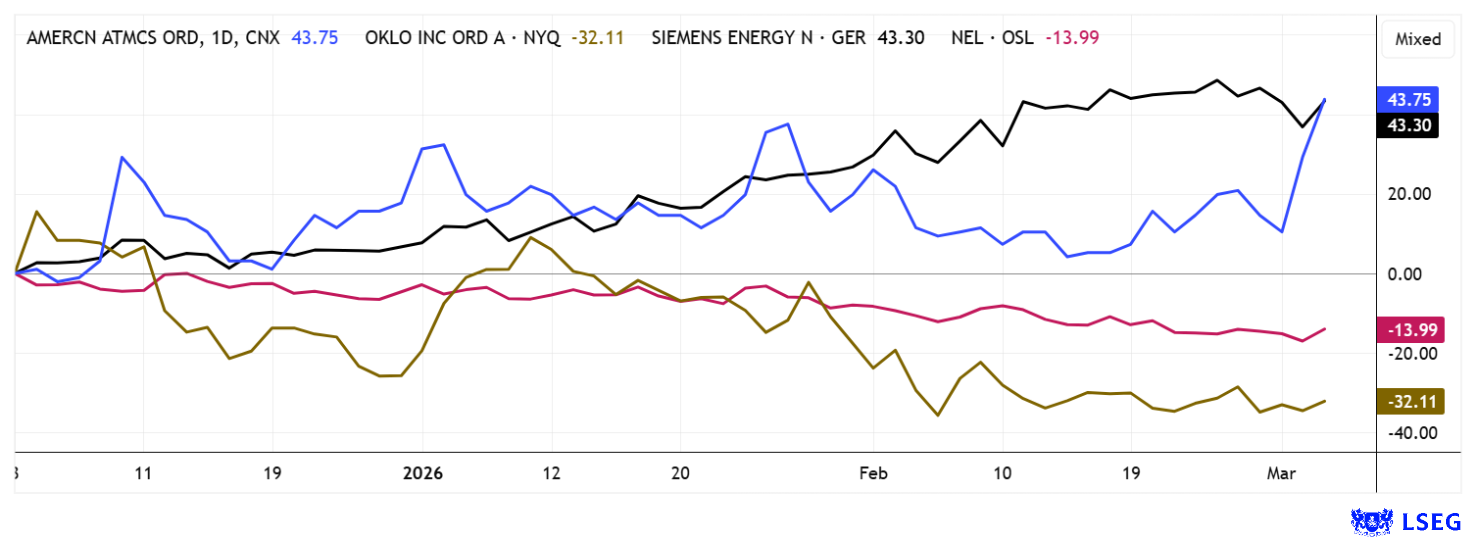
Energy markets have been in turmoil since the start of the war in Iran. This is hardly surprising, given that Iran's exports amounted to 5 million barrels of oil per day in the best of times. Now, however, the Strait of Hormuz is also under threat, which is driving up prices. This presents both opportunities and risks for investors. While oil multinationals are making strong gains, alternative energy companies are also coming back into focus. Siemens Energy has already performed well, and now Nel ASA and SMR specialist Oklo are following suit. American Atomics deserves particular attention, as it is establishing a closed supply chain for uranium and a new Western nuclear industry. Very exciting!
Conflict of interest
Pursuant to §85 of the German Securities Trading Act (WpHG), we point out that Apaton Finance GmbH as well as partners, authors or employees of Apaton Finance GmbH (hereinafter referred to as "Relevant Persons") currently hold or hold shares or other financial instruments of the aforementioned companies and speculate on their price developments. In this respect, they intend to sell or acquire shares or other financial instruments of the companies (hereinafter each referred to as a "Transaction"). Transactions may thereby influence the respective price of the shares or other financial instruments of the Company.
In this respect, there is a concrete conflict of interest in the reporting on the companies.
In addition, Apaton Finance GmbH is active in the context of the preparation and publication of the reporting in paid contractual relationships.
For this reason, there is also a concrete conflict of interest.
The above information on existing conflicts of interest applies to all types and forms of publication used by Apaton Finance GmbH for publications on companies.
Risk notice
Apaton Finance GmbH offers editors, agencies and companies the opportunity to publish commentaries, interviews, summaries, news and the like on news.financial. These contents are exclusively for the information of the readers and do not represent any call to action or recommendations, neither explicitly nor implicitly they are to be understood as an assurance of possible price developments. The contents do not replace individual expert investment advice and do not constitute an offer to sell the discussed share(s) or other financial instruments, nor an invitation to buy or sell such.
The content is expressly not a financial analysis, but a journalistic or advertising text. Readers or users who make investment decisions or carry out transactions on the basis of the information provided here do so entirely at their own risk. No contractual relationship is established between Apaton Finance GmbH and its readers or the users of its offers, as our information only refers to the company and not to the investment decision of the reader or user.
The acquisition of financial instruments involves high risks, which can lead to the total loss of the invested capital. The information published by Apaton Finance GmbH and its authors is based on careful research. Nevertheless, no liability is assumed for financial losses or a content-related guarantee for the topicality, correctness, appropriateness and completeness of the content provided here. Please also note our Terms of use.