January 30th, 2026 | 10:00 CET
War on the horizon, cold winter, and unresolved energy issues! CHAR Technologies has the answers
Despite all the geopolitical uncertainties, the capital markets are experiencing the largest and most powerful commodity rally of all time. This is driving up input costs for industry, further fueling already stubborn inflation. The fact that tariffs, wage increases, and high resource prices are affecting store shelves also implies significantly higher interest rates in the near future. Investors should consider alternatives and, especially for highly valued stocks, set tight stop-loss limits. However, with regard to unresolved energy issues, there are innovative solutions that can even be purchased on the stock market. Cleantech specialist CHAR Technologies has an interesting business model that makes sense in all weather conditions. A closer look reveals good medium-term prospects.
time to read: 4 minutes | Author: André Will-Laudien
ISIN: CHAR Technologies Ltd. | CA15957L1040
Table of contents:
Author

André Will-Laudien
Born in Munich, he first studied economics and graduated in business administration at the Ludwig-Maximilians-University in 1995. As he was involved with the stock market at a very early stage, he now has more than 30 years of experience in the capital markets.
Tag cloud
Shares cloud
CHAR Technologies – Industrial decarbonization on the agenda
CHAR Technologies pursues a clearly structured business model based on technologies for decarbonization using real resources. Using the company's proprietary high-temperature pyrolysis process, non-marketable wood residues and organic waste are converted into two valuable products. The biochar produced can replace fossil coal in emission-intensive industries, while the resulting synthesis gas is further utilized for energy. This dual revenue logic increases the profitability per plant and stabilizes cash flows across various energy and utility markets. The key factor is the modular and replicable plant architecture, which is designed not for individual projects but for a scalable pipeline. This positions the company less as a plant manufacturer and more as a long-term project developer in the cleantech sector.
Thorold – Commercial reference and operational test
The plant in Thorold marks the transition from technology development to commercial implementation. With commissioning currently underway, it is being demonstrated for the first time that high-temperature pyrolysis can be operated stably under industrial conditions. The planned capacity of around 5,000 tons of biocarbon per year serves as an operational reference for future projects. Thorold was deliberately chosen as a first, manageable step to validate processes, logistics, and product quality. The structured ramp-up phase reduces operational risks and creates reliable performance data in all operating modes. The project thus fulfills a central function as the foundation for larger follow-up investments.
Espanola: Scaling with anchor capital and reduced risk
The Espanola project represents the next step in development, with CHAR Tech entering the industrial scale. With a planned annual capacity of 50,000 tons of biocarbon, the plant is around five times the size of Thorold and demonstrates the scalability of the innovative technology. Particularly relevant is the CAD 10 million financial commitment from strategic partner BMI Group, which significantly increases financing security as anchor capital. In addition, the use of an existing pulp mill site in northern Ontario significantly reduces development and permitting risks. Secured access to regional forest resources rounds out a site concept that is deliberately designed to minimize risk.
IIF moderator Lyndsay Malchuk talks to CEO Andrew White about the plans for 2026.
Publication of financial data for 2025
In fiscal year 2025, CHAR Technologies reached a clear turning point, both operationally and financially. The deepened partnership with the BMI Group is of central importance here. In addition to CAD 2 million at the corporate level and CAD 8 million for Thorold, a further commitment of CAD 10 million for the Espanola project followed after the balance sheet date. At the same time, commercial biocarbon was produced in Thorold for the first time, completing the transition from the development phase to the revenue phase. The successful use of high-temperature pyrolysis for PFAS destruction in Baltimore also shows that the technology is scalable beyond the core business and can address additional regulatory markets.
Financially, there has been a clear improvement in the balance sheet: liabilities have been greatly reduced, while equity has increased significantly. Despite lower revenues, gross profit improved, indicating increasing operational penetration. The profit from the investment in a joint venture highlights the value contribution of successful project development. The planned net loss during the ongoing build-up phase was significantly reduced compared to the previous year. Overall, the key figures confirm that CHAR Technologies is progressing according to its scaling roadmap and increasingly converting operational risks into tangible value creation.
"With the release of our 2025 fiscal year results, we are very proud of the progress we have made this year," commented Andrew White, CEO of CHAR Technologies.
Conclusion: From a single project to a scalable project pipeline
CHAR Technologies is increasingly demonstrating that it is operating along a clearly defined development roadmap. There are currently very few competitors in the immediate environment that can offer similar technological penetration. The current projects build on each other. Thus, Espanola is not an isolated growth project, but the logical continuation after Thorold and thus evidence of pipeline progress. The combination of industrial scaling, a recurring sponsor, and resilient location logic strengthens the proof of concept. At the same time, the Company is addressing several structural growth markets with regulatory tailwinds. Looking at the timeline of developments, the Company is currently at an important turning point in the commercialization process. Exciting!
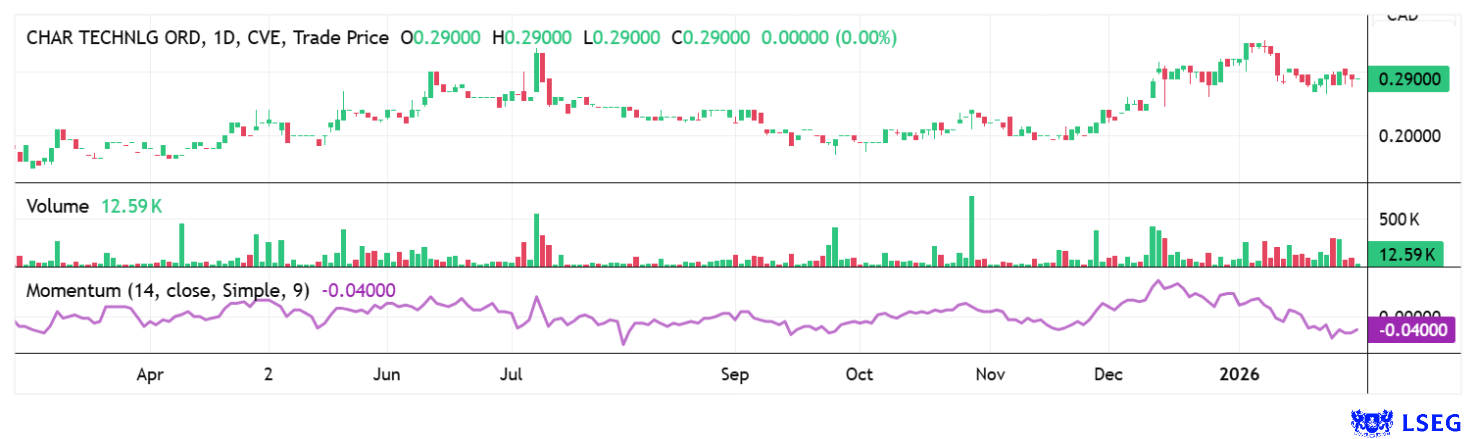
High volatility in the energy and commodities sector is the new normal in the markets. However, the outlook for energy service providers and greentech producers is improving almost daily in this environment. Expensive fossil fuels will have to be replaced by modern technologies in the long run. CHAR Technologies is demonstrating that rapid progress is possible. With a market valuation of CAD 38 million, the stock is still very attractively valued.
Conflict of interest
Pursuant to §85 of the German Securities Trading Act (WpHG), we point out that Apaton Finance GmbH as well as partners, authors or employees of Apaton Finance GmbH (hereinafter referred to as "Relevant Persons") currently hold or hold shares or other financial instruments of the aforementioned companies and speculate on their price developments. In this respect, they intend to sell or acquire shares or other financial instruments of the companies (hereinafter each referred to as a "Transaction"). Transactions may thereby influence the respective price of the shares or other financial instruments of the Company.
In this respect, there is a concrete conflict of interest in the reporting on the companies.
In addition, Apaton Finance GmbH is active in the context of the preparation and publication of the reporting in paid contractual relationships.
For this reason, there is also a concrete conflict of interest.
The above information on existing conflicts of interest applies to all types and forms of publication used by Apaton Finance GmbH for publications on companies.
Risk notice
Apaton Finance GmbH offers editors, agencies and companies the opportunity to publish commentaries, interviews, summaries, news and the like on news.financial. These contents are exclusively for the information of the readers and do not represent any call to action or recommendations, neither explicitly nor implicitly they are to be understood as an assurance of possible price developments. The contents do not replace individual expert investment advice and do not constitute an offer to sell the discussed share(s) or other financial instruments, nor an invitation to buy or sell such.
The content is expressly not a financial analysis, but a journalistic or advertising text. Readers or users who make investment decisions or carry out transactions on the basis of the information provided here do so entirely at their own risk. No contractual relationship is established between Apaton Finance GmbH and its readers or the users of its offers, as our information only refers to the company and not to the investment decision of the reader or user.
The acquisition of financial instruments involves high risks, which can lead to the total loss of the invested capital. The information published by Apaton Finance GmbH and its authors is based on careful research. Nevertheless, no liability is assumed for financial losses or a content-related guarantee for the topicality, correctness, appropriateness and completeness of the content provided here. Please also note our Terms of use.