March 13th, 2026 | 07:00 CET
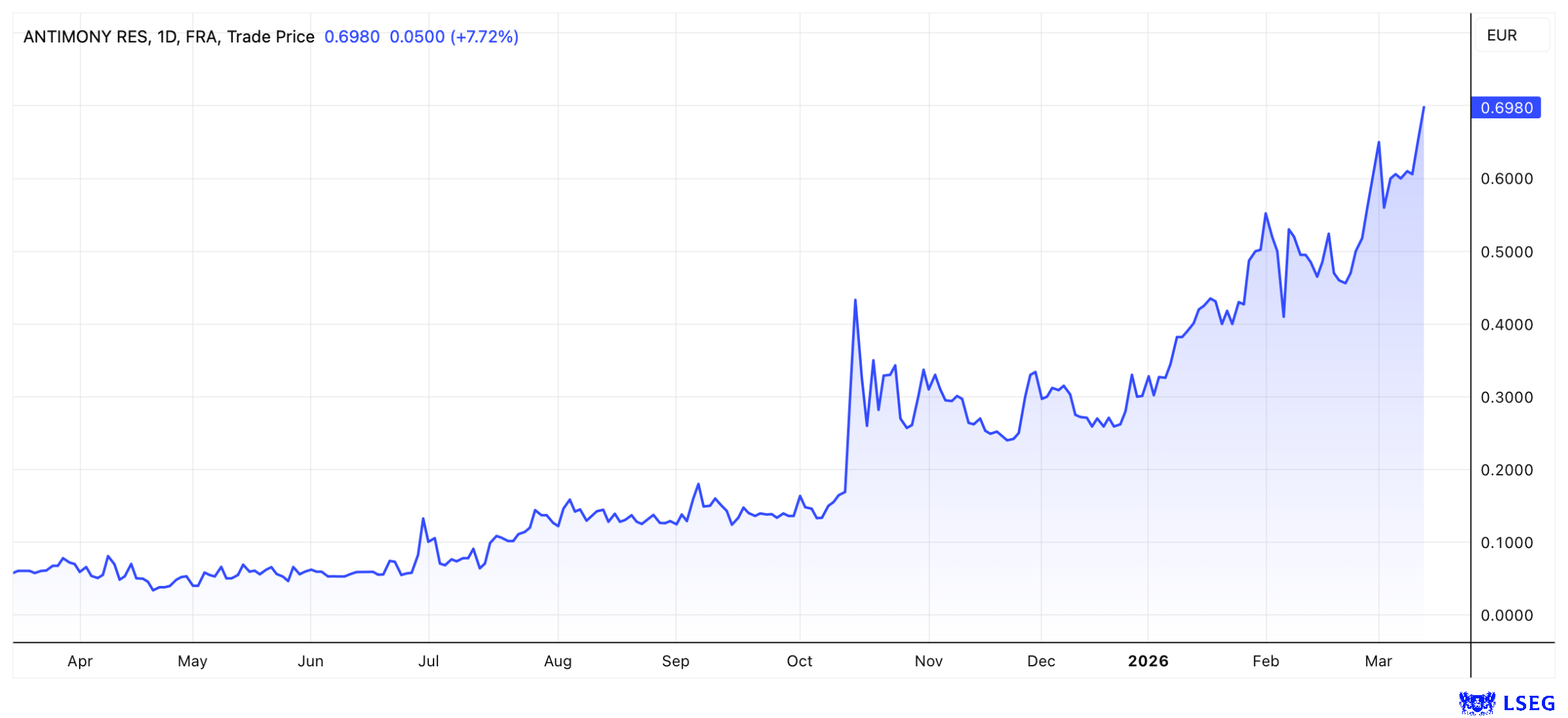
USD 5.6 billion in just a few days! Antimony, a key ammunition raw material, surges! Antimony Resources stock takes off!
The war against Iran is increasingly turning into a costly war of attrition for the US. The Trump administration was apparently convinced that massive military pressure would quickly cause the regime in Tehran to collapse. Instead, the conflict is dragging on, the enemy is proving more resilient than expected, and the US war objectives remain unclear. The bill is rising day by day. According to Reuters, expenditures for deployed ammunition alone in the first two days of the war totaled USD 5.6 billion. Against this backdrop, a scale of around USD 1 billion per day now almost seems reasonable. One thing is clear: ammunition is urgently needed. This makes critical raw materials even more critical. For investors, this presents opportunities.
time to read: 2 minutes | Author: Fabian Lorenz
ISIN: ANTIMONY RESOURCES CORP | CA0369271014 | CSE: ATMY , OTCQB: ATMYF
Table of contents:
Author

Fabian Lorenz
For more than twenty years, the Cologne native has been intensively involved with the stock market, both professionally and privately. He is particularly passionate about national and international small and micro caps.
Tag cloud
Shares cloud
Pressure on arms companies
With each passing day of war, another problem comes to the fore: the strain on American arsenals. Shortly after the war began, there was discussion in the US that stocks of missiles, precision weapons, and other ammunition were dwindling faster than they could be replaced. Reuters reported that the Trump administration had therefore invited top representatives of major arms manufacturers to the White House to discuss accelerating production. Not only is the ongoing deployment costing enormous sums of money, but the industry must now ramp up capacity in a short period of time. In addition, Israel and the Gulf states also need to produce or purchase more ammunition. On March 5, 2026, Ukrainian President Zelensky stated that over 800 Patriot missiles had been used in just three days of war in the Middle East. This is more than Ukraine has received in total since 2022.
The US does not produce antimony
Even if there are enough factories, ramping up ammunition production is likely to be a supply chain nightmare. This is because the raw materials too often come from China and Russia. This also applies to antimony. Although this raw material is less well known, it has long been high on the list of critical metals for Western countries. Demand for antimony is likely to continue to rise in the coming years. Grand View Research expects the global market to grow from USD 2.17 billion in 2023 to USD 3.30 billion by 2030. It is estimated that nearly 20% of global antimony demand comes from the defense industry. And antimony is not only used for ammunition, but also for specialized electronics such as night vision devices and sensors. It is also very important as a flame retardant in a wide variety of products and is even needed for semiconductors.
Nevertheless, for example, no antimony is produced in the US, and the country relies 100% on imports. The West, therefore, urgently needs domestic sources. Antimony Resources aims to contribute to this.
Outstanding antimony deposit
It is becoming increasingly clear that the company's Bald Hill project in Canada could have an outstanding antimony deposit. Massive antimony-bearing stibnite mineralization has now been identified in four separate areas. A 10,000-meter drilling program is currently underway. After the first 4,000 m, Antimony Resources recently provided a convincing update. The entire program is scheduled to be completed in April. The company plans to publish its first resource estimate in early June. The NI 43-101 report estimates the project's potential at around 2.7 million tonnes with an antimony content of 3% to 4%. If the current drilling confirms this, the deposit could be worth billions. It should be noted that the price of antimony is likely to continue to rise, and further areas will be explored. The company currently has a market capitalization of CAD 100 million.
Conclusion: Stock for the commodity supercycle
With Antimony Resources, investors benefit from the commodity supercycle. Antimony is less well known as a critical metal, but all the more important. The current zones of the Bald Hill project could already contain a resource worth several billion. In addition, there are further potential deposits, suggesting that prices will continue to rise.
Conflict of interest
Pursuant to §85 of the German Securities Trading Act (WpHG), we point out that Apaton Finance GmbH as well as partners, authors or employees of Apaton Finance GmbH (hereinafter referred to as "Relevant Persons") currently hold or hold shares or other financial instruments of the aforementioned companies and speculate on their price developments. In this respect, they intend to sell or acquire shares or other financial instruments of the companies (hereinafter each referred to as a "Transaction"). Transactions may thereby influence the respective price of the shares or other financial instruments of the Company.
In this respect, there is a concrete conflict of interest in the reporting on the companies.
In addition, Apaton Finance GmbH is active in the context of the preparation and publication of the reporting in paid contractual relationships.
For this reason, there is also a concrete conflict of interest.
The above information on existing conflicts of interest applies to all types and forms of publication used by Apaton Finance GmbH for publications on companies.
Risk notice
Apaton Finance GmbH offers editors, agencies and companies the opportunity to publish commentaries, interviews, summaries, news and the like on news.financial. These contents are exclusively for the information of the readers and do not represent any call to action or recommendations, neither explicitly nor implicitly they are to be understood as an assurance of possible price developments. The contents do not replace individual expert investment advice and do not constitute an offer to sell the discussed share(s) or other financial instruments, nor an invitation to buy or sell such.
The content is expressly not a financial analysis, but a journalistic or advertising text. Readers or users who make investment decisions or carry out transactions on the basis of the information provided here do so entirely at their own risk. No contractual relationship is established between Apaton Finance GmbH and its readers or the users of its offers, as our information only refers to the company and not to the investment decision of the reader or user.
The acquisition of financial instruments involves high risks, which can lead to the total loss of the invested capital. The information published by Apaton Finance GmbH and its authors is based on careful research. Nevertheless, no liability is assumed for financial losses or a content-related guarantee for the topicality, correctness, appropriateness and completeness of the content provided here. Please also note our Terms of use.