June 26th, 2026 | 07:15 CEST
This Investment Scenario Will Last for Years: Tungsten Giant Almonty and the Demand from Hensoldt, RENK, and Others
On January 1, 2027, the US Department of Defense's import ban on tungsten products from China, Russia, North Korea, and Iran will take effect. Because tungsten is considered an almost irreplaceable element in defense technology, semiconductors, and the aerospace industry, this ban is creating significant time pressure across these sectors. At the same time, the EU is also tightening requirements for raw material sovereignty with the Critical Raw Materials Act (CRMA). China is exacerbating the situation with export restrictions on dual-use materials. As a result, the global tungsten market is sliding into a severe structural shortage. We take a look at where the opportunities lie for investors—and which companies to watch.
time to read: 4 minutes | Author: Nico Popp
ISIN: ALMONTY INDUSTRIES INC. | CA0203987072 | TSX: AII , NASDAQ: ALM , ASX: AII , HENSOLDT AG INH O.N. | DE000HAG0005 , RENK AG O.N. | DE000RENK730
Table of contents:
Author

Nico Popp
At home in Southern Germany, the passionate stock exchange expert has been accompanying the capital markets for about twenty years. With a soft spot for smaller companies, he is constantly on the lookout for exciting investment stories.
Tag cloud
Shares cloud
Hensoldt and Capacity Constraints
Hensoldt reported a significant acceleration in growth in the first quarter of 2026. Order intake doubled compared to the same period last year, reaching EUR 1.483 billion. As a result, the order backlog reached a new record high of a whopping EUR 9.8 billion. The main drivers were major contracts to equip the German Puma and Schakal land systems, as well as contract extensions for Eurofighter radar systems. Quarterly revenue rose by more than 25% to EUR 496 million. Despite the excellent order situation, the stock retreated from its all-time high. Investors are concerned about the group's capacity bottlenecks. To counteract this bottleneck, the company says it is investing approximately EUR 1 billion in new production facilities and modernized manufacturing processes to work through the enormous backlog of orders. However, the growing problem of raw material supply persists.
RENK Is Also Suffering from Delays
The RENK Group also recorded the best start to a year in its corporate history. Order intake rose to EUR 582.3 million in the first quarter of 2026, driven by the Vehicle Mobility Solutions segment, whose defense-related revenue grew by more than 27%. The total order backlog reached an all-time high of EUR 6.9 billion. Quarterly revenue rose slightly by 4% to EUR 283.6 million, while adjusted EBIT climbed disproportionately by 10.4% to EUR 42.4 million. Among the most significant major orders are a NATO battle tank program worth approximately EUR 157 million and engines for the US M88 recovery tank worth EUR 49 million. The Marine & Industry segment experienced temporary disruptions in the supply and logistics chain, resulting in a 10.8% decline in revenue for the division. RENK itself expects these revenues to be deferred to the second and third quarters.
Almonty: A Quasi-Monopolist with Unique Offtake Agreements
As a raw materials producer, Almonty Industries operates directly at the source and focuses primarily on tungsten and molybdenum. The company reached a milestone in March of this year with the formal commissioning of the Sangdong mine in South Korea. Sangdong is considered one of the most significant tungsten deposits outside of China. According to the NI 43-101-compliant resource report, the project has inferred resources of approximately 50.7 million metric tonnes with a grade of 0.43% WO₃—roughly three times the global average. Once full commercial capacity is reached in 2027, the project is expected to account for approximately 40% of the global tungsten supply outside of China. The first quarter of 2026 marked a turning point for Almonty. Gross revenue rose 221% year-over-year to CAD 25.4 million, driven by the Panasqueira mine in Portugal—which has been in operation for decades—as well as soaring tungsten prices. The tungsten price in Rotterdam climbed to over USD 3,000 per MTU in the spring. This led to a positive adjusted EBITDA of CAD 6.1 million and an operating cash flow of CAD 9.7 million for Almonty.
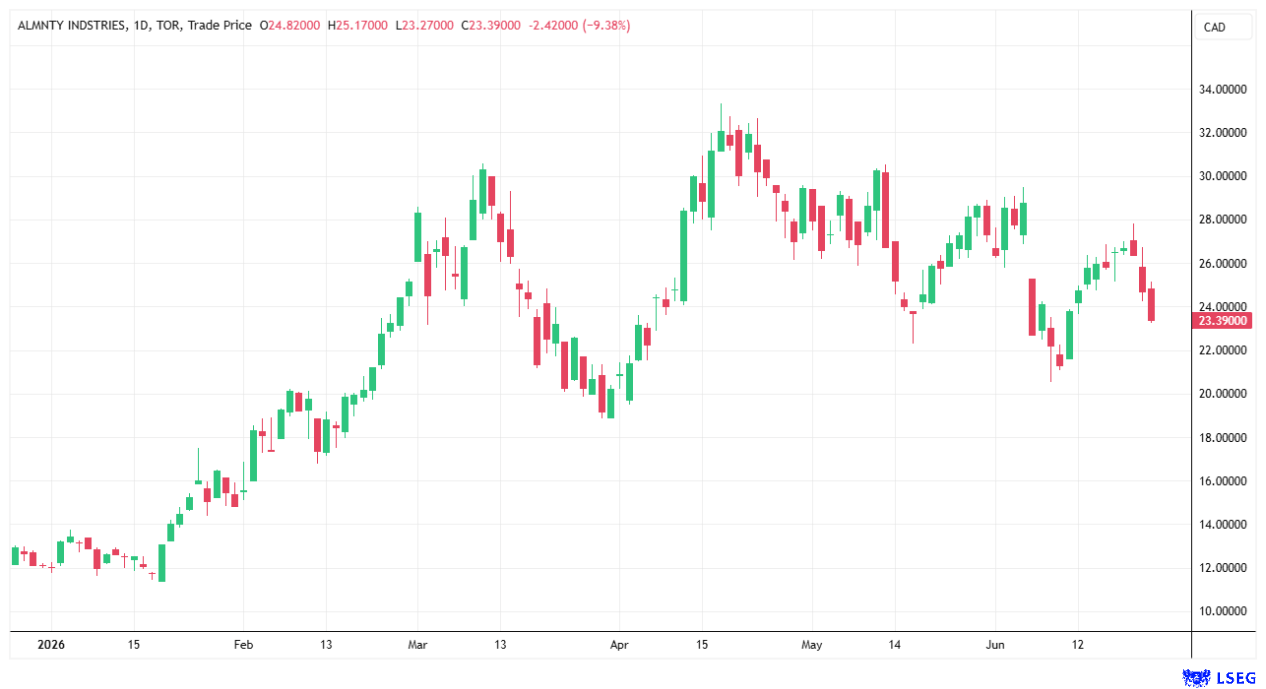
In addition, the company is advancing the adjacent molybdenum project in Sangdong. The property is proving to be a strategic asset in light of a national supply crisis in South Korea, which imports more than 90% of its molybdenum from China. Exploration drilling confirms historical grades and points to a mine life of over 45 years. To reduce its dependence on market fluctuations for both tungsten and molybdenum, Almonty secured a 15-year offtake agreement with the Plansee Group that includes a floor price guarantee. In addition, there is a three-year offtake agreement with Tungsten Parts Wyoming and the Israeli processor Metal Tech for the monthly delivery of at least 40 metric tonnes of tungsten oxide for US military applications. Since 2022, Almonty has also been evaluating the construction of an on-site nano-tungsten oxide processing plant in Sangdong, which is expected to have a capacity of 3,000 to 4,000 metric tonnes per year, to directly supply the South Korean semiconductor and battery industries. The processing of raw materials is also considered a bottleneck. If Almonty could contribute its expertise in this area, it could unlock further potential.
Bright Outlook for Almonty: Tungsten Trend Likely to Continue
The defense industry is coming under increasing pressure. While companies like Hensoldt and RENK are suffering from fluctuating costs and logistical bottlenecks despite full order books, raw material producers like Almonty are able to secure long-term contracts with favourable floor prices. Almonty benefits from its exceptional market position and the indispensability of tungsten. The penetrating power of modern tanks relies crucially on projectiles made of high-purity tungsten heavy-metal alloys. There are hardly any alternatives. Analysts at Cantor Fitzgerald also view Almonty positively in their latest May analysis, setting a one-year price target of USD 25.80. The key point here is that, even based on a long-term tungsten price of USD 600 per MTU—significantly below the current market level of over USD 3,000—the analysts arrive at their price target. As a tungsten producer with exceptional expertise and spare capacity, the company occupies a crucial niche for several industries at once. The investment case for Almonty is likely to remain strong for years to come.
Watch YouTube videoConflict of interest
Pursuant to §85 of the German Securities Trading Act (WpHG), we point out that Apaton Finance GmbH as well as partners, authors or employees of Apaton Finance GmbH (hereinafter referred to as "Relevant Persons") currently hold or hold shares or other financial instruments of the aforementioned companies and speculate on their price developments. In this respect, they intend to sell or acquire shares or other financial instruments of the companies (hereinafter each referred to as a "Transaction"). Transactions may thereby influence the respective price of the shares or other financial instruments of the Company.
In this respect, there is a concrete conflict of interest in the reporting on the companies.
In addition, Apaton Finance GmbH is active in the context of the preparation and publication of the reporting in paid contractual relationships.
For this reason, there is also a concrete conflict of interest.
The above information on existing conflicts of interest applies to all types and forms of publication used by Apaton Finance GmbH for publications on companies.
Risk notice
Apaton Finance GmbH offers editors, agencies and companies the opportunity to publish commentaries, interviews, summaries, news and the like on news.financial. These contents are exclusively for the information of the readers and do not represent any call to action or recommendations, neither explicitly nor implicitly they are to be understood as an assurance of possible price developments. The contents do not replace individual expert investment advice and do not constitute an offer to sell the discussed share(s) or other financial instruments, nor an invitation to buy or sell such.
The content is expressly not a financial analysis, but a journalistic or advertising text. Readers or users who make investment decisions or carry out transactions on the basis of the information provided here do so entirely at their own risk. No contractual relationship is established between Apaton Finance GmbH and its readers or the users of its offers, as our information only refers to the company and not to the investment decision of the reader or user.
The acquisition of financial instruments involves high risks, which can lead to the total loss of the invested capital. The information published by Apaton Finance GmbH and its authors is based on careful research. Nevertheless, no liability is assumed for financial losses or a content-related guarantee for the topicality, correctness, appropriateness and completeness of the content provided here. Please also note our Terms of use.