For several years now, the energy market has been undergoing a transformation known as the second nuclear renaissance. Driven by the rapidly rising demand for electricity for artificial intelligence (AI) and the associated data center infrastructure, as well as climate goals, nuclear power has become an indispensable pillar of the global baseload supply. According to reports from the International Energy Agency (IEA), nuclear power already reached record levels last year. But nuclear energy requires uranium as fuel. In a market environment characterized by a long-term supply gap, investors are increasingly seeing opportunities at the beginning of the value chain. While established industry giants like Cameco are operating at full capacity in the Canadian Athabasca Basin, more diversified mining groups such as Rio Tinto are once again placing greater emphasis on the strategic importance of uranium. At the same time, the exploration company Stallion Uranium is positioning itself in a promising mining region, offering investors the chance to participate in the new uranium cycle from the very beginning.
time to read: 3 minutes | Author: Nico Popp
ISIN: CAMECO CORP. | CA13321L1085 , STALLION URANIUM CORP | CA8529192087 | TSXV: STUD , OTCQB: STLNF , RIO TINTO LTD | AU000000RIO1 , RIO TINTO PLC LS-_10 | GB0007188757
Table of contents:
Author

Nico Popp
At home in Southern Germany, the passionate stock exchange expert has been accompanying the capital markets for about twenty years. With a soft spot for smaller companies, he is constantly on the lookout for exciting investment stories.
Tag cloud
Shares cloud
Cameco: Integrated Market Leader
Cameco is considered the backbone of the Western uranium supply. For years, the company has benefited from mines such as McArthur River and Cigar Lake in the Athabasca Basin. These offer high grades and thus attractive margins. The numbers speak for themselves: an adjusted EBITDA of approximately USD 1.4 billion for the past year impressed market participants. A key growth driver is the acquisition of a 49% stake in Westinghouse Electric Company, which transformed Cameco from a pure mining company into an integrated nuclear technology group. Through this strategic acquisition, the group covers nearly the entire fuel cycle and benefits directly from the construction of new reactors around the world. Analysts at RBC Capital recently raised their price targets for the company significantly, as the long-term contracts for fuel assembly production offer enormous planning security. This is exactly what long-term investors are looking for.
Rio Tinto: Broadens Its Strategic Positioning
For the diversified mining giant Rio Tinto, uranium is of great importance for the energy transition. While the group primarily directs its capital into sectors such as copper and iron ore, it is currently using its expertise in the uranium sector mainly for the environmentally sound remediation of the historic Ranger Mine in Australia. To gain full control over the reactivation measures and avoid legal uncertainties, the company increased its stake in the operating company to over 98% as early as the end of 2024. Rio Tinto remains a major player in the uranium market, controlling a significant portion of the global uranium supply through its holdings. Among some Rio Tinto shareholders, there are also efforts to re-evaluate the massive but politically stalled Jabiluka deposit in Australia in a changing environment. CEO Jakob Stausholm regularly reaffirms the goal of aligning the group with metals that are indispensable for the energy transition.
Stallion Uranium: New Discoveries in the Athabasca Basin
While the giants dominate the existing market, Stallion Uranium focuses on the significant exploration potential in the southwestern Athabasca Basin. There, the company controls the largest contiguous land package of over 1,700 km², located in the immediate vicinity of the world-class discoveries by NexGen Energy and Fission Uranium. The strategy is based on the systematic application of state-of-the-art geophysical data, such as VTEM Plus surveys, to identify new uranium-bearing structures beneath sandstone. In the first quarter, Stallion launched a comprehensive drilling program at the Moonlite Project, with a focus on the so-called Coyote Target. Geophysical signatures such as gravity anomalies and structural faults at this target show striking similarities to the neighboring billion-dollar Arrow deposit. A successfully completed financing round totaling approximately USD 4.4 million secures the ongoing exploration work in full.
Opportunities in Uranium: Structural Shortage Drives the Market
The market environment for these companies could hardly be better. The passage of the Prohibiting Russian Uranium Imports Act in the US is forcing a widespread shift away from Russian uranium supplies and favoring so-called "friend-shoring" toward North American projects. As a result, the spot price of uranium temporarily rose to over USD 100 per pound, with experts from Goldman Sachs and Bank of America seeing further upside potential up to USD 135. Estimates from the World Nuclear Association project that annual uranium demand will rise by 28% to just under 87,000 tons by 2030.
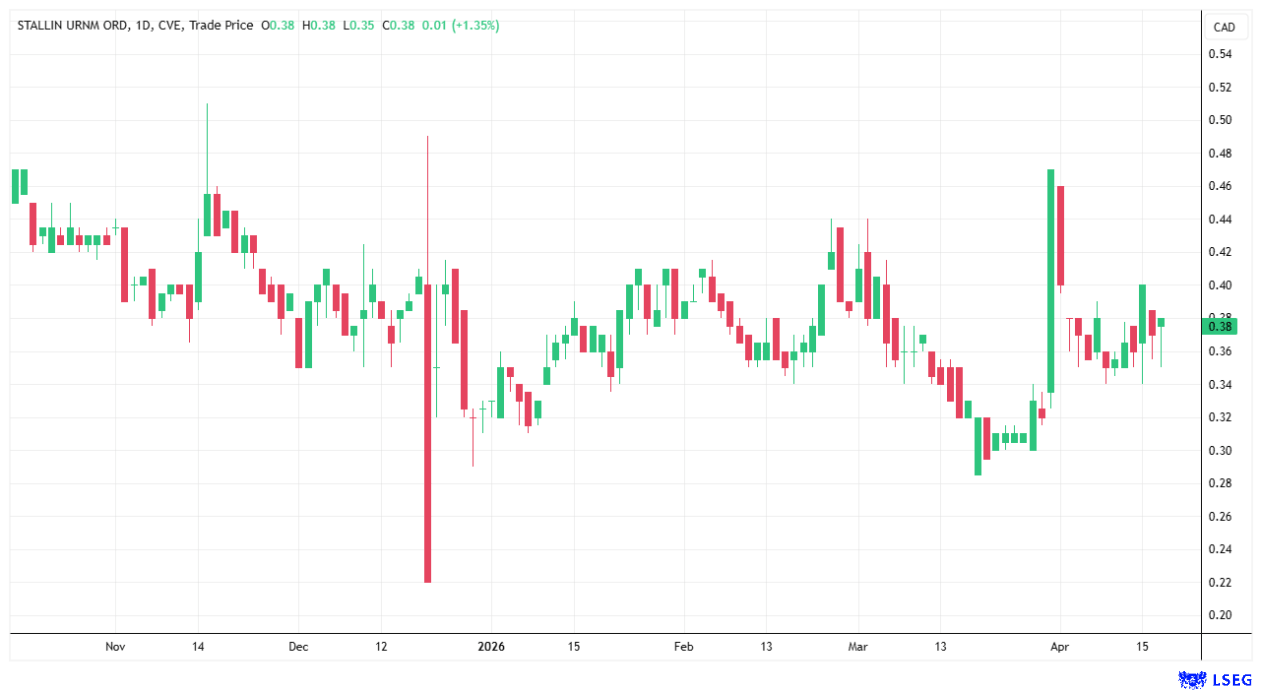
In this structural deficit, Stallion Uranium offers investors the opportunity to position themselves at the particularly lucrative beginning of the nuclear value chain through new discoveries. Given the market capitalization of CAD 55 million, speculative investors may see opportunities in the stock. Those with a more conservative approach would be better off choosing uranium specialist Cameco over the "commodity conglomerate" Rio Tinto. However, as little-known hidden gems, small-caps like Stallion Uranium can also fit into the portfolios of cautious investors. This requires appropriate position sizes and tight entry limits.
Conflict of interest
Pursuant to §85 of the German Securities Trading Act (WpHG), we point out that Apaton Finance GmbH as well as partners, authors or employees of Apaton Finance GmbH (hereinafter referred to as "Relevant Persons") may hold shares or other financial instruments of the aforementioned companies in the future or may bet on rising or falling prices and thus a conflict of interest may arise in the future. The Relevant Persons reserve the right to buy or sell shares or other financial instruments of the Company at any time (hereinafter each a "Transaction"). Transactions may, under certain circumstances, influence the respective price of the shares or other financial instruments of the Company.
In addition, Apaton Finance GmbH is active in the context of the preparation and publication of the reporting in paid contractual relationships.
For this reason, there is a concrete conflict of interest.
The above information on existing conflicts of interest applies to all types and forms of publication used by Apaton Finance GmbH for publications on companies.
Risk notice
Apaton Finance GmbH offers editors, agencies and companies the opportunity to publish commentaries, interviews, summaries, news and the like on news.financial. These contents are exclusively for the information of the readers and do not represent any call to action or recommendations, neither explicitly nor implicitly they are to be understood as an assurance of possible price developments. The contents do not replace individual expert investment advice and do not constitute an offer to sell the discussed share(s) or other financial instruments, nor an invitation to buy or sell such.
The content is expressly not a financial analysis, but a journalistic or advertising text. Readers or users who make investment decisions or carry out transactions on the basis of the information provided here do so entirely at their own risk. No contractual relationship is established between Apaton Finance GmbH and its readers or the users of its offers, as our information only refers to the company and not to the investment decision of the reader or user.
The acquisition of financial instruments involves high risks, which can lead to the total loss of the invested capital. The information published by Apaton Finance GmbH and its authors is based on careful research. Nevertheless, no liability is assumed for financial losses or a content-related guarantee for the topicality, correctness, appropriateness and completeness of the content provided here. Please also note our Terms of use.