March 20th, 2026 | 08:00 CET
The Stock to Watch in the Drone Boom: NEO Battery Materials Expands Production for Military Applications
The opportunities from the drone boom, robotics, and electric mobility - all in a single stock. That sums up the NEO Battery story in one sentence. The high-performance batteries manufactured in South Korea are urgently needed across all these sectors. Supply chains outside of China are becoming increasingly important, especially for drones, and NEO provides them. At the same time, the company outperforms Chinese competitors in terms of performance. Production is ramping up this year, and the company has already secured a plot of land for expansion. The initial focus is on cells for drone applications and collaboration with the South Korean Ministry of Defense. This could open doors within NATO. It can really only be a matter of time before the stock takes off.
time to read: 3 minutes | Author: Fabian Lorenz
ISIN: NEO BATTERY MATERIALS LTD | CA62908A1003 | TSXV: NBM , OTC: NBMFF
Table of contents:
Author

Fabian Lorenz
For more than twenty years, the Cologne native has been intensively involved with the stock market, both professionally and privately. He is particularly passionate about national and international small and micro caps.
Tag cloud
Shares cloud
New Production Capacity for Drone Batteries and More
In a rapidly growing drone market, NEO is positioning itself as an exciting specialist in high-performance, fast-charging, and geopolitically secure battery solutions. Most recently, the company reached another milestone. With the completed acquisition of a 1.3-hectare expansion site in South Korea, the company is laying the groundwork for the commercial production of high-performance battery cells for drones and robotics. Initially, the plan is to meet the demand for pouch cells produced outside of China. In the future, NEO also plans to offer cylindrical and prismatic cell formats. The projected annual capacity of around 500 MWh demonstrates the scale of the company's ambitions. Particularly noteworthy is its strategic positioning. NEO intends to consistently source raw materials and components outside of China and other critical supply sources, thereby precisely addressing the concerns raised by stricter defense and procurement regulations in the US and its allied nations.
At the same time, NEO is driving the scaling of its proprietary silicon anode technology, NBMSiDE®, and plans to produce up to 20 tons per year. With this, the company aims to serve a wide variety of drone applications, from kamikaze drones to reconnaissance and payload drones, where range and endurance are critical. It is strategically wise for NEO to initially target its home market of South Korea, and in particular the Ministry of Defense. Successful military validation in South Korea could open the door to further orders from the US, the Asia-Pacific region, and NATO countries.
NEO's Technological Edge Over Chinese Competitors
It has recently been proven that NEO Battery Materials' batteries are superior to those of Chinese competitors. A South Korean OEM customer tested their performance in practice. NEO's newly developed NBM Drone Cells were installed in one of the customer's commercial surveillance drones. The results were impressive: instead of around 30 minutes of flight time, as with a standard Chinese comparable battery, the NEO product delivered just under 60 minutes, roughly twice as long. And this was achieved at temperatures ranging from -3 to -5 °C. No compromises had to be made in terms of acceleration or speed.
In addition, the NEO battery impressed with its lower weight and fast charging capability. According to the company, the latter is attributable to its proprietary silicon anodes.
https://youtu.be/PLNIP9FtK58?si=wWN43z0fUa2ksjDn
Batteries for Drones, Robots, and Electric Vehicles
Overall, there are many good reasons to invest in NEO. It is becoming increasingly clear that the transition from research to commercialization is succeeding. After all, NEO batteries are in demand not only for drones. At the end of 2025, orders from a North American Fortune 500 automaker and a South Korean Fortune 500 automotive supplier had been reported. There is also strong interest from the robotics sector. In addition, NEO is collaborating with the Korea Institute for Defense Industry (KOIDI), making it an integral part of South Korea's defense industry ecosystem.
With its new facility for manufacturing battery cells for drones and robotics, NEO is bridging the gap between successful product development and industrial-scale production.
There is also a strong geopolitical tailwind. NEO is positioning itself as a provider of an NDAA-compliant, non-Chinese supply chain for drone batteries, thereby addressing a market that is undergoing structural realignment due to new US regulations. As Chinese batteries and components are gradually phased out of US defense procurement, significant opportunities are emerging for Western and allied suppliers. This is precisely where NEO intends to step in. Particularly interesting is the planned route via South Korea: first, military validation in the home market, followed by scaling based on a solid reference toward the US and NATO countries. If this approach succeeds, NEO would have a clear competitive advantage, not only technologically but also strategically, in a rapidly growing market.
Conclusion: When will the stock break out?
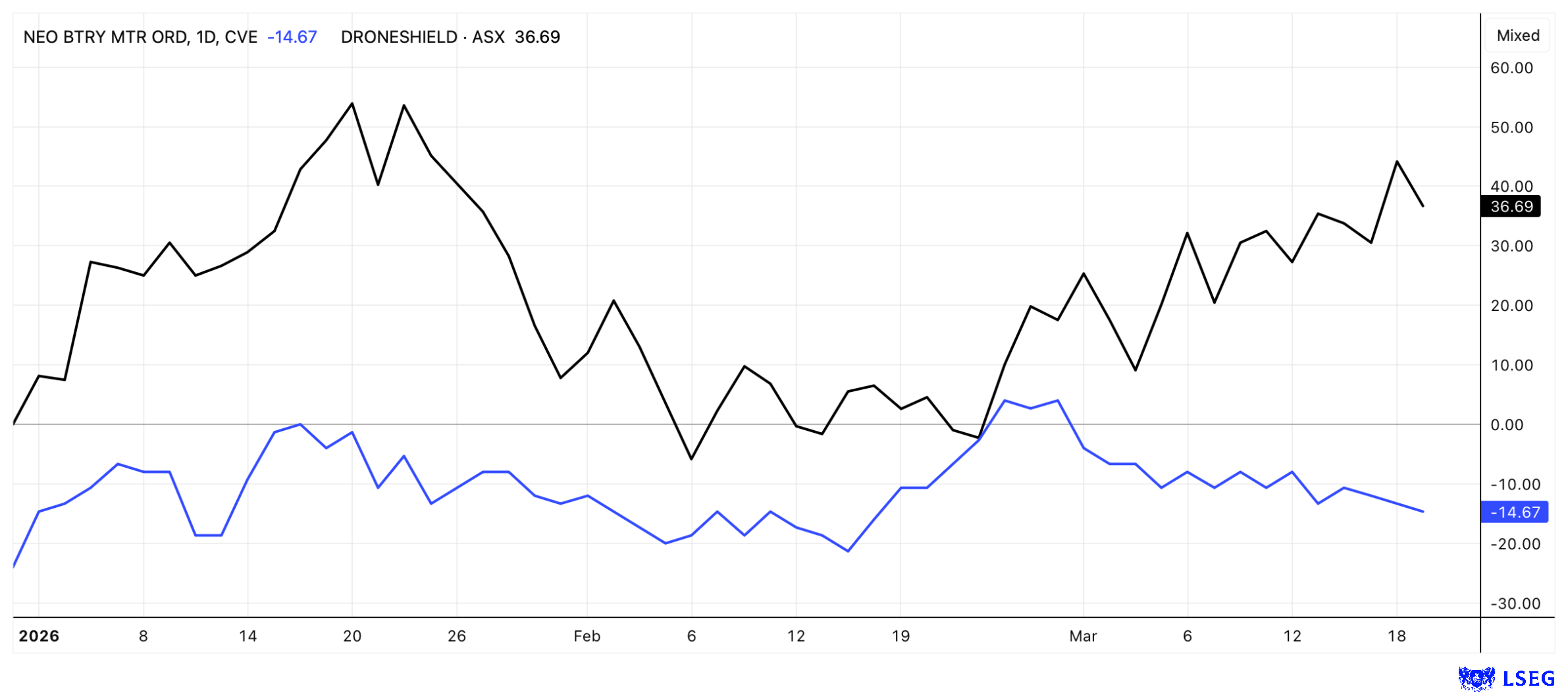
NEO shares have been trading sideways since the beginning of the year. It can really only be a matter of time before they break out to the upside. The current market capitalization stands at a manageable CAD 100 million. The company is consistently positioning itself as a winner in the booming drone and robotics market. The combination of proven performance superiority over comparable Chinese products, the development of its own production capacities, and a supply chain clearly tailored to Western requirements makes this a particularly compelling story.
Conflict of interest
Pursuant to §85 of the German Securities Trading Act (WpHG), we point out that Apaton Finance GmbH as well as partners, authors or employees of Apaton Finance GmbH (hereinafter referred to as "Relevant Persons") may hold shares or other financial instruments of the aforementioned companies in the future or may bet on rising or falling prices and thus a conflict of interest may arise in the future. The Relevant Persons reserve the right to buy or sell shares or other financial instruments of the Company at any time (hereinafter each a "Transaction"). Transactions may, under certain circumstances, influence the respective price of the shares or other financial instruments of the Company.
In addition, Apaton Finance GmbH is active in the context of the preparation and publication of the reporting in paid contractual relationships.
For this reason, there is a concrete conflict of interest.
The above information on existing conflicts of interest applies to all types and forms of publication used by Apaton Finance GmbH for publications on companies.
Risk notice
Apaton Finance GmbH offers editors, agencies and companies the opportunity to publish commentaries, interviews, summaries, news and the like on news.financial. These contents are exclusively for the information of the readers and do not represent any call to action or recommendations, neither explicitly nor implicitly they are to be understood as an assurance of possible price developments. The contents do not replace individual expert investment advice and do not constitute an offer to sell the discussed share(s) or other financial instruments, nor an invitation to buy or sell such.
The content is expressly not a financial analysis, but a journalistic or advertising text. Readers or users who make investment decisions or carry out transactions on the basis of the information provided here do so entirely at their own risk. No contractual relationship is established between Apaton Finance GmbH and its readers or the users of its offers, as our information only refers to the company and not to the investment decision of the reader or user.
The acquisition of financial instruments involves high risks, which can lead to the total loss of the invested capital. The information published by Apaton Finance GmbH and its authors is based on careful research. Nevertheless, no liability is assumed for financial losses or a content-related guarantee for the topicality, correctness, appropriateness and completeness of the content provided here. Please also note our Terms of use.