September 30th, 2026 | 11:05 CEST
The Next Big Thing: Quantum Computing! New Opportunities in Aqarios Quantum Technologies, D-Wave and IonQ?
The stock market loves the prospect of the next technological leap. Is quantum computing next in line? Quantum computers use the principles of quantum physics to solve certain highly complex tasks more efficiently than classical computers. The technology could dramatically transform industrial processes in medicine, energy, materials research, logistics and cybersecurity. Recently, Aqarios Quantum Technologies became the first pure-play quantum computing company to make its debut on the German stock exchange. The Munich-based company develops software for complex planning tasks and combines classical computing methods with quantum algorithms. Its latest move into the IBM ecosystem is drawing attention. The company also collaborates with numerous German blue-chip firms. IonQ has raised its revenue forecast following an acquisition, while D-Wave is benefiting from US government support. Although their business models differ, they share the common goal of turning quantum research into a scalable business. Which company will perform best in the coming months?
time to read: 4 minutes | Author: Carsten Mainitz
ISIN: AQARIOS QUANTUM TECHNOLOGIES AG | DE000A40UU44 , D-WAVE QUANTUM INC | US26740W1099 , IONQ INC | US46222L1089
Table of contents:
Author

Carsten Mainitz
The native Rhineland-Palatinate has been a passionate market participant for more than 25 years. After studying business administration in Mannheim, he worked as a journalist, in equity sales and many years in equity research.
Tag cloud
Shares cloud
Aqarios Quantum Technologies: A Pure Play from Germany
Since its stock market debut via a SPAC transaction in July, the company, as the first pure-play quantum computing stock, has brought a breath of fresh air to the German stock market. Its roots date back to 2021, when Aqarios was founded as a spin-off from Ludwig Maximilian University of Munich. Operations are consolidated in the wholly-owned subsidiary Aqarios GmbH.
At the heart of this is the Luna platform, which combines classical, AI-based, and quantum-based methods in a single interface. Customers can develop optimization applications, compare different approaches, and run them on various hardware. This approach reduces dependence on a single architecture. Thus, the business model combines software access and customer projects via tiered usage packages.
The company recently reported a notable success. The new quantum optimization software "Constrained Quantum Optimizer" is now available in the IBM Qiskit Functions Catalog and can be run directly on IBM quantum hardware via Qiskit. This gives Aqarios important access to the infrastructure of one of the leading quantum computing providers. Qiskit is considered one of the world's most widely used open-source frameworks for programming quantum computers. This lowers the technical barrier to entry and gives Aqarios additional access to developers and companies in the IBM ecosystem. Aqarios has been part of the IBM Quantum Network since 2024 and is now deepening its collaboration with the technology conglomerate.
There are also numerous connections to industry. Aqarios has projects with BASF, E.ON and MTU Aero Engines. As part of the QuCUN research consortium, the company collaborates with SAP, BASF and LMU Munich. A total of EUR 14.2 million in funding is available for this initiative.
The Munich-based company's strategic approach is promising, and the list of blue-chip names is impressive. However, the company is still in an early stage of development. Gross profit for the fiscal years 2023 through 2025 was just over EUR 1 million annually. Since this figure includes customer revenue and grants, neither this metric nor the resulting net income for the periods is particularly meaningful. At a current share price of around EUR 17, the German company is valued at approximately EUR 43 million. Compared to its competitors, that is not much.
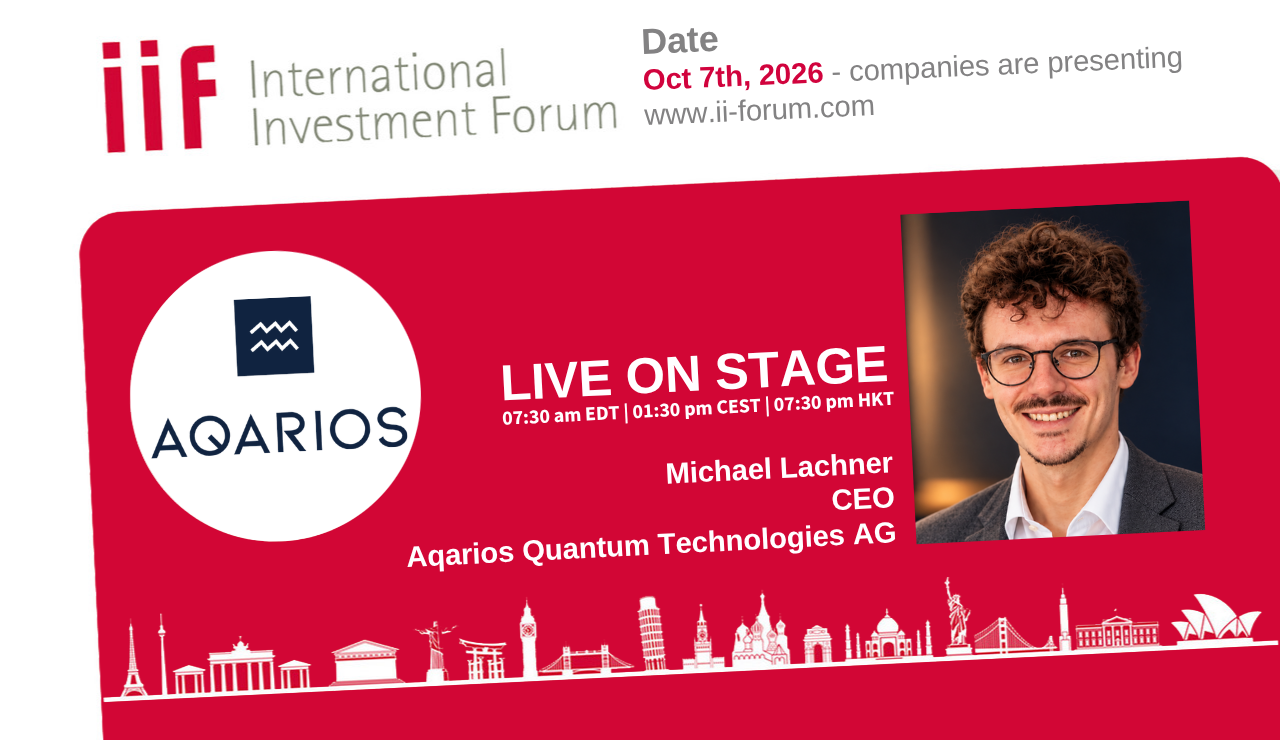
On October 7, CEO Michael Lachner will present the company and answer questions live at the virtual International Investment Forum (IIF). Participation is free. Register at www.ii-forum.com.
IonQ: Acquisitions Accelerate Growth
IonQ has a broad technological footprint. However, the focus is on quantum computers based on so-called trapped ions. In this approach, individual charged atoms are controlled using lasers and used as qubits. The approach is considered particularly precise and is expected to form the basis for high-performance quantum computers. IonQ develops universal quantum computers that, unlike specialized systems, can be used for a wide variety of different computations.
The US technology company offers access to its quantum computers via cloud platforms and develops the associated software, development tools and applications. Through partnerships with technology and cloud providers, IonQ integrates its systems into existing IT infrastructures, making them more accessible to customers. At the same time, the company is tapping into adjacent growth areas such as quantum networks, quantum sensing and quantum security. Its customers primarily include companies, research institutions and government agencies.
In the second quarter, revenue rose by a remarkable 287% to USD 80.1 million. As is typical for growth companies, the maxim "growth before profitability" applies here as well. During the period, the company reported an adjusted operating loss (EBITDA) of USD 120.3 million. Most recently, the company raised its revenue forecast for the current fiscal year to a target range of USD 450 to 460 million.
This figure now includes the semiconductor manufacturer SkyWater, which was acquired at the end of July. Strategically, IonQ is expanding its manufacturing capabilities and increasingly integrating its quantum computers into customers' existing IT and cloud systems. At a current share price of USD 45, the company is valued at USD 17.7 billion, or 39 times its projected 2026 revenue. Analysts have set an average price target of USD 67, representing a 50% upside.
D-Wave: Political Tailwind from the US
Canadian quantum computing specialist D-Wave focuses on complex optimization problems with its quantum annealing approach. The technology serves as a specialized tool for identifying particularly efficient solutions from a multitude of possible options. In addition to specialized annealing systems, D-Wave is now also developing universally programmable quantum computers.
D-Wave recently announced the signing of a letter of intent (LOI) under the US CHIPS and Science Act regarding access to up to USD 100 million in grants. In return, the US government is to receive a non-controlling minority stake in the company. Given the company's still-small revenue base, these sums are enormous.
In Q2, D-Wave generated USD 3.1 million in revenue and an operating loss (EBITDA) of USD 37.1 million. Nevertheless, order intake of USD 35.5 million reflects positive momentum. Shares are currently trading at USD 17, giving the company a market capitalization of just over USD 6 billion. On average, analysts believe the stock has the potential to double in value over the next 12 months.
Quantum computing offers significant disruptive potential. The race has only just begun. Aqarios is pursuing an interesting approach. Its integration into the ecosystem of market leader IBM creates visibility and additional application opportunities. Canadian specialist D-Wave is receiving support from the US government. IonQ is growing through acquisitions. It remains an exciting development.
Conflict of interest
Pursuant to §85 of the German Securities Trading Act (WpHG), we point out that Apaton Finance GmbH as well as partners, authors or employees of Apaton Finance GmbH (hereinafter referred to as "Relevant Persons") currently hold or hold shares or other financial instruments of the aforementioned companies and speculate on their price developments. In this respect, they intend to sell or acquire shares or other financial instruments of the companies (hereinafter each referred to as a "Transaction"). Transactions may thereby influence the respective price of the shares or other financial instruments of the Company.
In this respect, there is a concrete conflict of interest in the reporting on the companies.
In addition, Apaton Finance GmbH is active in the context of the preparation and publication of the reporting in paid contractual relationships.
For this reason, there is also a concrete conflict of interest.
The above information on existing conflicts of interest applies to all types and forms of publication used by Apaton Finance GmbH for publications on companies.
Risk notice
Apaton Finance GmbH offers editors, agencies and companies the opportunity to publish commentaries, interviews, summaries, news and the like on news.financial. These contents are exclusively for the information of the readers and do not represent any call to action or recommendations, neither explicitly nor implicitly they are to be understood as an assurance of possible price developments. The contents do not replace individual expert investment advice and do not constitute an offer to sell the discussed share(s) or other financial instruments, nor an invitation to buy or sell such.
The content is expressly not a financial analysis, but a journalistic or advertising text. Readers or users who make investment decisions or carry out transactions on the basis of the information provided here do so entirely at their own risk. No contractual relationship is established between Apaton Finance GmbH and its readers or the users of its offers, as our information only refers to the company and not to the investment decision of the reader or user.
The acquisition of financial instruments involves high risks, which can lead to the total loss of the invested capital. The information published by Apaton Finance GmbH and its authors is based on careful research. Nevertheless, no liability is assumed for financial losses or a content-related guarantee for the topicality, correctness, appropriateness and completeness of the content provided here. Please also note our Terms of use.