October 22nd, 2026 | 05:28 CEST
The Chancellor sees the Russian threat! Rearming with Rheinmetall, Hensoldt, Strategic Resources and TKMS
Federal Chancellor Friedrich Merz sees measures against the Russian threat as his top priority. Despite widespread concern, many German citizens would have preferred a more economically minded, progressive stance from the CDU. Yet the international defence industry can already celebrate the next upward wave, as the overall situation continues to guarantee robust growth. Finally, a chance to breathe a sigh of relief, as the spark had not really spread to the armaments sector since autumn 2025. But can the charts still be salvaged? Sector leader Rheinmetall has corrected more than 50% from its peak and has already had to backtrack operationally. Nevertheless, CEO Papperger repeatedly steps in as a share buyer, most recently at the end of September near the year's lows. Is this already the turning point? Time for an update on a closely watched sector.
time to read: 6 minutes | Author: André Will-Laudien
ISIN: Strategic Resources Inc | CA86277X4093 , RHEINMETALL AG | DE0007030009 , TKMS AG & CO KGAA | DE000TKMS001 , HENSOLDT AG INH | DE000HAG0005
Table of contents:
Author

André Will-Laudien
Born in Munich, he first studied economics and graduated in business administration at the Ludwig-Maximilians-University in 1995. As he was involved with the stock market at a very early stage, he now has more than 30 years of experience in the capital markets.
Tag cloud
Shares cloud
Rheinmetall: Can fear of Russia turn the tide?
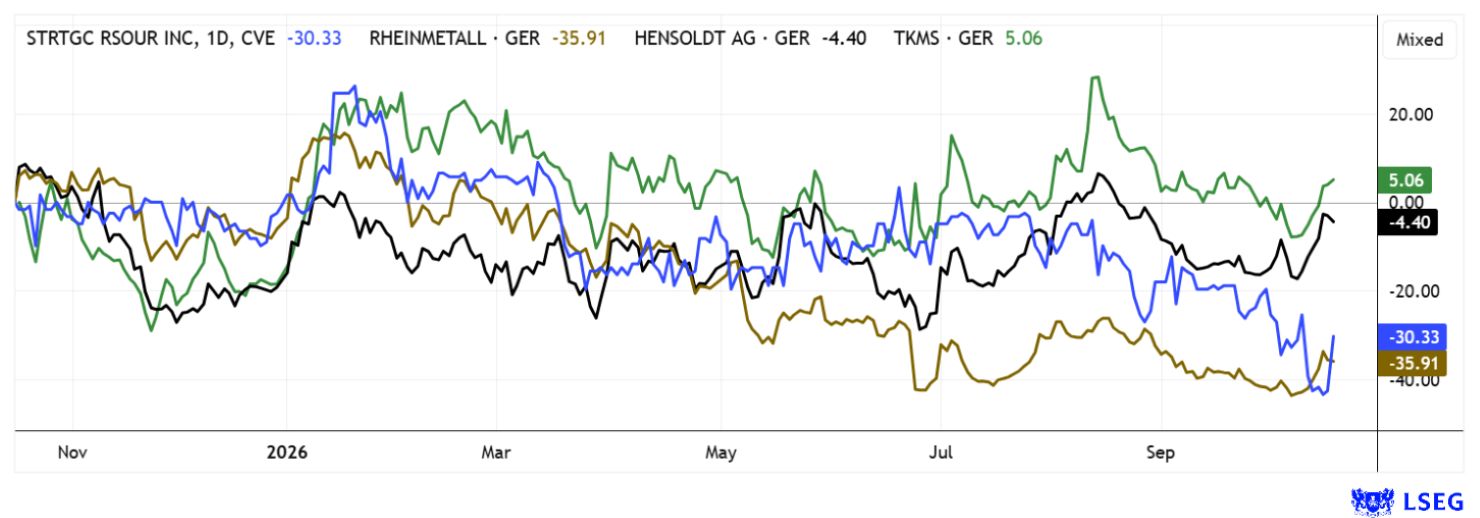
Düsseldorf-based defence group Rheinmetall suffered a painful share price slump after its historic all-time high of over EUR 2,000 in autumn 2025, with shares at times falling below EUR 1,000. Above all, the unexpected cancellation of the prestigious German frigate programme dealt a severe blow to investors' growth hopes. Amid this marked sector correction, persistent geopolitical tensions and the fundamental threat along NATO's eastern borders are now back in focus. With the example set at the highest level, persistent fears of Russia are driving a marked reassessment of the global security situation and forcing Western industrialised nations to permanently increase their defence budgets.
Rheinmetall's bulging order books in its tracked vehicles and large-calibre weapons divisions reflect the enormous backlog of demand from the Bundeswehr and allied armed forces. As at June 30, 2026, the backlog climbed to a record EUR 80.5 billion, up around 44% year on year. At the end of the 2025 financial year, the group recorded revenue of EUR 9.9 billion, with analysts expecting more than EUR 40 billion by 2030. However, doubts remain about whether CEO Papperger can also handle the high "run rate" in day-to-day operations. He appears convinced and continues to buy shares on a large scale, most recently at EUR 950. For 2027, the P/E ratio fell to 19.5 as a result of the correction, with the next quarterly results expected on November 5. Analysts on the LSEG platform put the new average 12-month price target at EUR 1,520. Well then!
Hensoldt: Modern satellite technology for Kyiv
Things are also looking up at Hensoldt. The Munich-based defence electronics specialist is strengthening its key strategic role in supporting Ukraine by supplying state-of-the-art space-based reconnaissance technology. As part of close cooperation, the company is providing the armed forces in Kyiv with high-resolution radar data that delivers precise situational pictures of the front lines even in extremely bad weather and complete darkness. This satellite technology enables the Ukrainian defence forces to conduct real-time reconnaissance of Russian troop movements and logistics infrastructure. Like its DAX peer Rheinmetall, Hensoldt is recording a historic rise in order intake to over EUR 10.3 billion, driven by the persistent threat along NATO's eastern borders. Investors battered by the sector are responding positively to the fundamental growth story, as Hensoldt's highly specialised technology products are regarded as an indispensable core of modern defence strategies. Compared with other industry players, Hensoldt's share price of just under EUR 86 is not far from its all-time high of EUR 103.20. However, the LSEG analysts' price target is only EUR 91. Fresh quarterly results will also be coming from Munich on November 5.
TKMS: Analysts increasingly positive
Following the brilliant naval coup against Rheinmetall, storm signals are flying at thyssenkrupp's naval subsidiary TKMS. The eight Meko A200AN frigates ordered are set for delivery in record time. The first ship is due to be completed by the end of 2029. After that, the shipyard intends to hand over another frigate to the Bundeswehr roughly every 9 months. The short construction period is possible because TKMS is not developing a completely new ship. The total order value is almost EUR 12 billion; in 2025, the former thyssenkrupp division generated just EUR 2.1 billion in revenue. The latest analyst upgrades are also record-breaking. Deutsche Bank, for example, rates the stock a Buy with a target of EUR 115, as does Bernstein, while mwb research presents an outlier on the upside at EUR 140. On average, the 9 assessments converge at EUR 107.90, representing a notable 27% upside from yesterday's price.
Strategic Resources: Nothing works without critical metals
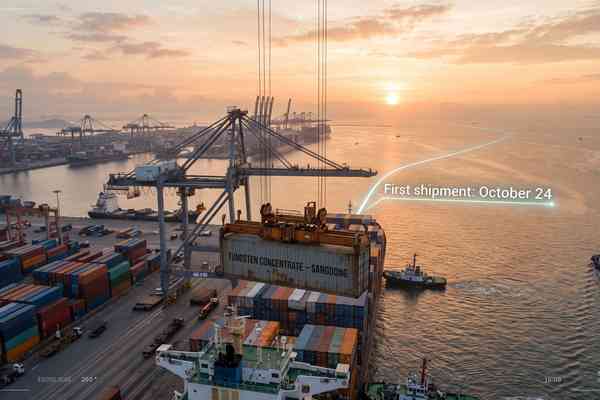
Anyone looking to invest in the defence sector should also keep an eye on the critical supply chains for strategic metals in the bigger picture. For what is often taken for granted can by no means be considered a given amid geopolitical conflicts. Fortunately, alliances within the Western community of nations are functioning, for example, between Europe and Canada. Companies based there recognise Europe's difficulty securing raw materials and are willing to make their products available to help remedy shortages. In August 2025, Germany and Canada agreed to deepen their bilateral raw-materials partnership to strengthen the resilience of their supply chains sustainably. The agreement aims to reduce dependence on China and ensure a secure supply of critical raw materials. The agreement creates closer links between German technology and Canadian mineral deposits, with Canada also investing hundreds of millions to expand port infrastructure and secure transport to Europe.
The Canadian company Strategic Resources is positioning itself as a Canadian challenger with ambitious growth plans. Rather than limiting itself to conventional ore mining, the company aims to refine iron, vanadium and titanium into high-quality industrial products, making Western supply chains less dependent on foreign raw material producers. The focus is on the BlackRock project in Québec, with around 127.8 million tonnes of ore reserves, whose iron-, vanadium-, and titanium-bearing magnetite offers an interesting combination of raw materials for several future markets. A pelletising plant with a target annual capacity of 4 million tonnes is planned at the deep-water port of Port Saguenay, intended to supply high-purity direct reduction pellets with an iron content of more than 67% for lower-emission steel production. With tighter climate requirements and the European Carbon Border Adjustment Mechanism (CBAM), such feedstocks are gaining importance as emissions-intensive production chains face increasing cost and competitive pressure. Support is coming from the US, where critical raw materials are becoming a greater focus of security and industrial policy and trade barriers and support measures could favour regional supply chains. Vanadium and titanium are on the US list of critical raw materials and are also being discussed in connection with defence applications and security of industrial supply.
IIF presenter Lyndsay Malchuk in conversation with CEO Sean Cleary about the upcoming construction of the extraction facility in Québec.
This creates a dual opportunity for Strategic Resources: the company could benefit from both demand for high-quality iron feedstock and a strategic reassessment of its accompanying metals. The Finnish Mustavaara project also serves as a technological door-opener, with its vanadium-rich magnetite concentrate selected for the FutSteel research project, whose participants include the University of Oulu and steel group SSAB. The initiative, which has EUR 17 million in funding, is investigating pathways to hydrogen-based, fossil-free steel production, thereby strengthening the industrial relevance of the raw materials portfolio, even though the selection does not yet guarantee subsequent offtake. In parallel, attention is turning to vanadium as a potential key component of stationary energy storage, as vanadium redox flow batteries can store large amounts of electricity and thereby balance fluctuating renewable energy feed-in. A letter of intent with Tyfast Energy aims to support the development of a North American vanadium battery value chain and could open additional long-term sales channels for the company.
The company's valuation appears ambitiously low at first glance. While the earlier feasibility study showed an after-tax net present value of around CAD 1.93 billion, Strategic Resources was recently trading at a market capitalisation of only around CAD 12 million. If CEO Sean Cleary succeeds in advancing BlackRock towards production while translating strategic demand for vanadium and high-quality iron into concrete partnerships and revenues, the small raw materials developer could become a significant component of North American security of supply. Extremely exciting!
Conclusion
As the tech correction now runs its course, the defence sector can welcome the reduced technical downward pressure. This gives investors room once again to ride the next upward wave that is beginning to emerge. Sector rotation is an indication of stretched valuations, so good diversification should generally be applied to smooth out uncontrollable volatility.
Conflict of interest
Pursuant to §85 of the German Securities Trading Act (WpHG), we point out that Apaton Finance GmbH as well as partners, authors or employees of Apaton Finance GmbH (hereinafter referred to as "Relevant Persons") currently hold or hold shares or other financial instruments of the aforementioned companies and speculate on their price developments. In this respect, they intend to sell or acquire shares or other financial instruments of the companies (hereinafter each referred to as a "Transaction"). Transactions may thereby influence the respective price of the shares or other financial instruments of the Company.
In this respect, there is a concrete conflict of interest in the reporting on the companies.
In addition, Apaton Finance GmbH is active in the context of the preparation and publication of the reporting in paid contractual relationships.
For this reason, there is also a concrete conflict of interest.
The above information on existing conflicts of interest applies to all types and forms of publication used by Apaton Finance GmbH for publications on companies.
Risk notice
Apaton Finance GmbH offers editors, agencies and companies the opportunity to publish commentaries, interviews, summaries, news and the like on news.financial. These contents are exclusively for the information of the readers and do not represent any call to action or recommendations, neither explicitly nor implicitly they are to be understood as an assurance of possible price developments. The contents do not replace individual expert investment advice and do not constitute an offer to sell the discussed share(s) or other financial instruments, nor an invitation to buy or sell such.
The content is expressly not a financial analysis, but a journalistic or advertising text. Readers or users who make investment decisions or carry out transactions on the basis of the information provided here do so entirely at their own risk. No contractual relationship is established between Apaton Finance GmbH and its readers or the users of its offers, as our information only refers to the company and not to the investment decision of the reader or user.
The acquisition of financial instruments involves high risks, which can lead to the total loss of the invested capital. The information published by Apaton Finance GmbH and its authors is based on careful research. Nevertheless, no liability is assumed for financial losses or a content-related guarantee for the topicality, correctness, appropriateness and completeness of the content provided here. Please also note our Terms of use.