April 17th, 2026 | 07:15 CEST
The Antimony Crisis: Antimony Resources at the Heart of Western Supply Security – How Lockheed Martin and Rio Tinto Are Responding
Created and published on behalf of Antimony Resources Corp.
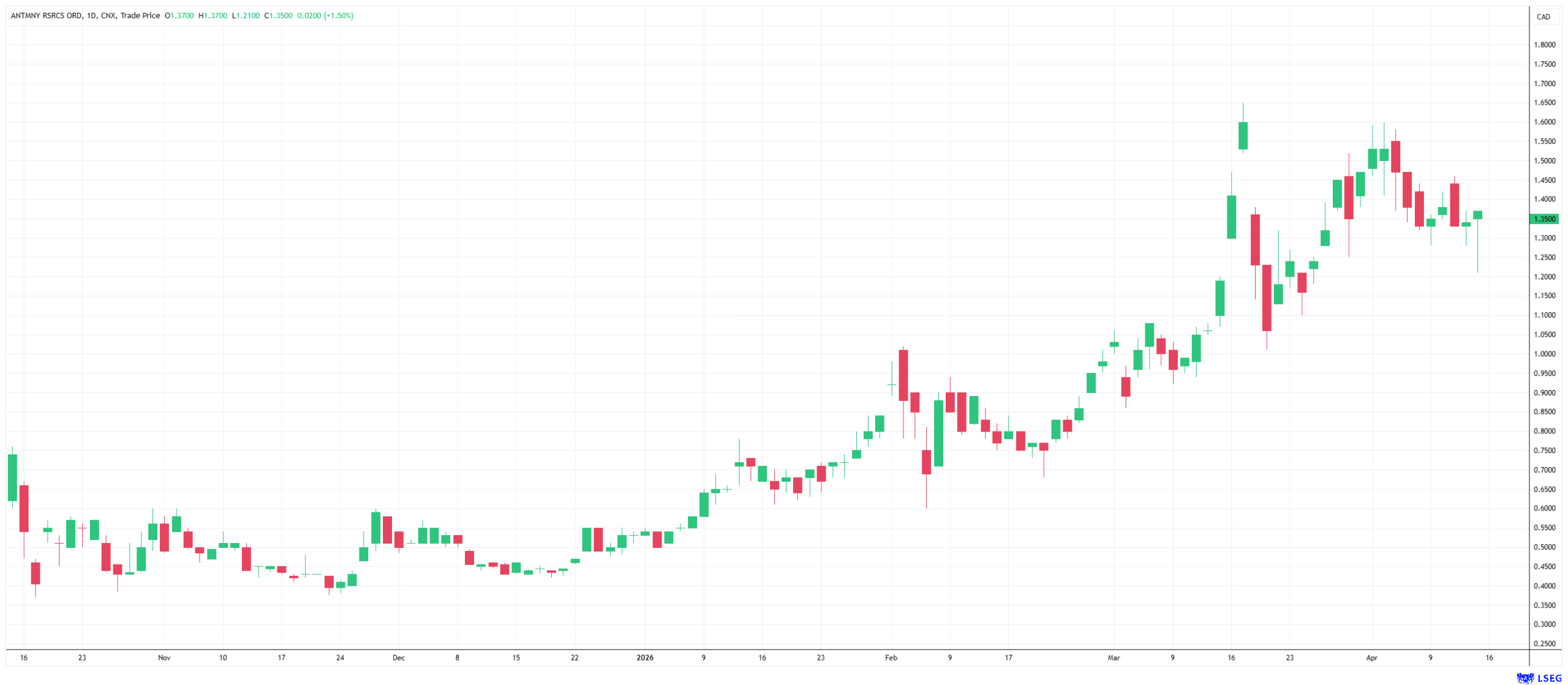
Shiny, silvery antimony has become a central element of the Western security architecture. China's export restrictions, which culminated in a targeted export ban on the US in 2024, forced Western supply chains to realign. Securing domestic supplies has thus become imperative, overshadowing short-term cost considerations. While defense giants like Lockheed Martin are desperately searching for reliable sources to maintain production of modern defense systems and mining companies like Rio Tinto are investing in processing capacity, specialized antimony companies are coming into focus. Antimony Resources is advancing the development of the Bald Hill project in New Brunswick, which is considered one of the most significant future antimony sources in North America. The company offers investors direct access to a market where small companies are becoming indispensable partners to industry, presenting significant opportunities for investors.
time to read: 3 minutes | Author: Nico Popp
ISIN: ANTIMONY RESOURCES CORP | CA0369271014 | CSE: ATMY , OTCQB: ATMYF , LOCKHEED MARTIN DL 1 | US5398301094 , RIO TINTO PLC LS-_10 | GB0007188757
Table of contents:
Author

Nico Popp
At home in Southern Germany, the passionate stock exchange expert has been accompanying the capital markets for about twenty years. With a soft spot for smaller companies, he is constantly on the lookout for exciting investment stories.
Tag cloud
Shares cloud
Structural Supply Shortage in Antimony
The scarcity of antimony is the direct result of China's long-term industrial policy strategy, which has shifted its dominance from raw material extraction to highly refined downstream segments. With the introduction of a comprehensive licensing system in 2024, export volumes of antimony-containing compounds fell significantly. The oligopolistic market structure with only a few players and the low price elasticity of this specialty metal subsequently led to sharply rising market prices. While antimony was still trading at around USD 5,900 per ton in early 2024, prices surged to a record high of nearly USD 60,000 in 2025 before consolidating at around USD 40,000 today.
According to analyses by the International Energy Agency (IEA), this situation is driven by a deficit fueled by exploding demand in the photovoltaic sector for solar glass and the strategic buildup of government reserves. To address this tight supply situation, the US government has launched Project Vault with USD 12 billion in financing from the Export-Import Bank. The goal is to create a national reserve for critical minerals. This national effort is elevating antimony from a niche specialty metal to a strategically relevant asset class.
Antimony Resources Stands Out With Its Bald Hill Project
Amid this market shift, Antimony Resources' Bald Hill project in the Canadian province of New Brunswick has positioned itself as one of the most promising properties in North America. The project boasts exceptionally high ore grades, which set it apart from most other global deposits. Recent drilling has confirmed massive mineralization extending over a strike length of 700 m. While average North American projects typically exhibit grades of less than 1% antimony, Antimony Resources' geologists are demonstrating a completely different scale. In the core zones, geologists encountered sections yielding grades of 11.7% Sb over 4.51 m and 14.91% Sb over 3.00 m. An independent technical report from last October estimates the initial potential of the main zone at around 2.7 million tons of ore, corresponding to a contained grade of over 80,000 tons of antimony.
Antimony Urgently Needed Worldwide
The urgency to bring projects like Bald Hill into production as quickly as possible is particularly evident in the Western defense industry. For companies like Lockheed Martin, antimony is an irreplaceable element used as a hardening agent in lead alloys for ammunition and in fuses. As current figures show, the arms industry is booming. Lockheed Martin has also recently significantly increased the number of guided missiles it produces. Furthermore, antimony-based semiconductors are at the heart of state-of-the-art infrared sensors used in advanced guidance systems. A contract signed by Lockheed in January 2026, worth USD 328.5 million to equip the Taiwanese Air Force, underscores this need. Since these highly sensitive applications require military-certified materials, direct access to reliable, non-Chinese primary sources has become a matter of survival for the defense giant.
While the defense industry is fueling demand, major mining companies are responding with a strategic realignment. As industry observers note, Rio Tinto is currently undergoing a transformation toward metals that are critical for the energy transition and national security. Just recently, Rio Tinto pushed through the sale of its California boron division for an estimated USD 2 billion to free up capital for the expansion of critical elements. At the same time, the mining giant is investing heavily in innovative extraction technologies such as the bio-hydrometallurgical Nuton process. By utilizing such resource-efficient technologies, Rio Tinto aims to exploit domestic deposits more efficiently and thus make a significant contribution to the West's strategic autonomy.
Antimony Resources Perfectly Positioned For The Long Term
Taken together, these developments are creating historically unprecedented market dynamics in the antimony sector. China's export bans have exposed weaknesses in supply chains and triggered a backlash—supply security is a top priority in both business and politics. This environment offers significant opportunities for investors. Companies like Antimony Resources are benefiting from this geopolitical tailwind. Given the first-class geology of the Bald Hill project and the desperate search by major industrial and defense conglomerates for secure supply sources, the company is emerging as an indispensable key player in the new resource architecture.
Watch YouTube videoConflict of interest
Pursuant to §85 of the German Securities Trading Act (WpHG), we point out that Apaton Finance GmbH as well as partners, authors or employees of Apaton Finance GmbH (hereinafter referred to as "Relevant Persons") currently hold or hold shares or other financial instruments of the aforementioned companies and speculate on their price developments. In this respect, they intend to sell or acquire shares or other financial instruments of the companies (hereinafter each referred to as a "Transaction"). Transactions may thereby influence the respective price of the shares or other financial instruments of the Company.
In this respect, there is a concrete conflict of interest in the reporting on the companies.
In addition, Apaton Finance GmbH is active in the context of the preparation and publication of the reporting in paid contractual relationships.
For this reason, there is also a concrete conflict of interest.
The above information on existing conflicts of interest applies to all types and forms of publication used by Apaton Finance GmbH for publications on companies.
Risk notice
Apaton Finance GmbH offers editors, agencies and companies the opportunity to publish commentaries, interviews, summaries, news and the like on news.financial. These contents are exclusively for the information of the readers and do not represent any call to action or recommendations, neither explicitly nor implicitly they are to be understood as an assurance of possible price developments. The contents do not replace individual expert investment advice and do not constitute an offer to sell the discussed share(s) or other financial instruments, nor an invitation to buy or sell such.
The content is expressly not a financial analysis, but a journalistic or advertising text. Readers or users who make investment decisions or carry out transactions on the basis of the information provided here do so entirely at their own risk. No contractual relationship is established between Apaton Finance GmbH and its readers or the users of its offers, as our information only refers to the company and not to the investment decision of the reader or user.
The acquisition of financial instruments involves high risks, which can lead to the total loss of the invested capital. The information published by Apaton Finance GmbH and its authors is based on careful research. Nevertheless, no liability is assumed for financial losses or a content-related guarantee for the topicality, correctness, appropriateness and completeness of the content provided here. Please also note our Terms of use.