August 14th, 2026 | 07:25 CEST
Sustainable Dividend Kings: Schneider Electric, Munich Re, and RE Royalties
Wars, inflation, and a faltering industrial sector—many investors must have rubbed their eyes in disbelief at the DAX's recent record-breaking run. But instead of pulling all their chips off the table and selling stocks, it might make sense to invest more defensively in uncertain times. As a rule, dividends already provide a safety cushion against price fluctuations. When companies also have a strong ESG profile, investors can often sleep even more soundly. We examine three companies and highlight their opportunities.
time to read: 3 minutes | Author: Nico Popp
ISIN: RE ROYALTIES LTD | CA75527Q1081 | TSXV: RE , OTCQX: RROYF , SCHNEIDER ELEC. INH. EO 4 | FR0000121972 , MUENCH.RUECKVERS.VNA O.N. | DE0008430026
Table of contents:
Author

Nico Popp
At home in Southern Germany, the passionate stock exchange expert has been accompanying the capital markets for about twenty years. With a soft spot for smaller companies, he is constantly on the lookout for exciting investment stories.
Tag cloud
Shares cloud
Schneider Electric Focuses on Efficiency and Steady Growth
At French automation specialist Schneider Electric, the transformation of industry is in full swing. The company serves key markets such as data centers, industrial facilities, and power grids with systems designed to boost digital efficiency. For the 2025 fiscal year, Schneider Electric projected total revenue of EUR 40.15 billion, with net income of EUR 4.16 billion and an operating margin of 15.71%, according to Hargreaves Lansdown. According to consensus forecasts (Hargreaves Lansdown), earnings per share are expected to climb from EUR 8.02 in 2024 to EUR 8.27 in 2025 and on to EUR 10.51 in the current fiscal year 2026. The dividend policy is also impressive—Schneider consistently pays out around 48-50% to shareholders, which, given improved business performance, supports a dividend increase to EUR 4.20 per share for 2025/26. In addition to strong financial results, the Schneider Sustainability Impact program also provides peace of mind. Thanks to the technologies provided, Schneider's customers have cumulatively reduced CO₂ emissions by 862 million metric tons since 2021, while the company's 1,000 most important suppliers have cut their operational emissions by 56%. Rating agencies are taking notice: Sustainalytics ranks Schneider Electric's ESG risk at 7.1, placing the company in the highest possible category.
Munich Re is fully leveraging its strengths
Munich Re is showing similarly robust operational performance. Its business model combines reinsurance activities with the ERGO Group's primary insurance lines and is based on smart pricing for complex risks. Following a record net profit of EUR 6.1 billion in fiscal year 2025, Munich Re generated a net profit of EUR 3.9 billion in the first half of 2026, with a return on equity of 23%. With Solvency II ratios of 298% at the end of 2025 and 304% in the second quarter of 2026, Munich Re's capital buffer is well above regulatory requirements. The Annual General Meeting approved an increase in the dividend for fiscal year 2025 from EUR 20.00 to EUR 24.00 per share, with management aiming for a total payout ratio of over 80% as part of the "Ambition 2030" program. Munich Re is also considered robust because the company realistically assesses climate risks. The Bavarian firm relies on proprietary climate models to factor in early-stage changes in loss frequencies resulting from extreme weather events into premium calculations. In addition, ESG criteria are incorporated into asset allocation, which consistently earns the company high rankings in ESG ratings.
RE Royalties: Sustainable Energy Expert Pays Generous Dividends
The Canadian financing specialist RE Royalties is taking a unique approach in the renewable energy sector. The company provides capital to developers of solar, wind, hydroelectric, energy storage, and biogas facilities and, in return, secures revenue-based license fees in the form of royalties. RE Royalties' portfolio comprises over 100 licensing rights designed to mitigate direct construction and operational risks by providing contractually fixed gross revenues from power purchase agreements. With a market capitalization of approximately CAD 15 million, RE Royalties must be considered a small-cap company. Unlike Munich Re, for example, RE Royalties is far less able to weather operational difficulties. This is likely one of the reasons the company has made several adjustments in recent quarters.
With a market capitalization of around CAD 15 million, RE Royalties is considered a small-cap company. Unlike a company such as Munich Re, RE Royalties has far less room to absorb operational difficulties. This may also explain why the company has made several adjustments to its business in recent quarters.
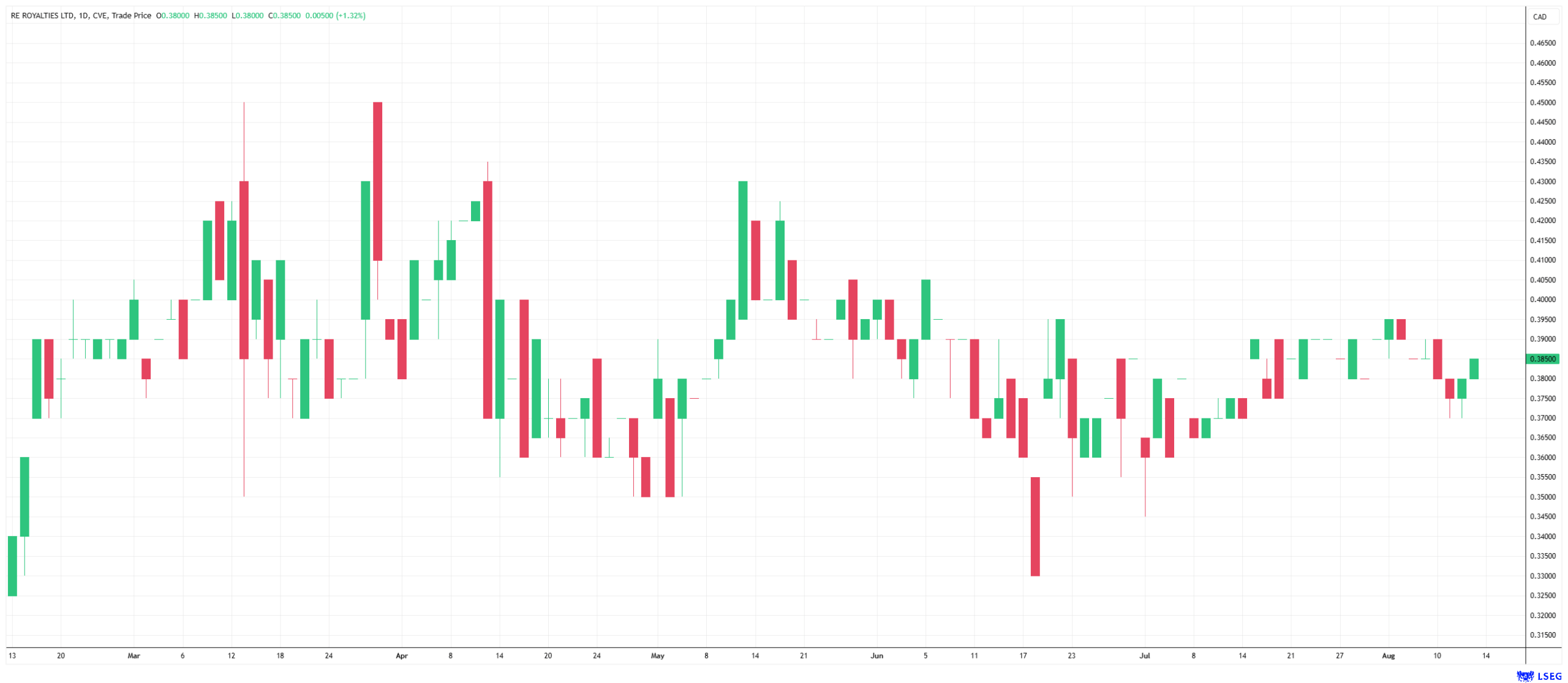
To become more resilient and be more flexible in capitalizing on operational opportunities, management adjusted its dividend policy. For years, RE Royalties maintained a quarterly dividend of CAD 0.01 per share, which, when share prices were falling, led to dividend yields that at times exceeded 10%. Since these distributions were not always covered by free cash flow, the company decided to adjust: RE Royalties shifted its distribution policy from quarterly payments to an annual distribution and explicitly prioritized reinvestment in new projects. While this realignment represents a minor setback for dividend hunters, it is likely to provide the company with long-term stability and operational flexibility.
RE Royalties: What Is the Upside?
It is well known that RE Royalties possesses proven expertise in renewable energy projects across various regions of the world. Despite the large number of successful projects, the company has so far been unable to achieve strong growth or attain a high market capitalization. For this reason, among others, the company commissioned PricewaterhouseCoopers Corporate Finance some time ago to identify ways to unlock potential within its otherwise successful business model—management did not even rule out a sale. Since many banks deliberately avoid getting involved in smaller renewable energy projects, there should be a market for RE Royalties. This is all the more true given its track record of more than 100 royalties. RE Royalties' stock remains exciting despite the new dividend policy—a breakthrough is in the air.
Watch YouTube videoConflict of interest
Pursuant to §85 of the German Securities Trading Act (WpHG), we point out that Apaton Finance GmbH as well as partners, authors or employees of Apaton Finance GmbH (hereinafter referred to as "Relevant Persons") may hold shares or other financial instruments of the aforementioned companies in the future or may bet on rising or falling prices and thus a conflict of interest may arise in the future. The Relevant Persons reserve the right to buy or sell shares or other financial instruments of the Company at any time (hereinafter each a "Transaction"). Transactions may, under certain circumstances, influence the respective price of the shares or other financial instruments of the Company.
In addition, Apaton Finance GmbH is active in the context of the preparation and publication of the reporting in paid contractual relationships.
For this reason, there is a concrete conflict of interest.
The above information on existing conflicts of interest applies to all types and forms of publication used by Apaton Finance GmbH for publications on companies.
Risk notice
Apaton Finance GmbH offers editors, agencies and companies the opportunity to publish commentaries, interviews, summaries, news and the like on news.financial. These contents are exclusively for the information of the readers and do not represent any call to action or recommendations, neither explicitly nor implicitly they are to be understood as an assurance of possible price developments. The contents do not replace individual expert investment advice and do not constitute an offer to sell the discussed share(s) or other financial instruments, nor an invitation to buy or sell such.
The content is expressly not a financial analysis, but a journalistic or advertising text. Readers or users who make investment decisions or carry out transactions on the basis of the information provided here do so entirely at their own risk. No contractual relationship is established between Apaton Finance GmbH and its readers or the users of its offers, as our information only refers to the company and not to the investment decision of the reader or user.
The acquisition of financial instruments involves high risks, which can lead to the total loss of the invested capital. The information published by Apaton Finance GmbH and its authors is based on careful research. Nevertheless, no liability is assumed for financial losses or a content-related guarantee for the topicality, correctness, appropriateness and completeness of the content provided here. Please also note our Terms of use.