September 15th, 2026 | 07:35 CEST
Power Metallic Mines, Oracle, and Adobe: Three Interesting Stocks Poised for a Revaluation?
Copper and precious metals lie dormant beneath Québec's soil, billion-dollar contracts are piling up in Oracle's order books, and Adobe is earning handsomely despite AI concerns. Yet doubts prevail on the stock market. That is exactly what makes these three stocks so interesting. Canadian explorer Power Metallic Mines has significant upside potential: the first resource estimate for the Lion Zone adds substance to hopes of a new mine. Analysts believe this hot stock could more than double in value. With Oracle and Adobe as well, investors are wondering whether the market is correctly identifying the risks or underestimating the opportunities. Fresh figures and news may provide new reasons to buy. We are taking a closer look at this trio in our stock review.
time to read: 11 minutes | Author: Lars Winter
ISIN: POWER METALLIC MINES INC. | CA73929R1055 | TSXV: PNPN , OTCBB: PNPNF , ORACLE CORP. DL-_01 | US68389X1054 , ADOBE INC. | US00724F1012
Table of contents:
Author

Lars Winter
A native of North Hesse, he has over 25 years of experience in financial journalism and active portfolio management and is regarded as a proven expert on German small-cap stocks and special situations.
After studying law at the University of Göttingen with a focus on banking and capital markets law, he began his career in Frankfurt's financial scene at the turn of the millennium. As a stock market and business journalist, the passionate amateur golfer wrote for leading investment newsletters, financial newspapers, and business magazines, including PLATOW Börse, Capital Depesche, BÖRSE ONLINE, Capital, and the Financial Times Deutschland.
Tag cloud
Shares cloud
Power Metallic Mines: On the Trail of Lion and Tiger
The world is building out power grids, data centres, and electric vehicles. This requires metals of all kinds. But while billions are flowing into electrification and the expansion of artificial intelligence, the supply of raw materials cannot be ramped up at the push of a button. New mines take years to develop, permits are a drawn-out process, and promising deposits in politically stable countries are highly sought after. This makes copper, nickel, platinum, palladium, and other strategic metals an exciting stock market theme. Whoever develops the right deposits could benefit significantly from the next supply shortage. This marks a turning point for companies searching today for tomorrow's supplies.
Among them is Power Metallic Mines. The Canadian explorer is not yet producing any metals. However, it is working on a project that could fulfill several key needs of Western industrial customers at once: a broad mix of raw materials, a reliable location, and access to North American supply chains. At the centre of this is the Nisk Project in the James Bay region of Québec.
Québec combines political stability and mining expertise with infrastructure and hydroelectric power. This combination is attractive to Western industrial conglomerates seeking to diversify their raw material supply. After all, a promising deposit alone is not enough; the metals must also be extractable and deliverable under reliable conditions. In addition to copper, the area contains nickel, platinum, palladium, gold, and silver. Nisk, Lion, and Tiger are the names of the zones that have been the focus of attention so far.
On September 8, the Canadian company released its first resource estimate for Lion. The zone is part of the Nisk project in Québec, in which Power Metallic Mines holds an 80% stake. The Lion resource, as determined by SGS Canada, comprises 4.145 million metric tonnes in the "indicated" category with a 3.86% copper equivalent grade. An additional 601,000 metric tonnes with a grade of 4.01% are classified as "inferred". This means that more than 85% falls into the geologically better-supported category. The pure copper content is 1.68%. Palladium, platinum, gold, and silver provide additional value, which is converted to copper equivalent based on established prices and yield assumptions. The figures refer to the entire project, not just Power Metallic's share.
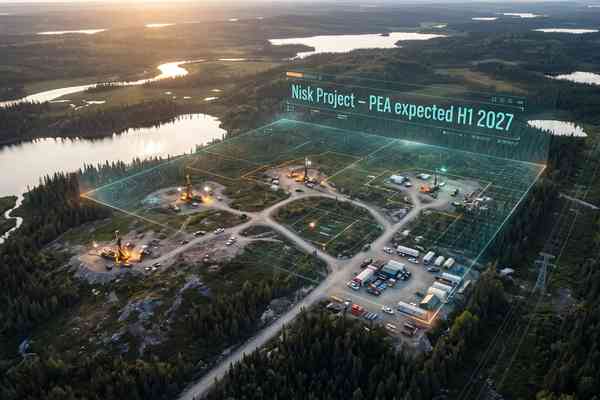
A preliminary economic assessment (PEA) is targeted for the first half of 2027. It is intended to examine a potential open-pit mine followed by underground mining and to quantify investments, costs, and earnings potential. A resource alone does not guarantee profitable mining.
A positive development comes from the lab: two circuit tests conducted by SGS yielded copper recoveries of more than 98% each. The tests produced concentrates with over 25% copper, which also contain precious metals. The lab results must be confirmed in industrial-scale operations. A year-round road and the Albanel substation are located about 9 km from Lion. The infrastructure facilitates development but does not replace an approved power connection.
The metals are present in Québec as sulfide ores. From a processing standpoint, this is more attractive than many laterite ores, from which nickel is extracted using high amounts of energy and chemicals. Add to this its proximity to infrastructure and affordable hydroelectric power from Hydro-Québec. Should Nisk indeed become a mine, the project would thus have an environmental advantage that matters in today's commodities market. Major industrial customers want more than just metal. They want traceable supply chains, stable sources, and the lowest possible carbon footprint.
Management is picking up the pace. More than 1,000 m of drilling is planned for the coming months. In doing so, Power Metallic Mines relies not only on traditional geology but also on modern geophysical methods. Superconducting quantum magnetometers are designed to detect even the faintest magnetic signals. Added to this is seismic environmental tomography, which uses the Earth's natural background noise to map subsurface structures. Behind these complex terms is a simple goal: to pinpoint promising drill targets more precisely and improve the search at depth.
Meanwhile, 5 drilling rigs are in operation. Results from the summer program are expected in the coming weeks. The potential extends far beyond individual zones: approximately 330 km² and about 50 km of promising basin margins offer ample room for further discoveries.
In June, investor funding totalling over CAD 28 million poured into the company's coffers. The fresh capital gives the company room to grow and expand its operations. With Robert Friedland, Rob McEwen, and Eric Sprott now on the shareholder list, the company includes several well-known commodity investors.
The stock market is likely to pay particular attention to Eric Sprott. The well-known Canadian commodity investor contributed CAD 2 million through his investment company and acquired 1.6 million shares at CAD 1.25 each. Sprott's involvement is no substitute for successful drilling. However, it draws attention to the explorer and signals confidence. After all, especially in this early stage of development, the ability to finance further exploration is just as important as the quality of the project.
Power Metallic Mines thus combines several key ingredients for an exciting exploration story: a sought-after mix of metals, its location in Québec, impressive drill results, and fresh capital. Power Metallic Mines' stock performance also becomes interesting when looking at its market capitalization. Trading at CAD 1.18, it is valued at approximately CAD 308 million on the stock market. Currently, four analysts cover the stock, all of whom recommend buying; the average price target is CAD 2.68, about 127% above the current share price. The experts at Hannam & Partners recently raised their target by 13% to CAD 2.70 following the resource estimate.
The current share price has reflected this optimism only to a limited extent. Since the start of the year, the stock is down about 6%, and since the start of the month, it has fallen about 18%. The market apparently wants to see more. If Lion continues to grow and the mining concept proves convincing, the valuation gap could narrow. The stock remains speculative and is dependent on drilling results, metal prices, and capital market sentiment. But the fundamentals are sound and could still deliver significant price gains for bold investors if positive news emerges in the coming months.
Oracle: The AI Boom Comes at a Price
The US corporation Oracle is one of the world's leading providers of enterprise software, database solutions, and cloud infrastructure. In recent years, the company has consistently expanded its business model from traditional on-premises solutions to cloud-based offerings. Key growth drivers include Oracle Cloud Infrastructure and the Fusion and NetSuite applications. A look at the latest figures also shows that Oracle is far from being a stale database provider. Oracle is growing rapidly. In the first quarter of 2026/27, revenue rose by 30% to USD 19.3 billion. Adjusted earnings per share also increased by 30% to USD 1.92, significantly exceeding analysts' expectations of USD 1.74.
The company is ramping up its artificial intelligence business in a big way. Cloud infrastructure revenue surged by as much as 121% to USD 7.4 billion. The entire cloud business already contributed USD 11.61 billion to the company's total revenue—up 62%. Oracle is increasingly earning its revenue from the computing power that the AI boom is devouring.
Contractually secured, unrecognised revenue is a major source of optimism. These so-called remaining performance obligations now total a staggering USD 664 billion. In the most recent quarter alone, new AI cloud contracts worth more than USD 30 billion were added. However, this volume is spread out over future fiscal years. A full order backlog does not yet equate to a full cash reserve. Oracle must provide the promised computing power and then execute the contracts profitably.
Management remains confident, however. The company continues to target at least USD 90 billion in revenue for the current fiscal year. The forecast for adjusted earnings per share has been raised to at least USD 8.10. Consolidated revenue is expected to grow by another 30 to 34% as early as the second quarter. These are growth rates one would hardly have expected from an established software company of this magnitude.
However, the transition to becoming a provider of massive computing power comes with a catch: before the billions can reliably flow back in, they must first be spent. The cost of this growth is equally impressive. In the first quarter alone, investments totalled around USD 28 billion. But customer prepayments of about USD 11.36 billion helped finance the expansion. Free cash flow, with outflows of USD 5.4 billion, was significantly better than the USD 9.56 billion in outflows analysts had feared.
For the full year, expenditures of USD 90 to USD 95 billion are expected. Free cash flow is suffering, while financing needs are rising. Added to this is the importance of major customers such as OpenAI. Long-term contracts provide planning certainty, but focusing on just a few customers also increases dependence. Many new customers pay in advance or provide their own hardware. Nevertheless, analyst estimates put current financial debt on the balance sheet at about USD 125 billion.
Skepticism persists on the stock market. Since the start of the year, the stock has lost nearly 23% of its value. Based on the adjusted annual forecast, the P/E ratio stands at around 18.6. Of the 43 analysts currently covering the stock, 35 recommend "Buy", 7 recommend "Hold", and 1 recommends "Sell". The median price target of USD 247.53 implies a potential upside of just under 65%. Larry Ellison provided additional talking points over the weekend. The co-founder withdrew a plan to sell up to 50 million shares, which would have amounted to approximately USD 7.5 billion. This withdrawal eliminates a potential supply glut.
For investors, Oracle remains an exciting but challenging AI bet. The latest figures show that the enormous demand is increasingly translating into revenue and profit. The key question now is how much of that will remain in the company's coffers after the data centre expansion. If this transition is successful, the stock has plenty of upside potential. Until then, investors should keep a close eye not only on growth rates but, above all, on capital discipline. After all, even in the AI era, the same rule applies: in the long run, what matters is what is left after the big investment spree.
Adobe: Big Profits, Little Confidence
Record revenue, rising profits, and a higher full-year forecast: Adobe has essentially delivered everything investors want to hear. Yet the stock once again fell on the latest figures. The reason runs deeper than the usual disappointment over a few million dollars in the outlook. The market doubts whether the top dog in creative software can defend its position in the AI era. For investors, this raises an intriguing question: is a business model being rightly reevaluated, or is a still-profitable company being prematurely written off?
Operational performance initially argues against doomsday scenarios. In the third quarter of fiscal year 2026, revenue rose 13% to USD 6.76 billion. Bottom line, Adobe earned USD 1.83 billion. For the full year, management raised its targets to approximately USD 26.58 billion to USD 26.63 billion in revenue and adjusted earnings of USD 24.45 to USD 24.50 per share. Adobe is thus far from being a company whose business is already collapsing.
However, as is well known, the stock market trades on the future. And things are looking less rosy there. Competitors like Canva and Figma are increasing competitive pressure. As it becomes increasingly easy to create images, designs, and advertising graphics using AI, consumers' willingness to pay for established creative software is inevitably being put to the test.
The outlook for the final quarter did little to dispel these concerns. Adobe expects revenue of USD 6.8 to USD 6.85 billion. The midpoint is slightly below analysts' estimate of USD 6.85 billion. A small difference, but one that, given the current nervous market sentiment, is enough to fuel new doubts.
Yet Adobe's own AI push is definitely having an impact. Annualized recurring revenue from the offerings labelled "AI-first" grew by more than 150% compared to the previous year. That is an encouraging sign. However, it does not yet answer the crucial question of how significantly these offerings can accelerate the growth of the entire group in the long term. Source: Barron's
The enormous reach offers potential. Adobe now reports 1 billion monthly active users. For its creative freemium offerings, which allow users to get started for free, the user base climbed by more than 70% to over 100 million. This could become a major distribution channel. But at some point, free usage must turn into a paid subscription. Reach alone does not pay the bills.
From our perspective, Adobe therefore deserves a nuanced assessment. The numbers show a growing, highly profitable company. At the same time, it would be too easy to dismiss the competition from AI as nothing more than a market myth. The key lies in converting new users into paying customers and retaining existing customers with better tools. If this succeeds, today's skepticism could prove exaggerated. For a sustainable share price recovery, Adobe needs, above all, proof that its own AI push is also tangibly driving the business forward.
The valuation offers a certain buffer for this. The analyst consensus puts the P/E ratio for the current year at only around 10.3. For 2027, analysts expect a P/E ratio of about 9. Nevertheless, they are not euphoric. There are currently 12 "Buy" recommendations, compared to 22 "Hold" and 5 "Sell" recommendations. The median price target of USD 278.75 is only about 11% above the current price. The bottom line is that Adobe remains a bet on undervalued earnings potential despite AI competition.
Conclusion: Three Opportunities with Different Hurdles
Power Metallic offers geological potential, Oracle offers enormous growth, and Adobe offers low price-to-earnings (P/E) ratios along with buyback potential. The greatest opportunities arise when the companies dispel the market's doubts. For Power Metallic, further drilling and the PEA must be particularly convincing. If this succeeds, analysts estimate the stock could more than double in value.
Conflict of interest
Pursuant to §85 of the German Securities Trading Act (WpHG), we point out that Apaton Finance GmbH as well as partners, authors or employees of Apaton Finance GmbH (hereinafter referred to as "Relevant Persons") may hold shares or other financial instruments of the aforementioned companies in the future or may bet on rising or falling prices and thus a conflict of interest may arise in the future. The Relevant Persons reserve the right to buy or sell shares or other financial instruments of the Company at any time (hereinafter each a "Transaction"). Transactions may, under certain circumstances, influence the respective price of the shares or other financial instruments of the Company.
In addition, Apaton Finance GmbH is active in the context of the preparation and publication of the reporting in paid contractual relationships.
For this reason, there is a concrete conflict of interest.
The above information on existing conflicts of interest applies to all types and forms of publication used by Apaton Finance GmbH for publications on companies.
Risk notice
Apaton Finance GmbH offers editors, agencies and companies the opportunity to publish commentaries, interviews, summaries, news and the like on news.financial. These contents are exclusively for the information of the readers and do not represent any call to action or recommendations, neither explicitly nor implicitly they are to be understood as an assurance of possible price developments. The contents do not replace individual expert investment advice and do not constitute an offer to sell the discussed share(s) or other financial instruments, nor an invitation to buy or sell such.
The content is expressly not a financial analysis, but a journalistic or advertising text. Readers or users who make investment decisions or carry out transactions on the basis of the information provided here do so entirely at their own risk. No contractual relationship is established between Apaton Finance GmbH and its readers or the users of its offers, as our information only refers to the company and not to the investment decision of the reader or user.
The acquisition of financial instruments involves high risks, which can lead to the total loss of the invested capital. The information published by Apaton Finance GmbH and its authors is based on careful research. Nevertheless, no liability is assumed for financial losses or a content-related guarantee for the topicality, correctness, appropriateness and completeness of the content provided here. Please also note our Terms of use.