November 20th, 2026 | 05:55 CET
Power for Starlink in Remote Areas: HPQ Silicon pits 80 hours against SpaceX – Enovix shows where the silicon battery market is growing
Created and published on behalf of HPQ Silicon
Until now, anyone needing a reliable internet connection far from civilisation faced a major challenge: where does the power come from when the nearest electrical outlet is miles away? With its Starlink Mini 2 and integrated 71 Wh battery offering up to 4.5 hours of runtime, SpaceX is showing the way forward for the consumer market. However, this is hardly sufficient for professional applications. This is where HPQ Silicon comes in. With the ENDURA+ MiniMax, the company has unveiled an external power system based on silicon anodes that, according to the company, should power the terminal for up to 80 hours. And Enovix is showing which markets are likely to adopt silicon batteries first.
time to read: 3 minutes | Author: Nico Popp
ISIN: HPQ Silicon Inc | CA40444L1031 , SPACE EXPLORATION TECHNOLOGIES CORP | US84615Q1031 , ENOVIX CORPORATION | US2935941078
Table of contents:
Author

Nico Popp
At home in Southern Germany, the passionate stock exchange expert has been accompanying the capital markets for about twenty years. With a soft spot for smaller companies, he is constantly on the lookout for exciting investment stories.
Tag cloud
Shares cloud
SpaceX: The benchmark for the consumer market
SpaceX is redefining the basic requirements for everyday mobile internet use. On November 10, 2026, the company unveiled the Starlink Mini 2. The terminal features a replaceable 71 Wh battery which, according to the manufacturer, enables a connection lasting up to 4.5 hours. Invited customers in the US can pre-order the Mini 2 for USD 999, including a one-year subscription. SpaceX is thus primarily targeting end consumers and digital nomads. However, 71 Wh is hardly enough for continuous field use. Moreover, according to leaked firmware data, the Mini 2 transmits significantly less frequently than its predecessor, likely limiting upload bandwidth for data-intensive professional applications.
Enovix: Silicon batteries find their market in drones and the military
Battery manufacturer Enovix shows where the market for silicon anodes is heading. In its smartphone business, the company halted field tests because its cells fell short of the required energy density. It is now focusing on drones, defence and smart glasses. As early as the third quarter, around 70% of revenue came from drone and defence customers, with revenue rising 38% to USD 11.0 million. For 2027, management is targeting revenue of USD 65 to 85 million. Market research firm Fortune Business Insights expects the global market for silicon-anode batteries to grow from USD 489.18 million in 2026 to USD 11,928.36 million in 2034, driven primarily by electric mobility. Other institutes have significantly more cautious forecasts.
Power requirements in the field: Why capacity matters
According to Starlink, the Mini terminal consumes an average of 20 to 40 W. If it runs around the clock, for example for sensors, cameras or communications at an exploration camp, consumption at 30 W adds up to around 720 Wh per day. A 71 Wh battery therefore provides power for only a few hours, so multi-day operations without access to the grid require storage in the kWh range.
HPQ Silicon: Maximum autonomy for professional off-grid systems
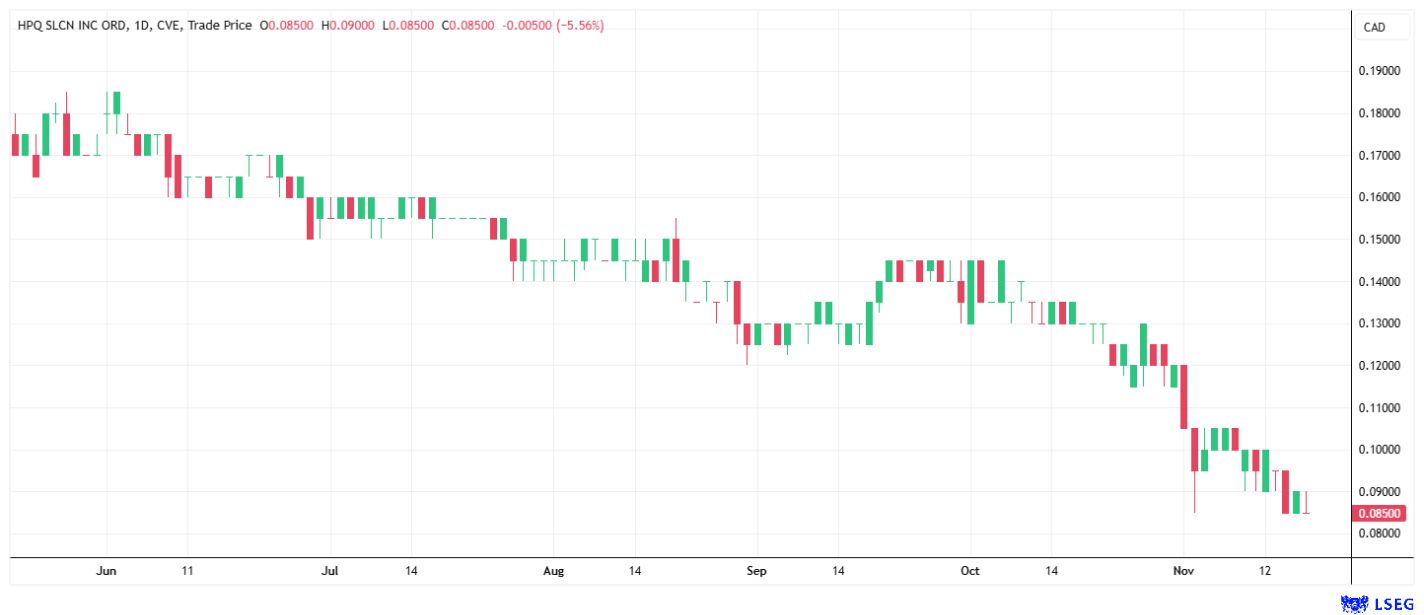
HPQ Silicon is closing the gap left by SpaceX's system for professional users. Together with its French investee company Novacium, the company is developing silicon-anode material for next-generation batteries. On November 17, 2026, HPQ presented the ENDURA+ MiniMax external power system, which is designed for the Starlink Mini terminal. According to the announcement dated November 17, 2026, the ENDURA+ MiniMax delivers 1.95 kWh from 84 fourth-generation cylindrical lithium-ion cells and is intended to power the terminal for up to 80 hours. The ENDURA+ GEN4 cell has a nominal rating of 6,500 mAh or 23.4 Wh and, according to the announcement last July, received UL 1642 safety certification. With the MiniMax, HPQ is targeting mining, forestry and defence. Wherever field personnel must manage without the power grid for days, this storage capacity could enable uninterrupted communications.
HPQ Silicon: Distribution structures and military partners
For HPQ, according to the announcement dated November 17, 2026, the MiniMax is the first commercial sales channel for Gen4 cells in the mobile off-grid power supply market. According to the same announcement, HPQ holds a 36.8% stake in Novacium and owns the exclusive distribution rights for Canada, the US and Mexico. Reservations are expected to open in early January 2027, subject to certification, with initial deliveries planned between the end of the first quarter and the beginning of the second quarter of 2027. Novacium is already securing orders in the drone business. In a mid-September announcement, French counter-drone specialist Alta Ares placed an initial order for more than 100 battery packs. In August, Novacium also announced an order for third-generation battery packs for the French army's FPV drones. HPQ and Novacium signed an evaluation agreement with Aptera Motors on October 15, 2026. The US manufacturer is testing the ENDURA+ cells, with this explicitly not constituting a supply commitment.
Conclusion: Silicon batteries conquer the niche first
SpaceX, Enovix and HPQ Silicon show how widely the power requirements of mobile communications vary. While consumers benefit from compact all-in-one solutions, industrial and military users require long operating times. However, using novel anode materials entails technological risks, such as the cyclical expansion of silicon during charging, which can impair battery life. Nevertheless, the progress made by HPQ and Enovix shows that silicon-anode batteries are moving beyond the development phase and can play an important role in decentralised power supply. This may create opportunities for investors. Investors should keep battery technology on their radar, especially where power is scarce far from the grid.
Conflict of interest
Pursuant to §85 of the German Securities Trading Act (WpHG), we point out that Apaton Finance GmbH as well as partners, authors or employees of Apaton Finance GmbH (hereinafter referred to as "Relevant Persons") may hold shares or other financial instruments of the aforementioned companies in the future or may bet on rising or falling prices and thus a conflict of interest may arise in the future. The Relevant Persons reserve the right to buy or sell shares or other financial instruments of the Company at any time (hereinafter each a "Transaction"). Transactions may, under certain circumstances, influence the respective price of the shares or other financial instruments of the Company.
In addition, Apaton Finance GmbH is active in the context of the preparation and publication of the reporting in paid contractual relationships.
For this reason, there is a concrete conflict of interest.
The above information on existing conflicts of interest applies to all types and forms of publication used by Apaton Finance GmbH for publications on companies.
Risk notice
Apaton Finance GmbH offers editors, agencies and companies the opportunity to publish commentaries, interviews, summaries, news and the like on news.financial. These contents are exclusively for the information of the readers and do not represent any call to action or recommendations, neither explicitly nor implicitly they are to be understood as an assurance of possible price developments. The contents do not replace individual expert investment advice and do not constitute an offer to sell the discussed share(s) or other financial instruments, nor an invitation to buy or sell such.
The content is expressly not a financial analysis, but a journalistic or advertising text. Readers or users who make investment decisions or carry out transactions on the basis of the information provided here do so entirely at their own risk. No contractual relationship is established between Apaton Finance GmbH and its readers or the users of its offers, as our information only refers to the company and not to the investment decision of the reader or user.
The acquisition of financial instruments involves high risks, which can lead to the total loss of the invested capital. The information published by Apaton Finance GmbH and its authors is based on careful research. Nevertheless, no liability is assumed for financial losses or a content-related guarantee for the topicality, correctness, appropriateness and completeness of the content provided here. Please also note our Terms of use.