April 28th, 2025 | 07:00 CEST
Over 300% upside potential for cleantech stocks: Will dynaCERT finally outshine Nel, Plug Power, and Co.?
Analysts believe that dynaCERT shares are currently undervalued by more than 300%. The Company is on the verge of a breakthrough with its technology for reducing fuel consumption and emissions in diesel engines. Revenue is expected to multiply in the current year, with the trend continuing to rise sharply. Industry sentiment for cleantech and renewable energy stocks has also improved noticeably in recent weeks. This is because it is not only in Germany that the price of CO₂ is becoming a key lever for climate protection. dynaCERT helps companies save CO₂ and generate revenue through the sale of certificates. Perhaps Rheinmetall, KNDS, and Co. will follow suit in the future?
time to read: 4 minutes
|
Author:
Fabian Lorenz
ISIN:
DYNACERT INC. | CA26780A1084 , NEL ASA NK-_20 | NO0010081235 , PLUG POWER INC. DL-_01 | US72919P2020
Table of contents:
Author

Fabian Lorenz
For more than twenty years, the Cologne native has been intensively involved with the stock market, both professionally and privately. He is particularly passionate about national and international small and micro caps.
Tag cloud
Shares cloud
Revenue more than 10x in 2 years
Analysts at GBC Research recommend dynaCERT shares as a "Buy". Their target price for the Canadian cleantech company's stock is a strong EUR 0.48. The share, which is also actively traded on German stock exchanges, is currently trading at EUR 0.10. This means the experts expect a performance potential of 380%. Revenue is expected to climb even higher. GBC analysts expect dynaCERT to generate CAD 21 million in revenue next year. In 2024, this figure was only CAD 1.60 million. A significant profit is then expected to be achieved by 2026. Operating earnings (EBITDA) are forecast at CAD 4.79 million. Earnings per share are expected to reach CAD 0.01, resulting in a price-to-earnings (P/E) ratio of 15. This is anything but expensive for a fast-growing cleantech company. Peer group companies like Nel ASA and Plug Power are still far from reaching profitability.
With German management tapping into the billion-dollar market
DynaCERT's European offensive with its HydraGEN technology for reducing CO₂ emissions and improving fuel efficiency in diesel engines has come at the perfect time. The Company is already successful in North and South America in the oil and gas industry and in mining. Now, with German automotive experts Bernd Krüper as President and Kevin Unrath as COO, the Company aims to make a strong push into the European market.
And the new German government seems to be giving dynaCERT a powerful boost. The black-red coalition is allocating an additional EUR 100 billion to the Climate and Transformation Fund (KTF). The aim is to promote climate protection and energy efficiency in Germany in order to achieve climate neutrality by 2045. Specifically, CO₂ and other greenhouse gases are to be reduced. The CO₂ pricing system is, therefore, to be a central component of a mix of instruments. dynaCERT offers exactly the right technology to reduce emissions and generate CO₂ certificates.
Will HydraGEN technology soon be used in tanks?
The HydraGEN technology was developed by dynaCERT to reduce pollutant emissions and fuel consumption in commercial vehicles. The patented hydrogen-based system can be retrofitted into conventional diesel engines within just a few hours. The hydrogen required is produced by a small electrolyzer and fed into the combustion process via the engine compartment. As a result, efficiency increases, more energy is available, and fuel consumption is reduced. Accordingly, less CO₂ is produced, and fewer pollutants such as nitrogen oxides (NOx) are emitted.
The focus so far has been on users of heavy vehicles in the mining, oil and gas, transport, and power generation sectors. However, Bernd Krüper has already indicated in recent interviews that there are inquiries from other industries, such as shipping. Then, Germany's new key sector could also come into play: defense. The heavy diesel engines in Leopard 2 tanks, howitzers, and troop transporters are real polluters. Rheinmetall, KNDS, and others could significantly improve their environmental balance by working with dynaCERT. Although this is not currently an official topic, it will likely become one sooner or later, at least in Germany. A defense contract could likely send the dynaCERT stock through the roof, but this is purely speculative at this stage. However, Steyr Motors impressively demonstrated in March what an order from the armaments industry can trigger.
HydraGEN enables revenue from CO₂ certificates
With the HydraGEN technology, companies can not only improve costs and their ESG balance sheet but also generate a new source of income through the sale of CO₂ certificates. Tesla has already made a fortune with this. At the end of last year, the CO₂ certification company VERRA awarded the mandatory emissions label for the HydraGEN technology. dynaCERT's strategy is to share the revenue from certificate sales with its customers. Analysts at GBC Research expect the cleantech company to generate significant revenue from this new business segment starting next year. As the revenue is recurring, it should have a particularly strong impact on profits.
Positive news flow expected
The chances are good that dynaCERT shares will be driven by positive news flow in the coming months. The Company has been generating buzz in recent weeks by participating in leading trade fairs such as the Hanover Industry Fair, PDAC in Vancouver and, most recently, bauma in Munich. In an interview with Lyndsay Malchuk from Stockhouse Publishing at bauma, Bernd Krüper spoke positively about global demand. Click here for the full interview.
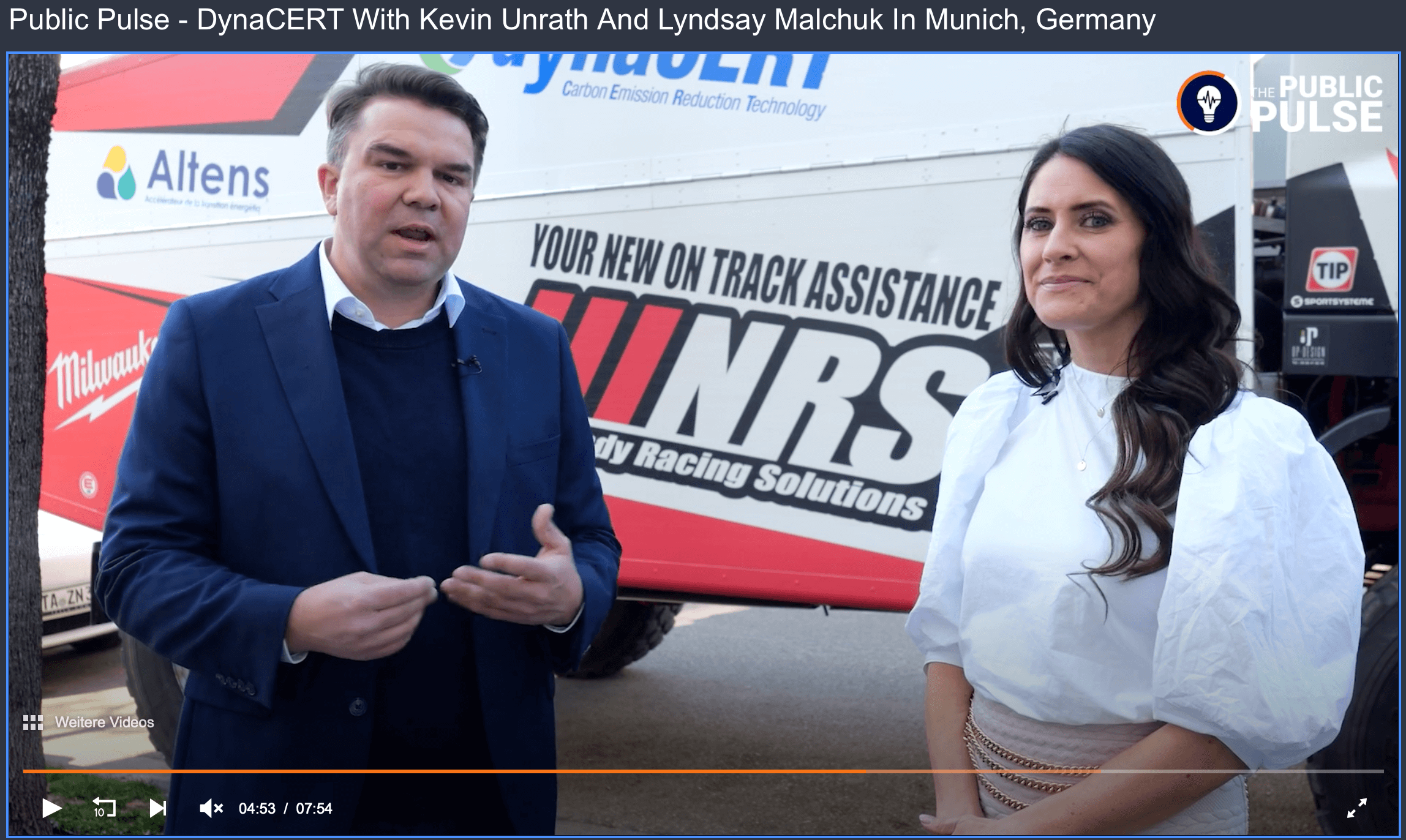
The interview with Kevin Unrath and Lyndsay Malchuk also offers fascinating insights into how dynaCERT aims to transform the industry sustainably. Click here for the full interview.
Conclusion: Multiplication possible
The analysts at GBC believe that dynaCERT shares could multiply in value. There are good reasons for this optimism. The technology is proven, reduces costs, and enables new revenue streams. The political environment beyond Germany's borders is also favorable. If initial sales successes are reported following the trade fairs, the stock could skyrocket and eclipse former hydrogen high-flyers Nel ASA and Plug Power.
Conflict of interest
Pursuant to §85 of the German Securities Trading Act (WpHG), we point out that Apaton Finance GmbH as well as partners, authors or employees of Apaton Finance GmbH (hereinafter referred to as "Relevant Persons") may hold shares or other financial instruments of the aforementioned companies in the future or may bet on rising or falling prices and thus a conflict of interest may arise in the future. The Relevant Persons reserve the right to buy or sell shares or other financial instruments of the Company at any time (hereinafter each a "Transaction"). Transactions may, under certain circumstances, influence the respective price of the shares or other financial instruments of the Company.
In addition, Apaton Finance GmbH is active in the context of the preparation and publication of the reporting in paid contractual relationships.
For this reason, there is a concrete conflict of interest.
The above information on existing conflicts of interest applies to all types and forms of publication used by Apaton Finance GmbH for publications on companies.
Risk notice
Apaton Finance GmbH offers editors, agencies and companies the opportunity to publish commentaries, interviews, summaries, news and the like on news.financial. These contents are exclusively for the information of the readers and do not represent any call to action or recommendations, neither explicitly nor implicitly they are to be understood as an assurance of possible price developments. The contents do not replace individual expert investment advice and do not constitute an offer to sell the discussed share(s) or other financial instruments, nor an invitation to buy or sell such.
The content is expressly not a financial analysis, but a journalistic or advertising text. Readers or users who make investment decisions or carry out transactions on the basis of the information provided here do so entirely at their own risk. No contractual relationship is established between Apaton Finance GmbH and its readers or the users of its offers, as our information only refers to the company and not to the investment decision of the reader or user.
The acquisition of financial instruments involves high risks, which can lead to the total loss of the invested capital. The information published by Apaton Finance GmbH and its authors is based on careful research. Nevertheless, no liability is assumed for financial losses or a content-related guarantee for the topicality, correctness, appropriateness and completeness of the content provided here. Please also note our Terms of use.