January 6th, 2022 | 13:39 CET
Nvidia, BrainChip, Daimler, Infineon - Not only Tesla can build e-cars!
Intelligent and powerful chips remain in demand like road salt in the depths of winter. The supply chains are still struggling, and the scarce raw materials are increasing the cost prices. As a result, prices for high-tech materials will continue to skyrocket in the new year. The car manufacturers will probably be hit hardest, as it will not be possible to raise prices at will, especially in Europe, because of foreign competition. Innovation could be an effective means of combating the erosion of margins. We present a few innovative ideas for investors.
time to read: 4 minutes | Author: André Will-Laudien
ISIN: NVIDIA CORP. DL-_001 | US67066G1040 , BRAINCHIP HOLDINGS LTD | AU000000BRN8 , DAIMLER AG NA O.N. | DE0007100000 , INFINEON TECH.AG NA O.N. | DE0006231004
Table of contents:
Author

André Will-Laudien
Born in Munich, he first studied economics and graduated in business administration at the Ludwig-Maximilians-University in 1995. As he was involved with the stock market at a very early stage, he now has more than 30 years of experience in the capital markets.
Tag cloud
Shares cloud
Nvidia - Intelligent chips make it the winner of the year 2021
Nvidia shareholders were able to relax in 2021. Their shares gained a full 135% over a 12-month horizon, something that very few NDX stocks have managed. The manufacturer of high-performance graphics cards has thus almost quadrupled its value since the beginning of 2020.
A fledgling business unit that deals with virtual reality simulation showed the highest sector growth in 2021 at plus 144%. Capturing the imagination of Nvidia investors was a recent announcement by Facebook founder Mark Zuckerberg that his company would be fully focused on a so-called "metaverse" - a virtual environment where work, leisure activities and other real-life things would be possible. To achieve this, a lot of computing power is needed across the board. While Facebook parent company Meta relies on Nvidia rival AMD for the chips for its server farms, Nvidia has already launched its own platform called "Omniverse" to profit from the current hype of "world simulation".
At the start of the year, the Nvidia share now saw slight profit-taking. No big deal because the Company's positioning is excellent. High-tech, virtual reality and the automotive industry are currently vying for the rationed deliveries of the coveted chips.
BrainChip Holdings - Already in strong demand at the start of the year
The start of the year was like a week of jubilation for BrainChip Holdings. The share price rose by a full 37% in the first few trading days. Accompanying news was the appointment of Pia Turcinov as a non-executive director of the Company. Bringing 30 years of industry expertise, she is both an innovator and mentor and will be responsible for further developing and commercializing BrainChip's product portfolios.
BrainChip Holdings is an Australian semiconductor company that manufactures a revolutionary neuromorphic processor called "Akida." The Akida processor can learn on its own while in use, as it improves the overall performance of artificial intelligence systems by reducing latency and power consumption. The new chip with AI capabilities represents a wide range of application areas, including control of autonomous vehicles, IoT devices and drones. In 2021, BrainChip Holdings partnered with Japan's MegaChips to further develop its edge-based artificial intelligence.
BRN shares have now reached a market capitalization of AUD 1.3 billion. The stock is actively traded on Nasdaq and in Germany. The journey should continue upwards; research house Pitt Street sees a further 55% upside potential and issues a 12-month price target of AUD 1.45 in its buy study.
Daimler - 1000km range with the EQXX
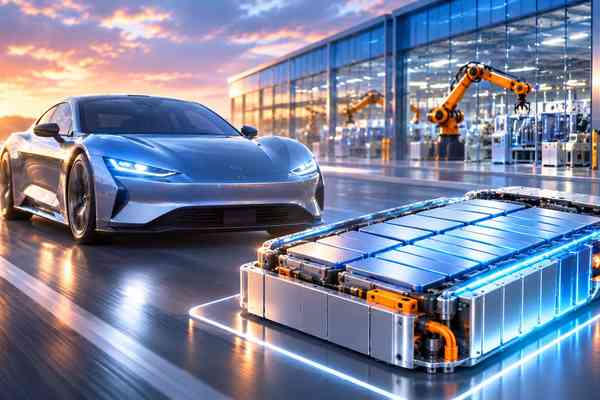
At the moment, there are still reservations about electric mobility: too few charging stations and too short a range. At least the latter problem now seems to be solved at Daimler. Under the somewhat unwieldy name Vision EQXX, Mercedes has now unveiled an e-mobile that scores points for its high energy efficiency and allegedly manages up to 1,000 kilometers on one charge cycle. Long-distance travel by e-car would thus no longer be a problem, and the still suboptimal network of charging stations would no longer be a major issue.
The happy news for all e-mobility fans was announced by Daimler Board of Management member and CTO Markus Schäfer via conference call on January 3, 2022. Also on the timetable: The first test drives with the prototype are to take place in just a few months, and the model could then go into series production in about 2 to 3 years. The still-secret battery has a new cell structure, improved chemistry and a housing made of carbon instead of aluminum - the result: half as much installation space and only a third of the usual weight. The entire car weighs only 1750 kilograms, an outstanding figure for an electric vehicle.
Daimler's stock is jubilant, moving up 7% at the start of the year. The German premium manufacturer has now taken up the Tesla chase; after all, the US competitor is worth 15 times as much as the Company from Stuttgart!
Infineon - Further ahead with new sensors
Infineon (IFX) is the largest chip manufacturer from Germany. Stormy growth is on the horizon for the current fiscal year. At the CES tech show in Las Vegas at the beginning of the year, the Company announced new CO2 sensors designed to increase energy efficiency in buildings and provide a tool for ventilation related to pandemic response. The sensor, called XENSIV PAS, works with photoacoustic spectroscopy. It involves directing light at a specific wavelength into a chamber containing ambient air.
The shortage of chips has been discussed intensively in the media for some time now. The megatrend of e-mobility is playing right into the hands of IFX. The share turned upwards again at the end of the year, after a slight drop of 10% in November. Currently, the resistance line at EUR 41.60 still has to fall, and then it can go back to the all-time high of EUR 43.80.
The year 2022 will set the course for the high-tech and automotive industry. High commodity prices and the shortage of chips continue to be a burden. Nvidia, Infineon and Daimler are well-known blue chips. The Australian company BrainChip is launching new technology with blockbuster potential.
Conflict of interest
Pursuant to §85 of the German Securities Trading Act (WpHG), we point out that Apaton Finance GmbH as well as partners, authors or employees of Apaton Finance GmbH (hereinafter referred to as "Relevant Persons") may in the future hold shares or other financial instruments of the mentioned companies or will bet on rising or falling on rising or falling prices and therefore a conflict of interest may arise in the future. conflict of interest may arise in the future. The Relevant Persons reserve the shares or other financial instruments of the company at any time (hereinafter referred to as the company at any time (hereinafter referred to as a "Transaction"). "Transaction"). Transactions may under certain circumstances influence the respective price of the shares or other financial instruments of the of the Company.
Furthermore, Apaton Finance GmbH reserves the right to enter into future relationships with the company or with third parties in relation to reports on the company. with regard to reports on the company, which are published within the scope of the Apaton Finance GmbH as well as in the social media, on partner sites or in e-mails, on partner sites or in e-mails. The above references to existing conflicts of interest apply apply to all types and forms of publication used by Apaton Finance GmbH uses for publications on companies.
Risk notice
Apaton Finance GmbH offers editors, agencies and companies the opportunity to publish commentaries, interviews, summaries, news and etc. on news.financial. These contents serve information for readers and does not constitute a call to action or recommendations, neither explicitly nor implicitly. implicitly, they are to be understood as an assurance of possible price be understood. The contents do not replace individual professional investment advice and do not constitute an offer to sell the share(s) offer to sell the share(s) or other financial instrument(s) in question, nor is it an nor an invitation to buy or sell such.
The content is expressly not a financial analysis, but rather financial analysis, but rather journalistic or advertising texts. Readers or users who make investment decisions or carry out transactions on the basis decisions or transactions on the basis of the information provided here act completely at their own risk. There is no contractual relationship between between Apaton Finance GmbH and its readers or the users of its offers. users of its offers, as our information only refers to the company and not to the company, but not to the investment decision of the reader or user. or user.
The acquisition of financial instruments entails high risks that can lead to the total loss of the capital invested. The information published by Apaton Finance GmbH and its authors are based on careful research on careful research, nevertheless no liability for financial losses financial losses or a content guarantee for topicality, correctness, adequacy and completeness of the contents offered here. contents offered here. Please also note our Terms of use.