October 1st, 2026 | 08:30 CEST
No Chips, No AI – But Without Power, Nothing Runs! Big Opportunities Await in AMD, Nvidia, HPQ Silicon and Infineon
Is the AI boom starting to overheat? The fact is, the entire tech sector is heading straight for a critical bottleneck. While the developers of the world's fastest graphics processors and accelerator hardware are driving computing power to astronomical heights, the industry's foundation is beginning to falter. At the end of the day, every neural network and every sophisticated language model is only as good as the infrastructure that keeps it alive. The next phase of technological evolution will therefore no longer be decided solely in the design studios of Silicon Valley, but at the level of efficient power supply and revolutionary materials. This is where specialized semiconductor giants and innovative pioneers in cutting-edge anode materials come into play. They provide the key technologies needed to manage the exploding energy demands of modern data centres and mobile systems. The market winner will be determined by who produces the most efficient power semiconductors and next-generation battery cells. For investors, this means betting on the right suppliers for the energy transition now will secure the most profitable positions for the tech future. We do the math!
time to read: 6 minutes | Author: André Will-Laudien
ISIN: HPQ SILICON INC | CA40444L1031 | TSXV: HPQ , OTCQB: HPQFF , NVIDIA CORP. DL-_001 | US67066G1040 , INFINEON TECH.AG NA O.N. | DE0006231004 , ADVANCED MIC.DEV. DL-_01 | US0079031078
Table of contents:
Author

André Will-Laudien
Born in Munich, he first studied economics and graduated in business administration at the Ludwig-Maximilians-University in 1995. As he was involved with the stock market at a very early stage, he now has more than 30 years of experience in the capital markets.
Tag cloud
Shares cloud
AMD and Nvidia: The Rulers of the Processor World
The daily ups and downs of the two chip designers, AMD and Nvidia, resemble a spectacle, yet they regularly involve sums in the tens of billions. Although the two dominate the global market for high-performance processors, their supremacy hangs by a thread, dependent on external factors. Without the high-precision production capacities of high-tech contract manufacturers in Asia, the two rivals' most brilliant chip architectures would remain merely theoretical designs on paper. Other limiting factors remain: the global boom in training artificial intelligence systems consumes unimaginable amounts of energy, so designers' growth is directly tied to the capacity limits of modern power grids and highly efficient cooling systems. Then there are the geopolitical trade conflicts and restrictive export controls, which drastically increase the pressure on global supply chains for critical raw materials and noble gases.
Leading investment banks are therefore increasingly assessing the future development of the two tech giants with a nuanced view of these vulnerabilities. In their latest analyses, Wall Street firms are placing greater emphasis on how resilient the companies are to supply bottlenecks and which one is optimizing the energy efficiency of its next-generation accelerators fastest. Despite these operational risks, major financial institutions forecast massive long-term upside for the dynamic duo, as global appetite for computing power remains unbroken. On the LSEG Refinitiv platform, these hopes are clear: 47 "Buy" recommendations for AMD and 62 for Nvidia. What is striking: After a 300% gain over 12 months, AMD's price target has no room left, while Nvidia still has 40% upside to reach USD 323. No wonder, since a share buyback program worth a nearly unimaginable USD 235 billion has just been announced. But ultimately, this amounts to only 5% of the outstanding shares; by comparison, at a German company like Siemens, it would be 100%. This miraculous multiplication of money was still unimaginable just a few years ago, but when it comes to "thinking big," European investors in particular still have a lot to learn!
Infineon: The Energy-Saving Champion Is Gaining Significant Ground
Infineon, Germany's leading chip hope, operates at the critical intersection of energy efficiency and power delivery. This is underscored by a recent rating from research firm Gartner, which named Infineon the "Company to Beat" in AI power supply. A key commercial driver here is the Munich-based company's official entry into the NVIDIA MGX AI Factory ecosystem, where proprietary semiconductor solutions, such as innovative SiC-JFETs, are revolutionizing complex 800-VDC voltage conversion directly on the server board. Thanks to forward-looking, multibillion-dollar investments in wide-bandgap materials such as silicon carbide and gallium nitride, the German company has drastically reduced power losses in server racks and delivered maximum power density.
This strategic foresight is already reflected in record figures: driven by the exploding demand for AI infrastructure, the Power division recorded a sequential revenue jump of 14% to a historic EUR 1.44 billion in the third quarter of the current fiscal year. For fiscal year 2027, management is already forecasting specific AI revenue of an impressive EUR 2.5 billion, thanks to the company's broadly diversified AI supply chain. Despite these bright prospects, the German company faces fierce competition, as emerging rivals are vying for market share both in advanced interconnect semiconductors and directly at the level of final power conversion in processors. To defend this pole position in the long term and fully tap into the immense growth potential, the semiconductor specialist is consistently accelerating its strategic AI investments. At some point, fund managers might conclude: "Without the green power platforms and intelligent energy management chips from Germany, even the fastest computing hardware from US competitors will ultimately run out of juice." By then, the Munich-based company will likely no longer be available for purchase on the stock market for EUR 74 billion. Incidentally, experts on the LSEG platform expect the stock to reach more than EUR 87 in just 12 months, based on the current price of EUR 59. Well then!
HPQ Silicon: Military Accolade Paves the Way for Commercial Success
When it comes to energy efficiency, the Canadian innovation leader HPQ Silicon is also making a name for itself. In recent weeks, the company appears to have shifted into high gear commercially, transforming itself from a pure technology developer into a sought-after key player in the cleantech and defence sectors. The accolade comes, of all places, from Europe. The French Army's Technical Section (STAT) has officially commissioned HPQ partner Novacium to supply high-capacity prototypes for tactical radios. After intensive testing, the groundbreaking Gen3 and Gen4 silicon anode cells delivered 23% more energy capacity than previous standard batteries, despite the same form factor. The ambitious goal of this military program is to potentially double radio operating time without changing the existing infrastructure. This breakthrough follows a first commercial order for FPV drone battery packs from the French regiment. If field testing is successful, the project will serve as a first-class technological benchmark for the armed forces of allied NATO nations. For HPQ Silicon, this milestone underscores the strategic value of its 36.8% stake in Novacium and secures exclusive marketing rights in North America.
President, Chairman, and CEO Bernard Tourillon outlined his strategy at the 19th International Investment Forum.
And progress continues on the industrial cleantech front with the successful completion of a strategic realignment. At the end of September, HPQ and PyroGenesis sealed a 50/50 ownership structure for their joint venture, HPQ Silica Polvere Inc. (HSPI). PyroGenesis converted its 10% revenue share into a full 50% stake, creating a powerful, perfectly aligned marketing platform. At the heart of this alliance is the disruptive Fumed Silica Reactor (FSR) technology, whose pilot phase has validated the single-stage, market-ready production of fumed silica directly from quartz. Unlike conventional, highly environmentally harmful methods, the FSR process eliminates toxic chlorosilanes. The result is low-carbon production with drastically reduced operating costs and a minimized energy footprint. The partners are already in concrete discussions with a leading global manufacturer regarding the next commercial rollout. In addition, advanced negotiations are underway for a 1,000-metric-ton joint venture in the US, as well as large-scale projects with an Asian prospect and a partner in the Middle East, which are targeting capacities of several tens of thousands of metric tons per year. As a result, the HPQ Silicon stock combines a solid defensive story with massive cleantech scaling potential for investors. Investors looking to make ambitious investments in the AI sector should keep an eye on the global energy transition. With a market capitalization of just CAD 66 million, HPQ Silicon appears significantly undervalued relative to its innovative solutions. Extremely exciting!
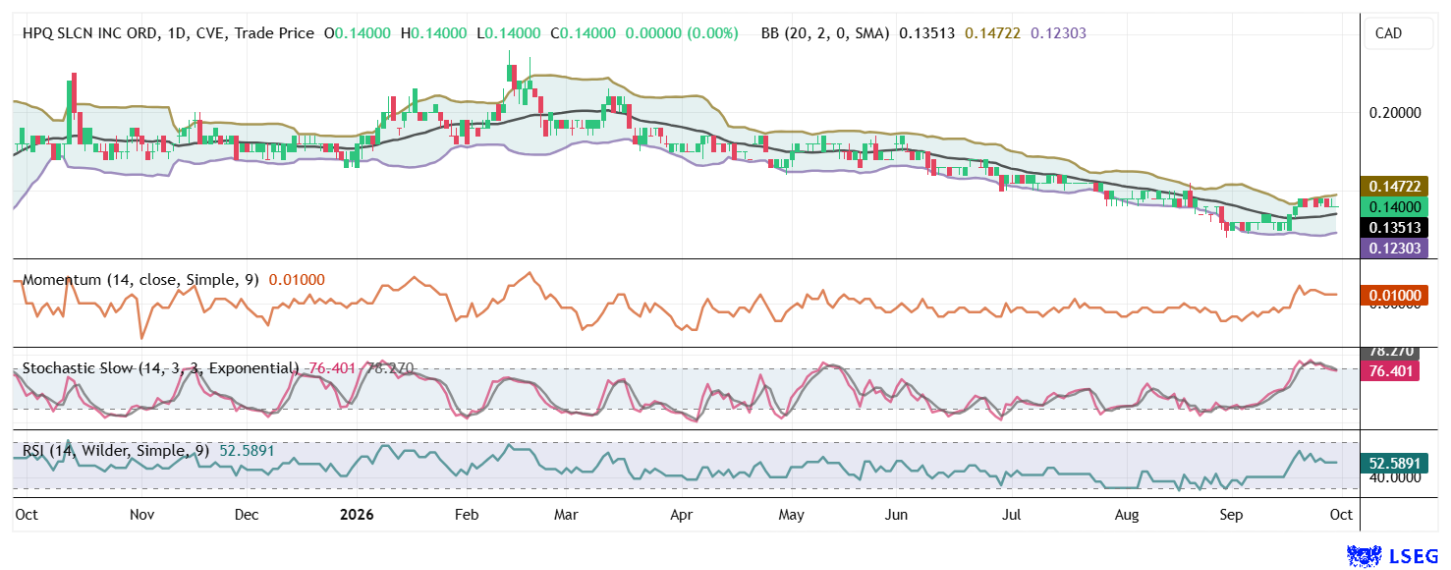
The last few days have seen significant increases in trading volume. Source: LSEG Refinitiv, September 30, 2026.
The AI megatrend is becoming a hot topic for stock market investors. Over the past 12 to 24 months, industry leaders have demonstrated what the emergence of a new segment means: revaluation! What AMD and Nvidia have demonstrated with share price gains of several hundred percent could serve as a potential blueprint for the future for innovative niche providers like HPQ Silicon. As always, the key is getting in early! A balanced investment strategy protects against concentration risk.
Conflict of interest
Pursuant to §85 of the German Securities Trading Act (WpHG), we point out that Apaton Finance GmbH as well as partners, authors or employees of Apaton Finance GmbH (hereinafter referred to as "Relevant Persons") currently hold or hold shares or other financial instruments of the aforementioned companies and speculate on their price developments. In this respect, they intend to sell or acquire shares or other financial instruments of the companies (hereinafter each referred to as a "Transaction"). Transactions may thereby influence the respective price of the shares or other financial instruments of the Company.
In this respect, there is a concrete conflict of interest in the reporting on the companies.
In addition, Apaton Finance GmbH is active in the context of the preparation and publication of the reporting in paid contractual relationships.
For this reason, there is also a concrete conflict of interest.
The above information on existing conflicts of interest applies to all types and forms of publication used by Apaton Finance GmbH for publications on companies.
Risk notice
Apaton Finance GmbH offers editors, agencies and companies the opportunity to publish commentaries, interviews, summaries, news and the like on news.financial. These contents are exclusively for the information of the readers and do not represent any call to action or recommendations, neither explicitly nor implicitly they are to be understood as an assurance of possible price developments. The contents do not replace individual expert investment advice and do not constitute an offer to sell the discussed share(s) or other financial instruments, nor an invitation to buy or sell such.
The content is expressly not a financial analysis, but a journalistic or advertising text. Readers or users who make investment decisions or carry out transactions on the basis of the information provided here do so entirely at their own risk. No contractual relationship is established between Apaton Finance GmbH and its readers or the users of its offers, as our information only refers to the company and not to the investment decision of the reader or user.
The acquisition of financial instruments involves high risks, which can lead to the total loss of the invested capital. The information published by Apaton Finance GmbH and its authors is based on careful research. Nevertheless, no liability is assumed for financial losses or a content-related guarantee for the topicality, correctness, appropriateness and completeness of the content provided here. Please also note our Terms of use.