June 2nd, 2026 | 06:10 CEST
Lithium, Uranium, and Copper: How Albemarle, American Atomics, and Antofagasta Are Benefiting from the Energy Revolution!
The world is changing at a rapid pace. The superpowers are locked in competition, and Europe is navigating its path between the US and China. Behind this lie enormous economic shifts that are placing significant demands on businesses and society. The war in the Persian Gulf has brought the extremely diverse yet fragile energy sector back into the spotlight. People are increasingly opting for electric vehicles, batteries are becoming more important, and baseload power has become critical for many nations. Not least, massive investments are needed—especially in Europe and North America—in the often very old and now sometimes dilapidated power grid. These radical changes are driving demand for uranium, lithium, and copper. We are therefore taking a look at the stocks of Albemarle, American Atomics, and Antofagasta!
time to read: 7 minutes | Author: Tarik Dede
ISIN: AMERICAN ATOMICS INC | CA0240301089 | CSE: NUKE , ALBEMARLE CORP. DL-_01 | US0126531013 , ANTOFAGASTA PLC LS-_05 | GB0000456144
Table of contents:
Author

Tarik Dede
Even as a high school student in northern Germany, he developed a strong interest in the “Neuer Markt” and the dynamics of the equity markets. Small- and mid-cap companies were at the center of his focus from the very beginning. After completing his training as a certified bank clerk, he deepened his economic expertise through formal studies in economics as well as through various positions within Frankfurt’s financial sector. Today, he has been actively involved in the capital markets for more than 25 years, both professionally and as a private investor.
Tag cloud
Shares cloud
Antofagasta: A Giant in Chile
Who would have thought! Oil prices are rising, interest rates are climbing, and economists are worried about a global recession and inflation in the wake of the war in the Persian Gulf. This is actually a scenario in which the price of copper should be falling sharply. After all, "Dr. Copper" is considered one of the best leading indicators of the state of the global economy. But not at all. Copper ended May with its highest closing price ever. And that is primarily due to a boom in demand, while the market is facing a supply deficit.
Antofagasta was founded in 1888 under the name The Antofagasta and Bolivia Railway Company and began as a railroad in the port city of the same name in northern Chile. Today, the London-based company is one of the world's largest copper producers and focuses entirely on the Andean nation. In the first quarter, the group produced 143,000 tons of copper, about 7.6% less than in the same quarter of the previous year. However, the decline was accepted as planned due to lower processing rates and fluctuations in ore grade. Production is expected to rise gradually for the rest of the year. In addition to the red industrial metal, the four main mines in Chile also produced 46,500 ounces of gold (+8.4%). The pure cash costs (excluding by-products) stood at USD 2.77 per pound of copper. By comparison, a pound of copper currently costs about USD 6.40 in New York. The high prices for the by-products gold and molybdenum also drastically reduced Antofagasta's net cash costs by about a third to USD 1.08.
This year, the company aims to achieve copper production of 650,000 to 700,000 tons as planned and invest a massive USD 3.4 billion. Part of this amount will go toward expanding the Los Pelambres mine, the group's flagship copper and molybdenum project. Here, the desalination plant in particular is being expanded to ramp up capacity in the long term. In addition, Antofagasta plans to build a second concentrator at Centinela to increase production there by around 30% in the future.
The company pays a dividend twice a year (fall/spring). Most recently, in May, the dividend was USD 0.48 per share. For the coming full year, analysts expect the dividend to increase further to approximately USD 0.70 per share. The stock has performed extremely well recently. Since hitting a low in the spring of 2025, the shares have nearly tripled on the LSE. As long as copper prices remain favourable, the trend should continue.
American Atomics: From Rock to Reactor
For several years now, the nuclear industry has also been making a comeback. While Germany has phased out nuclear power, others are investing heavily in this baseload technology. China is leading the way, currently building or planning more than 30 nuclear power plants. But the return is already firmly on the agenda in the United States as well. As early as May 2025, the US government had passed a decree to deregulate and expand nuclear energy. The United States aims to expand capacity to up to 400 gigawatts by 2050. Work is already underway to reactivate the Palisades plant in Michigan. Three Mile Island is also scheduled to go online as early as next year.
However, the uranium used as fuel for these power plants comes primarily from Russia and its partner countries: in addition to the material itself, most of the expertise is likely located there as well. This poses a problem for the US. American Atomics is now working to fill this gap. Management envisions a vertically integrated group in the nuclear sector, from uranium mining to processing and refining. Instead of simply selling the mined uranium ore as a raw material (yellowcake) to intermediaries, American Atomics aims to build its own processing infrastructure to better capitalize on the growing demand.
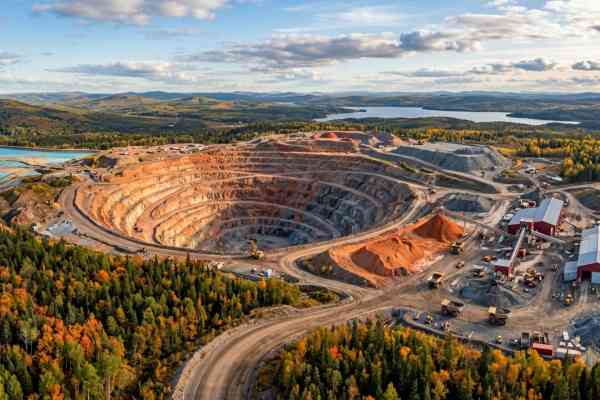
The core upstream project is located in Utah. The Big Indian project is situated in the historic Lisbon Valley Mining District in the southeastern part of the state. It comprises 217 contiguous claims. Through a Definitive Option Agreement with Indian Prospectors LLC, American Atomics can acquire an interest of up to 80% in the project. The geological potential is considered enormous because the Lisbon Valley was historically a highly productive uranium region. American Atomics is focusing on the less-explored eastern flank of the region. In doing so, management can build on historical data from the oil and gas industry dating back to the 2000s, avoiding the need to start from scratch. To date, 28 of 51 drill holes have shown strong gamma radiation anomalies at depths of approximately 670 to 850 m. Permits are currently being prepared for a proprietary drilling program that could provide clarity on the project's economic viability as early as this year.
In addition to this exploration work, American Atomics has already taken important steps toward processing the material. For instance, the company established a strategic 50/50 joint venture with CVMR. The partner is a world-leading specialist in metal refining and vapour metallurgy and already works for the US Department of Defence, among others. Together, the companies are planning to build a next-generation uranium mill directly in the US. Using CVMR's patented, modular technology, the uranium is to be processed in a highly efficient and environmentally friendly manner. American Atomics is gearing its infrastructure toward producing so-called HALEU (High-Assay Low-Enriched Uranium). This is a special, higher-enriched fuel required for the new small modular reactors (SMRs) and for military systems.
With this "rock-to-reactor" approach, American Atomics is well-positioned to benefit from the nuclear industry's comeback in the US. The company has a tight capital structure; including options and warrants, only about 75 million shares are outstanding. The market capitalization is thus approximately CAD 24.3 million, offering significant upside potential. Now management must deliver convincing drilling results!
Albemarle: Lithium Prices Are Rising Again
Demand for electric vehicles has been rising steadily for years. Countries like Norway are in the lead, as they now register almost exclusively battery-powered vehicles for new registrations. In the world's largest auto market, the People's Republic of China, this share is already over 50%. Little seems to stand in the way of this triumph over the internal combustion engine, especially since high oil prices are currently driving demand strongly in many other countries as well.
Albemarle, along with Chile's SQM, is arguably the largest supplier of lithium. The US company's business model spans the extraction, processing, and marketing of lithium and highly specialized chemicals. In this respect, the company is a hybrid of a specialty chemicals group and a lithium producer. In the lithium sector, it is the global leader and currently holds a global market share of around 16%. Like many others, the company suffered from falling prices following the market's boom phase. However, lithium prices have been rising again since last year. Market observers unanimously agree that customers' high inventories are running low. The business is divided into two segments: In the first segment, Albemarle mines lithium and processes it into high-purity compounds (lithium carbonate, lithium hydroxide) used in the cathodes of electric vehicle batteries and stationary grid storage systems. The "white gold" is primarily extracted from salt lakes in northern Chile, which provides a significant cost advantage. In the other segment, Specialties, the company operates a stable, more defensive business focused primarily on bromine and bromine derivatives. These are produced from the company's own deposits in Arkansas (US) and the Dead Sea (Jordan). Bromine products are primarily used as flame retardants in electronic components (e.g. for AI data centers), in semiconductors, in the pharmaceutical industry, and in drilling fluids for the oil and gas sector.
Strong Figures Thanks to Higher Lithium Segment
Albemarle presented a strong first-quarter 2026 report in early May. Revenue rose 33% year-over-year to USD 1.43 billion. The main driver was the Energy Storage (Lithium) segment, where revenue surged 70% as higher lithium prices and increased sales volumes took effect. Adjusted EBITDA soared 148% to USD 664 million as a result. A look at the EBITDA margin in the lithium business, which stood at 62%, shows just how well things are going. The figures beat market consensus across the board. The stock remains in an upward trend, having more than tripled in value over the past year. However, there is still a long way to go to reach the all-time highs from 2022. Those looking to bet on the long-term rise in demand for electric vehicles and energy storage will find a diversified blue-chip stock here.
Consumer habits are changing worldwide, with significant implications for the energy sector. Metals such as copper, uranium, and lithium stand to benefit the most from this trend. With Albemarle, investors can bet on a blue-chip stock from the lithium sector. American Atomics could rise to become a major player in the US nuclear industry through its vertically integrated approach. Antofagasta, on the other hand, is one of the world's largest copper producers and is currently benefiting massively from rising copper prices.
Conflict of interest
Pursuant to §85 of the German Securities Trading Act (WpHG), we point out that Apaton Finance GmbH as well as partners, authors or employees of Apaton Finance GmbH (hereinafter referred to as "Relevant Persons") may hold shares or other financial instruments of the aforementioned companies in the future or may bet on rising or falling prices and thus a conflict of interest may arise in the future. The Relevant Persons reserve the right to buy or sell shares or other financial instruments of the Company at any time (hereinafter each a "Transaction"). Transactions may, under certain circumstances, influence the respective price of the shares or other financial instruments of the Company.
In addition, Apaton Finance GmbH is active in the context of the preparation and publication of the reporting in paid contractual relationships.
For this reason, there is a concrete conflict of interest.
The above information on existing conflicts of interest applies to all types and forms of publication used by Apaton Finance GmbH for publications on companies.
Risk notice
Apaton Finance GmbH offers editors, agencies and companies the opportunity to publish commentaries, interviews, summaries, news and the like on news.financial. These contents are exclusively for the information of the readers and do not represent any call to action or recommendations, neither explicitly nor implicitly they are to be understood as an assurance of possible price developments. The contents do not replace individual expert investment advice and do not constitute an offer to sell the discussed share(s) or other financial instruments, nor an invitation to buy or sell such.
The content is expressly not a financial analysis, but a journalistic or advertising text. Readers or users who make investment decisions or carry out transactions on the basis of the information provided here do so entirely at their own risk. No contractual relationship is established between Apaton Finance GmbH and its readers or the users of its offers, as our information only refers to the company and not to the investment decision of the reader or user.
The acquisition of financial instruments involves high risks, which can lead to the total loss of the invested capital. The information published by Apaton Finance GmbH and its authors is based on careful research. Nevertheless, no liability is assumed for financial losses or a content-related guarantee for the topicality, correctness, appropriateness and completeness of the content provided here. Please also note our Terms of use.