July 21st, 2026 | 07:05 CEST
Hydrogen Slump and "Tesla Fantasy": How Plug Power, Ballard Power, and First Hydrogen Aim to Regain Momentum
The hydrogen ramp-up in the industrial sector has reached a critical juncture. On the one hand, the scarcity of fossil fuels is driving the need to invest now; on the other hand, the struggling economy is wary of the associated costs. While climate targets remain firmly in place despite recent adjustments within the EU, and the International Energy Agency (IEA) projects global hydrogen demand to reach a staggering 17,500 terawatt-hours by mid-century, the hydrogen industry is facing mounting pressure. In Germany, policymakers are intensifying this pressure through the national implementation of the EU's RED III Directive. This directive stipulates that, starting in 2026, fuel suppliers must demonstrate compliance with mandatory minimum quotas for renewable fuels. According to calculations by Provaris Energy, failure to comply could result in penalties of EUR 120 per gigajoule, equivalent to an effective surcharge of up to EUR 15 per kilogram of hydrogen. With domestic hydrogen production capacity expected to remain constrained, the pressure to act is mounting. Is the hydrogen economy finally gaining momentum? We take a closer look at the industry and highlight several key companies that could benefit from the next phase of development.
time to read: 3 minutes | Author: Nico Popp
ISIN: First Hydrogen Corp. | CA32057N1042 | TSXV: FHYD , PLUG POWER INC. DL-_01 | US72919P2020 , BALLARD PWR SYS | CA0585861085
Table of contents:
Author

Nico Popp
At home in Southern Germany, the passionate stock exchange expert has been accompanying the capital markets for about twenty years. With a soft spot for smaller companies, he is constantly on the lookout for exciting investment stories.
Tag cloud
Shares cloud
Ballard Power Cuts Operating Expenses and Focuses on Vertical Integration
Canadian fuel cell specialist Ballard Power is feeling the headwinds within industry and is taking steps to counter them under the leadership of new CEO Marty Neese. Through radical job cuts and portfolio streamlining, management reduced operating expenses by 36% to USD 16.4 million in the first quarter of 2026. At the same time, revenue climbed 26% to USD 19.4 million, while operating cash burn was reduced by 68% to USD 7.8 million. To use its capital as efficiently as possible, management has temporarily frozen costly expansion plans for massive factories in China and in the US state of Texas.
Instead of focusing solely on expansion, Ballard is pursuing deeper integration into the value chain and recently acquired the British specialist GeoPura for approximately GBP 301.1 million. Through the acquisition of the British company, Ballard Power secures revenue from the British HAR1 subsidy program and expands its potential sales market to USD 20 billion. Backed by a comfortable cash reserve of USD 516.8 million and an order backlog of USD 112.9 million, Ballard Power aims to be profitable by 2028.
Plug Power Halts Costly Projects
Plug Power is also making a U-turn and has halted the extremely costly construction of its own power-generation facilities. The company divested assets in the US state of Texas. This move generated liquidity for Plug Power. Just how important this turnaround is for the company is also evident from the fact that the end of its large-scale projects effectively means forgoing a USD 1.66 billion loan program from the US Department of Energy.
First Hydrogen Shines in Rigorous Testing at Amazon and Wales & West Utilities
The Canadian company First Hydrogen positions itself at the intersection of commercial vehicles, autonomous robotics, and decentralized energy, and is fully committed to innovation. Rather than operating solely as a hardware manufacturer, which would require significant investment, the Canadian company has always relied on collaboration with partners and a so-called "capital-light model." The performance of its own fuel-cell transporter was demonstrated years ago in comprehensive field tests. During an intensive real-world test with e-commerce giant Amazon in the Greater London area, First Hydrogen's demonstration vehicle covered a distance of 535 km, made 1,547 delivery stops, and delivered 3,462 packages. After analyzing the driving data, Amazon confirmed that the van has a real-world range of 397 km in the heaviest urban traffic. Even in freezing temperatures in southern Wales, the vehicle covered over 2,000 km for the operator Wales & West Utilities, with a low hydrogen consumption of 1.58 kg per 100 km. The planned second generation of the van is expected to enable ranges of up to 1,000 km starting in 2028.
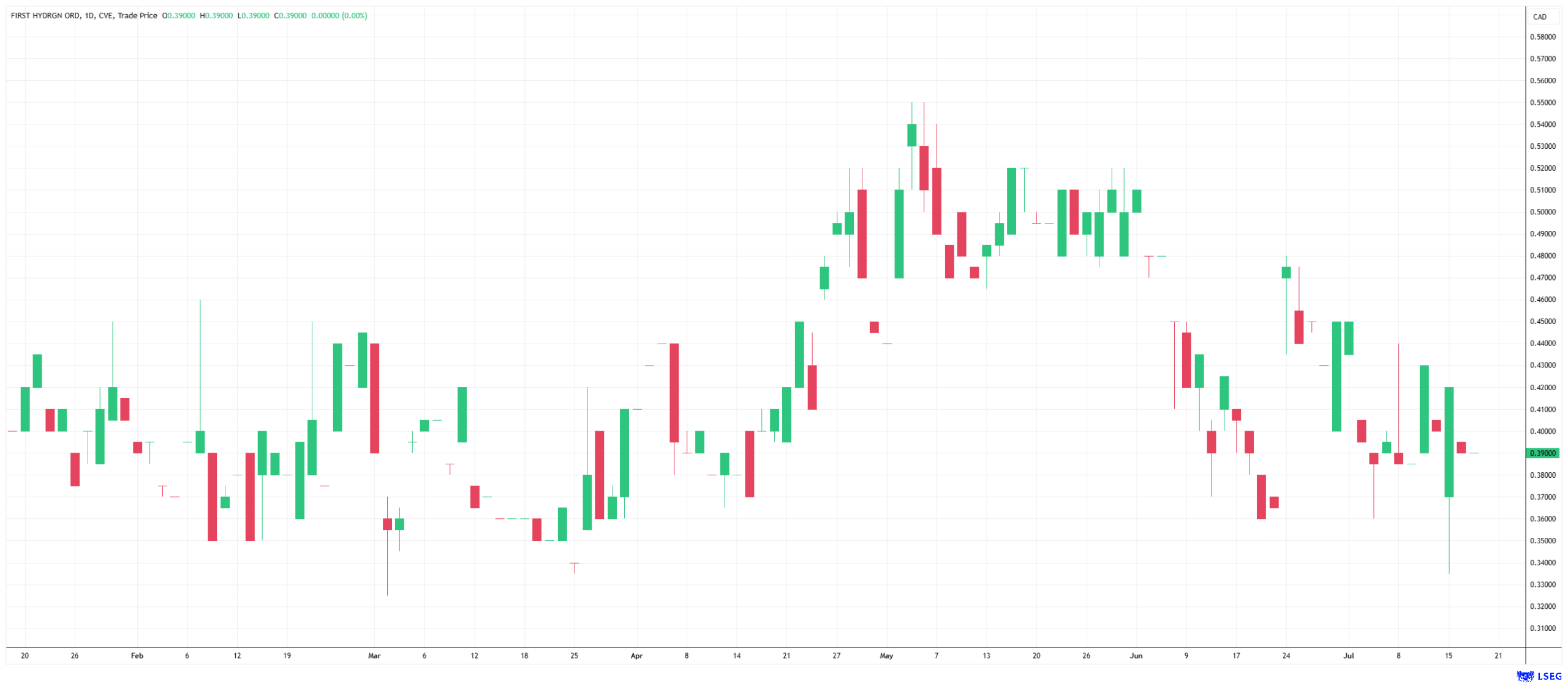
To reliably serve customers in the future, First Hydrogen plans to build a production and assembly facility in Shawinigan, Canada, featuring a 35 MW electrolysis plant and a capacity for up to 25,000 vehicles per year. At the same time, First Hydrogen's management is driving progress through specialized subsidiaries. Through its subsidiary First Humanoid, First Hydrogen signed a letter of intent in June of this year to acquire a 60% stake in a robotics company holding 26 granted and 10 pending patents for gearboxes and high-performance motors, while its First Nuclear division is researching small modular reactors. As Tesla begins collecting training data for humanoid robots in Grünheide, it no longer seems far-fetched for smaller companies to operate in future-oriented fields that sounded like science fiction just a few years ago. The fact that First Hydrogen is also winning over professional investors is demonstrated by its most recent private placement in April 2026, which raised approximately CAD 3.0 million in gross proceeds.
First Hydrogen: Speculative Opportunities for the Bold
First Hydrogen is a jack-of-all-trades in future technologies. While its hydrogen plans are well advanced and the latest generation of delivery vehicles promises not only long ranges but also other practical advantages, the company's involvement with mini-reactors and humanoid robots exudes "Tesla-style excitement." With a market capitalization of only around CAD 36 million, First Hydrogen should be considered a speculative investment. On the other hand, this valuation also implies significant upside potential if the company reports positive news in the near future. The stock is known for its dynamic price movements**.
Conflict of interest
Pursuant to §85 of the German Securities Trading Act (WpHG), we point out that Apaton Finance GmbH as well as partners, authors or employees of Apaton Finance GmbH (hereinafter referred to as "Relevant Persons") may hold shares or other financial instruments of the aforementioned companies in the future or may bet on rising or falling prices and thus a conflict of interest may arise in the future. The Relevant Persons reserve the right to buy or sell shares or other financial instruments of the Company at any time (hereinafter each a "Transaction"). Transactions may, under certain circumstances, influence the respective price of the shares or other financial instruments of the Company.
In addition, Apaton Finance GmbH is active in the context of the preparation and publication of the reporting in paid contractual relationships.
For this reason, there is a concrete conflict of interest.
The above information on existing conflicts of interest applies to all types and forms of publication used by Apaton Finance GmbH for publications on companies.
Risk notice
Apaton Finance GmbH offers editors, agencies and companies the opportunity to publish commentaries, interviews, summaries, news and the like on news.financial. These contents are exclusively for the information of the readers and do not represent any call to action or recommendations, neither explicitly nor implicitly they are to be understood as an assurance of possible price developments. The contents do not replace individual expert investment advice and do not constitute an offer to sell the discussed share(s) or other financial instruments, nor an invitation to buy or sell such.
The content is expressly not a financial analysis, but a journalistic or advertising text. Readers or users who make investment decisions or carry out transactions on the basis of the information provided here do so entirely at their own risk. No contractual relationship is established between Apaton Finance GmbH and its readers or the users of its offers, as our information only refers to the company and not to the investment decision of the reader or user.
The acquisition of financial instruments involves high risks, which can lead to the total loss of the invested capital. The information published by Apaton Finance GmbH and its authors is based on careful research. Nevertheless, no liability is assumed for financial losses or a content-related guarantee for the topicality, correctness, appropriateness and completeness of the content provided here. Please also note our Terms of use.