March 23rd, 2026 | 07:25 CET
Hunting for Bargains After the Sell-Off: What Investors Need to Know About SAP, Vonovia, and Pure One Right Now
The stock market currently resembles a battlefield where even the strongest names find little mercy and are getting hammered. Whether it is software pioneers like SAP or real estate giants like Vonovia, the massive sell-off has left deep scars in some portfolios. But while many investors are pulling the ripcord in a panic, something completely different is brewing behind the scenes. The fundamental strength of these companies is often completely forgotten amid the current market noise. Whether AI will really destroy and replace as much as feared at SAP remains to be seen. Things get particularly exciting when you look beyond the horizon to Australia, where Pure One is currently blazing entirely new trails in clean mobility. All three stocks currently share a rather depressing price level, which could, however, form the basis for a massive recovery. In this report, we analyze why sentiment might be worse than reality and where the hidden treasures might be buried. Will SAP and Vonovia find their bottom? And can Pure One celebrate its long-awaited breakthrough through strategic milestones? Read the analysis now on the courage required, new market lows, and the hope for imminent price surges.
time to read: 6 minutes | Author: Mario Hose
ISIN: SAP SE O.N. | DE0007164600 , VONOVIA SE NA O.N. | DE000A1ML7J1 , PURE ONE CORPORATION LIMITED | AU0000442865 | ASX: P1E
Table of contents:
Author

Mario Hose
Born and raised in Hannover, Lower Saxony follows social and economic developments around the globe. As a passionate entrepreneur and columnist he explains and compares the most diverse business models as well as markets for interested stock traders.
Tag cloud
Shares cloud
SAP: Is the Software Pioneer on the Verge of a Turning Point?
Sometimes the stock market feels like a world that is hard to understand. This is particularly evident right now with SAP, the flagship of the German software industry. Those looking at the stock ticker these days see a picture of devastation. On Friday, the stock plummeted to its lowest level since the beginning of 2024. With a closing price of EUR 152.80, the stock has lost massive ground. Since the start of the year, the loss has totaled over 20%, making SAP one of the weakest performers on the entire DAX. It is not just a classic sell-off; it is more like a bloodbath, leaving many investors at a loss. But a closer look reveals that a historic turning point is currently taking place here.
Behind the scenes, CEO Christian Klein is working on a radical overhaul of the business model. The old system of user licenses could be phased out. Starting in July 2026, the company plans to implement usage-based pricing for artificial intelligence. That sounds logical, as intelligent software agents are taking on more and more tasks that used to be handled by humans. But the market remains skeptical. A recent survey shows that so far, only 3% of customers use SAP's in-house AI solutions. The vast majority prefer to rely on external providers such as OpenAI. This is painful for the Walldorf-based company. SAP is responding with so-called Forward Deployed Engineering Teams, which are tasked with developing solutions directly on-site at the customer's location. That could help. But skepticism remains high.
Despite the stock price losses, there are also bright spots in the company's operations. Cloud revenue grew by an impressive 23% last year to EUR 21 billion. Free cash flow nearly doubled to over EUR 8.24 billion. A practical example of this success is the US berry producer Naturipe. The company uses SAP's RISE platform to digitize its extremely time-sensitive supply chain. The fresh berries must reach customers in top quality 365 days a year. This is only possible with state-of-the-art logistics based on S/4HANA. Analysts are therefore sticking to their "Buy" recommendations despite the current slump.
Some even see the price target at EUR 280, representing significant upside potential. So perhaps the current low is just the calm before a massive storm to the upside.
From a technical perspective, the price could dip back down to the EUR 140 range, but under normal market conditions, the low should then be "in the bag."
Vonovia: The Return of Stability
From the digital realm of the software world, we now turn to the more solid foundations of the real estate industry. Vonovia has been on a rollercoaster ride in recent years. Rising interest rates and general skepticism toward tangible assets sent the stock plummeting. It was a creeping sell-off that brought many doubters onto the scene. But anyone who reads the latest figures from a few days ago closely will recognize a turnaround. After a tough previous year with deep red numbers, a billion-euro profit is finally back on the books. The Bochum-based company has fought its way back and is showing a resilience that many would not have thought possible.
Earnings per share for the 2025 fiscal year stood at an impressive EUR 4.47. By comparison, just one year earlier, the company had to absorb a loss of EUR 1.09. That is a massive leap forward. Shareholders are also set to benefit from this newfound strength. The dividend is being raised slightly to EUR 1.25. This is an important signal to the market and shows that management has full confidence in its own financial foundation. Although revenue declined slightly to EUR 4.98 billion, profitability has stabilized significantly. This is no small feat in a market environment where interest rates remain high.
The market reaction was nevertheless "subdued," to say the least, though this is typical for a stock that is being watched with a rather critical eye. Many market participants are still not entirely convinced. Analysts at JPMorgan have slightly adjusted their price target but remain fundamentally optimistic about the stock. For 2026, Vonovia is targeting an adjusted pre-tax profit of up to EUR 2 billion. The stock is currently trading well below its intrinsic value. Those who show courage now could benefit massively from a normalization in the real estate sector. Once interest rate fears have subsided, Vonovia shares could spring upward. In any case, the foundation for a genuine price surge has been laid by the return to profitability. From a technical perspective, the stock could well head back toward EUR 30.
Pure One: Full Speed Ahead into a Green Future
Our journey finally takes us far away from the major German conglomerates to Australia, to Pure One Corporation Limited. Here, it becomes clear that clean transportation and innovative energy solutions could be the next big thing on the stock market. Pure One has transformed itself from a pure hydrogen specialist into a versatile provider of zero-emission mobility. The latest reports from February and March paint the picture of a "green player" acting with great strategic acumen. While the major indices are wavering and trending downward, Pure One is consistently expanding its market position.
A decisive milestone was the announcement on February 24. The subsidiary Eastern Gas Corporation Limited, known as EGA for short, has successfully listed on the Australian Stock Exchange (ASX). Shares have been officially traded there since February 26. Pure One continues to hold a substantial 69.4% stake in EGA. This IPO is a brilliant move to highlight the value of the gas projects while simultaneously generating capital for Pure One's core business areas.
Thanks to this clear separation, Pure One can now fully concentrate on its fleet solutions. These include not only hydrogen trucks but also battery-electric vehicles and innovative battery-swapping systems.
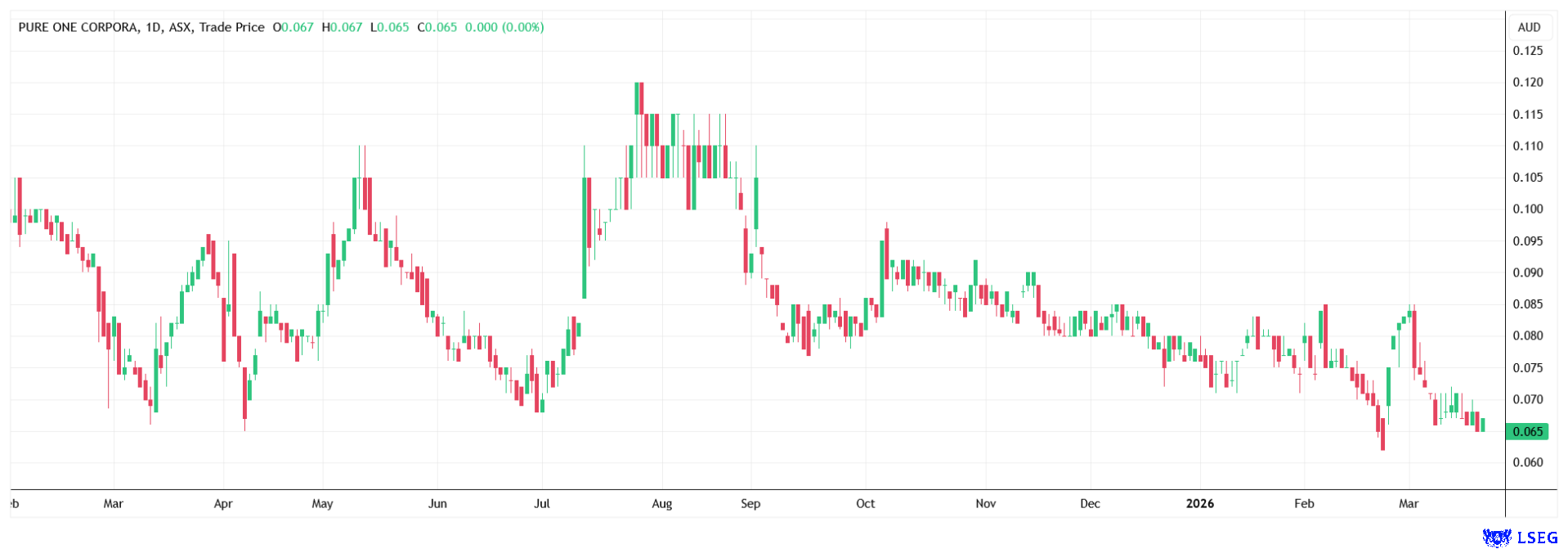
The half-year report, published in mid-March, underscores this positive development. The company presents a clear vision for the coming years. Experts forecast annual revenue growth of more than 50%. The goal is clearly defined: Pure One aims to be profitable within the next three years. In particular, the focus on commercial fleet solutions promises stable and growing revenue. Even though the stock price currently remains at a low level, the fundamental development is impressive. The combination of proven hydrogen technology and modern battery systems makes the company a real hidden gem in the cleantech sector. There is a matter-of-fact yet palpable sense of optimism. The stock appears undervalued following the general industry sell-off. If the projected growth rates materialize, Pure One could be poised for a dynamic upward move. From a technical perspective, the stock is finding support at its current level.
A look at SAP, Vonovia, and Pure One reveals a common pattern of undervaluation following a (massive) sell-off. While SAP faces a major challenge in transitioning to AI-based pricing, it possesses an operational foundation that is second to none. The cloud figures are a strong argument for a recovery in the near future. Vonovia has already achieved its operational turnaround and is once again shining with billions in profits, making the stock a classic value play in a recovery phase. Finally, Pure One offers significant upside potential in the clean energy sector. With the successful IPO of its subsidiary EGA and a clear focus on commercial fleet solutions, the company has done its homework. At current levels, all three stocks offer an exciting starting point for investors willing to think countercyclically. The period of negative performance could soon give way to a phase in which stock prices reflect the company's actual strength. It remains an exciting time for anyone who recognizes the potential behind the raw numbers.
Conflict of interest
Pursuant to §85 of the German Securities Trading Act (WpHG), we point out that Apaton Finance GmbH as well as partners, authors or employees of Apaton Finance GmbH (hereinafter referred to as "Relevant Persons") currently hold or hold shares or other financial instruments of the aforementioned companies and speculate on their price developments. In this respect, they intend to sell or acquire shares or other financial instruments of the companies (hereinafter each referred to as a "Transaction"). Transactions may thereby influence the respective price of the shares or other financial instruments of the Company.
In this respect, there is a concrete conflict of interest in the reporting on the companies.
In addition, Apaton Finance GmbH is active in the context of the preparation and publication of the reporting in paid contractual relationships.
For this reason, there is also a concrete conflict of interest.
The above information on existing conflicts of interest applies to all types and forms of publication used by Apaton Finance GmbH for publications on companies.
Risk notice
Apaton Finance GmbH offers editors, agencies and companies the opportunity to publish commentaries, interviews, summaries, news and the like on news.financial. These contents are exclusively for the information of the readers and do not represent any call to action or recommendations, neither explicitly nor implicitly they are to be understood as an assurance of possible price developments. The contents do not replace individual expert investment advice and do not constitute an offer to sell the discussed share(s) or other financial instruments, nor an invitation to buy or sell such.
The content is expressly not a financial analysis, but a journalistic or advertising text. Readers or users who make investment decisions or carry out transactions on the basis of the information provided here do so entirely at their own risk. No contractual relationship is established between Apaton Finance GmbH and its readers or the users of its offers, as our information only refers to the company and not to the investment decision of the reader or user.
The acquisition of financial instruments involves high risks, which can lead to the total loss of the invested capital. The information published by Apaton Finance GmbH and its authors is based on careful research. Nevertheless, no liability is assumed for financial losses or a content-related guarantee for the topicality, correctness, appropriateness and completeness of the content provided here. Please also note our Terms of use.