The global financial architecture is undergoing a period of profound change. While stock markets appear resilient thanks to AI, alarming imbalances are emerging in the credit sector and government budgets. Global debt has reached the USD 340 trillion mark, which is roughly three to four times the world's economic output. In this complex landscape, gold is proving its role as a store of value: data from the World Gold Council (WGC) shows that demand exceeded the 5,000-ton mark for the first time last year. Even after temporary sell-offs, the precious metal remains in extremely high demand, with central banks from China, India, and Poland acting as buyers. Forecasts from renowned financial institutions see the gold price returning to above the USD 6,000 mark in the medium term. While warning signs from the private credit market are driving investors toward established producers like Newmont, second-tier stocks are also coming into focus. For risk-conscious investors, Desert Gold offers attractive leverage.
time to read: 3 minutes | Author: Nico Popp
ISIN: DESERT GOLD VENTURES INC | CA25039N4084 | TSXV: DAU , OTCQB: DAUGF , BLUE OWL CAPITAL CORPORATION | US69121K1043 , NEWMONT CORP. DL 1_60 | US6516391066
Table of contents:
Author

Nico Popp
At home in Southern Germany, the passionate stock exchange expert has been accompanying the capital markets for about twenty years. With a soft spot for smaller companies, he is constantly on the lookout for exciting investment stories.
Tag cloud
Shares cloud
Blue Owl Capital: Bad News from the Private Credit Market
The private credit market, which has grown to a volume of around USD 2 trillion, is showing clear signs of overheating. Long touted as a lucrative alternative to traditional bonds, rising default rates among mid-market companies are leading to a reassessment of risks. One example is Blue Owl Capital, an asset manager with USD 165 billion in assets. The firm's flagship fund came under pressure in the first quarter of 2026 when investor redemption requests significantly exceeded the 5% limit. Analysts are warning of a liquidity mismatch in this context: while the underlying corporate loans are highly illiquid, the fund structures offer quarterly redemption options. The downgrading of loans to software companies illustrates the fragility of this segment. Due to advances in artificial intelligence, the prospects for many SaaS business models are dwindling. In contrast, tangible assets such as gold, which, unlike bonds, carry no counterparty risk, stand to benefit.
Newmont as a Core Gold Supplier
In traditional mining, Newmont is regarded as a reliable global player. As the world's largest gold producer, the company benefits directly from higher precious metal prices. The group closed the 2025 fiscal year with revenue of USD 16.5 billion and adjusted EBITDA of USD 6.2 billion. Through strict cost management, Newmont succeeded in stabilizing operating maintenance costs at USD 1,450 per ounce, which leads to enormous free cash flows when gold prices exceed USD 5,000 or higher. For shareholders, this financial strength pays off in the form of a steady dividend, which most recently stood at USD 0.25 per quarter. Analysts at Zacks Investment Research view the stock as a classic core investment that tracks the gold price with moderate operating leverage. However, for investors seeking greater return potential, gold blue-chip stocks face limitations due to their high market capitalization.
Desert Gold: Mali as an Underrated Location for Gold Explorers
Investors seeking maximum leverage must turn their attention to explorers that control extensive resources in regions that have not yet been fully evaluated. Here, Mali in West Africa comes into focus as a geographical hidden gem. Geologists consider the Senegal-Mali Shear Zone (SMSZ) to be one of the most gold-rich structures on the African continent. Industry giants such as Barrick Mining with the Loulo-Gounkoto complex or B2Gold with the Fekola mine have been operating highly profitable large-scale operations here for years. Although West Africa is often shunned by risk-averse investors, the Malian government has created much-needed regulatory clarity by passing new mining laws last year. An agreement was also reached in the dispute with Barrick Mining. This new legal certainty enables mining companies to reliably plan and economically advance their projects, which should significantly reduce the risk premium on projects in this region in the medium term. One thing is clear: the Malian government also has an interest in successful mining projects.
Desert Gold on The Verge of Moving Into Production
In what is arguably Mali's most promising region, the Canadian company Desert Gold Ventures is developing its SMSZ project. Covering an area of 440 sq km, the company holds the largest non-producing land package in the region, surrounded by existing world-class mines. Exploration work to date has already identified a confirmed resource of 1.1 million ounces of gold. The strategic turning point for Desert Gold is the transition from explorer to active producer, planned for the second half of 2026.
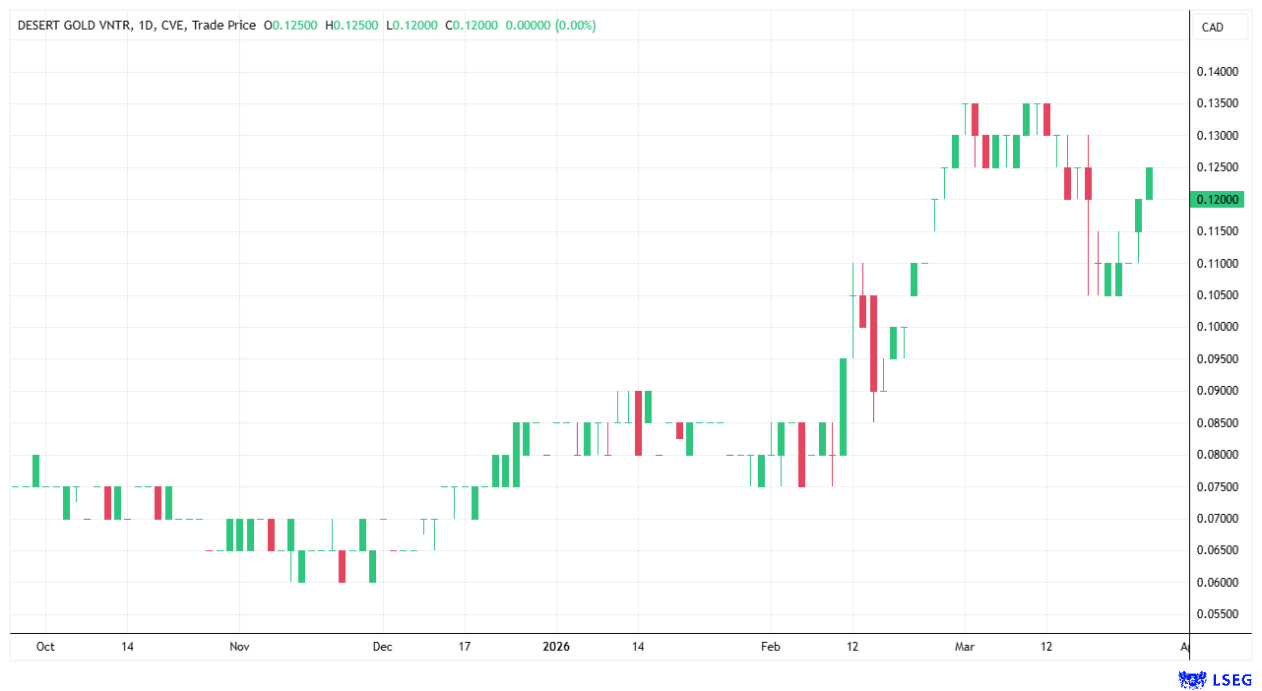
Management plans to construct a low-cost heap leach plant for the Barani East and Gourbassi West zones, initially targeting an annual production of 30,000 to 40,000 ounces. Research firm GBC Research has initiated coverage of the company with a clear "Buy" recommendation. Analysts emphasize the significant upside potential of the gold in the ground and set a price target of CAD 0.26. At current prices of around CAD 0.07, this corresponds to a theoretical return potential of over 270%. Investors see a setup with Desert Gold's stock where the ongoing gold boom meets an imminent start of production in a region overlooked by the market. Risk-aware investors should stay on top of Desert Gold and definitely keep the stock on their watchlist.
Watch YouTube videoConflict of interest
Pursuant to §85 of the German Securities Trading Act (WpHG), we point out that Apaton Finance GmbH as well as partners, authors or employees of Apaton Finance GmbH (hereinafter referred to as "Relevant Persons") currently hold or hold shares or other financial instruments of the aforementioned companies and speculate on their price developments. In this respect, they intend to sell or acquire shares or other financial instruments of the companies (hereinafter each referred to as a "Transaction"). Transactions may thereby influence the respective price of the shares or other financial instruments of the Company.
In this respect, there is a concrete conflict of interest in the reporting on the companies.
In addition, Apaton Finance GmbH is active in the context of the preparation and publication of the reporting in paid contractual relationships.
For this reason, there is also a concrete conflict of interest.
The above information on existing conflicts of interest applies to all types and forms of publication used by Apaton Finance GmbH for publications on companies.
Risk notice
Apaton Finance GmbH offers editors, agencies and companies the opportunity to publish commentaries, interviews, summaries, news and the like on news.financial. These contents are exclusively for the information of the readers and do not represent any call to action or recommendations, neither explicitly nor implicitly they are to be understood as an assurance of possible price developments. The contents do not replace individual expert investment advice and do not constitute an offer to sell the discussed share(s) or other financial instruments, nor an invitation to buy or sell such.
The content is expressly not a financial analysis, but a journalistic or advertising text. Readers or users who make investment decisions or carry out transactions on the basis of the information provided here do so entirely at their own risk. No contractual relationship is established between Apaton Finance GmbH and its readers or the users of its offers, as our information only refers to the company and not to the investment decision of the reader or user.
The acquisition of financial instruments involves high risks, which can lead to the total loss of the invested capital. The information published by Apaton Finance GmbH and its authors is based on careful research. Nevertheless, no liability is assumed for financial losses or a content-related guarantee for the topicality, correctness, appropriateness and completeness of the content provided here. Please also note our Terms of use.