January 19th, 2026 | 07:40 CET
CEO Buys Big – Almonty Turns into a Raw-Material Weapon Against China
Without tungsten, many key industries would grind to a halt. The transition metal is indispensable for armaments, semiconductors, aerospace, and is now moving further into the center of strategic interests with fusion research. At the same time, China controls over 80% of global supply and is tightening its export restrictions. The West is desperately seeking alternatives. This is precisely where Almonty Industries positions itself as one of the largest non-Chinese tungsten producers. The stock is receiving additional attention due to significant insider purchases by CEO Lewis Black - a signal that investors should not ignore.
time to read: 3 minutes | Author: Stefan Feulner
ISIN: ALMONTY INDUSTRIES INC. | CA0203987072
Table of contents:
Author

Stefan Feulner
The native Franconian has more than 20 years of stock exchange experience and a broadly diversified network.
He is passionate about analyzing a wide variety of business models and investigating new trends.
Tag cloud
Shares cloud
No strategic autonomy without tungsten
This extremely heat-resistant and dense raw material is indispensable for defense, aerospace, semiconductors, mechanical engineering, and increasingly also for future technologies such as nuclear fusion. At the same time, China controls over 80% of the global supply. With tighter export controls and only temporary export licenses, Beijing is increasingly using this dominance for geopolitical purposes. This is increasing the pressure on Western industries to establish alternative supply chains. This is precisely where Almonty Industries comes in as the largest Western tungsten producer with mines in Europe, Asia, and, in the future, the US.
From raw material to strategic commodity
Tungsten has long been much more than a classic niche metal for special applications. In addition to its firm place in the defense industry, aerospace, mechanical engineering, and semiconductor manufacturing, the raw material is increasingly becoming the focus of a technology that could fundamentally change the global energy system: nuclear fusion. In international test facilities such as the French Tokamak WEST and the South Korean KSTAR, new records in temperature, runtime, and plasma stability have recently been achieved using tungsten components.
The reason for this development lies in the metal's unique material properties. Tungsten can withstand extreme heat flows and temperatures of several million degrees without structural failure. At the same time, it binds significantly less tritium than previous carbon-based inner walls, which is crucial for the long-term and controlled operation of fusion reactors. Although tungsten places high demands on purity and process control, this is precisely where researchers see the key to the long-term operation of future reactors. If the transition from the experimental phase to commercial use of nuclear fusion is successful, this could not only increase demand for tungsten but also change it structurally and permanently.
Western supply dependent on Almonty
Almonty Industries is closing this strategic supply gap with visible operational progress. In South Korea, active mining has already begun at the Sangdong project, with commercial production set to start imminently. Sangdong is considered to be the largest tungsten mine outside China in the future and is therefore of enormous importance for the security of supply for Western industrial and defense companies. At the same time, Almonty is pushing ahead with the expansion of the established Panasqueira mine in Portugal, which has been reliably supplying tungsten for years and can contribute additional volumes in the short term.
At the same time, the Company is establishing a strategically important presence in the US with the Gentung Brown's Lake project in Montana. The site has permits and existing infrastructure, with production scheduled to start in 2026. All in all, this creates a geographically diversified production portfolio in politically stable regions, which gives the Company a clear competitive advantage over Chinese-dominated supply chains.
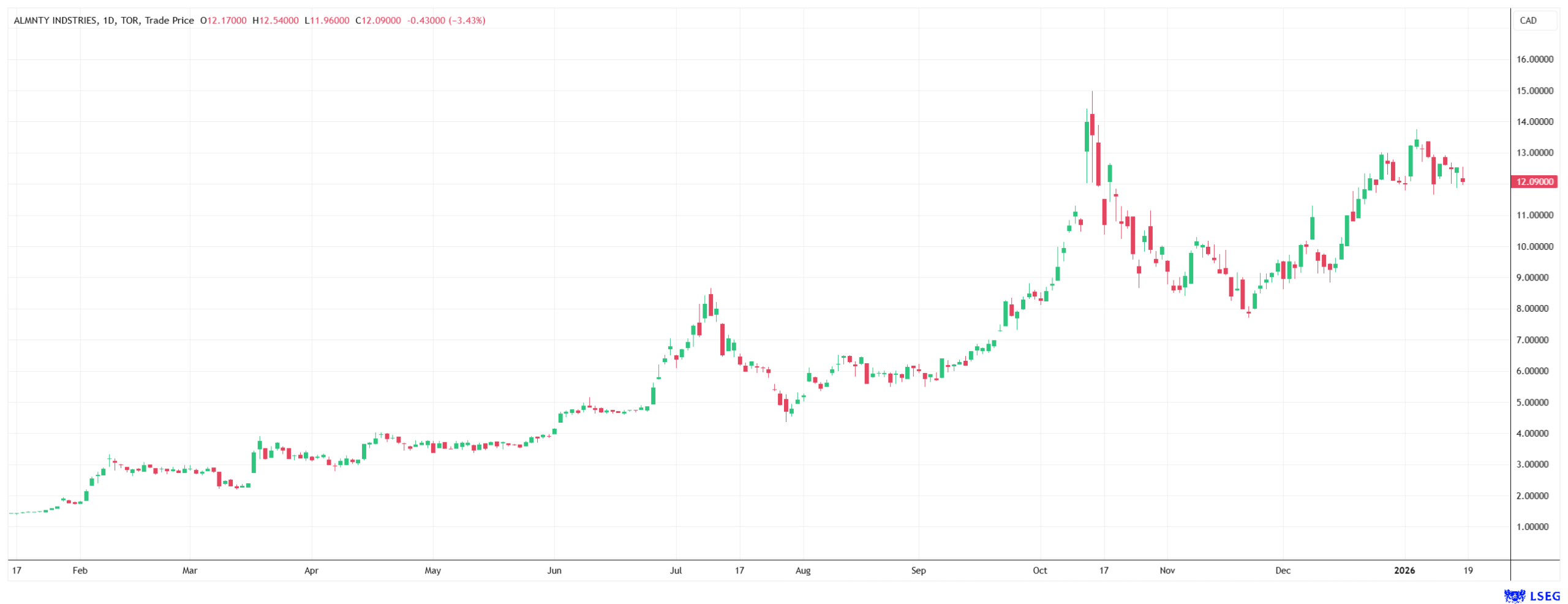
The market environment also plays into Almonty's hands. The spot price for tungsten is now over USD 800 per MTU, and CEO Lewis Black even considers USD 1,000 per MTU to be realistic. It is particularly noteworthy that Almonty is already operating profitably at around USD 300 per MTU. While many analysts are still calculating with significantly lower price assumptions, current market prices show the earnings potential that could open up if the supply shortage continues.
Insider purchases: Three transactions, one clear signal
The market is paying particular attention to Lewis Black's recent activities. The CEO has significantly increased his personal commitment in recent months:
• November 2025: Share purchase worth USD 316,500
• December 2025: further acquisition worth CAD 412,499.25
• January 2026: further purchase worth CAD 184,999.26
The transactions were carried out as part of capital measures and through the conversion of warrants, which provided Almonty with additional fresh capital. Black now holds a total of 23.62 million shares, or 8.99% of the Company, ranking second among shareholders behind Global Tungsten & Powders Corp.
Tungsten is evolving from a specialty metal to a key geopolitical commodity. With operational mines, a major project in South Korea about to start production, and planned expansion into the US, Almonty is positioning itself as the key Western alternative to China. The insider purchases by CEO Lewis Black can be seen as a sign of confidence in the business model. In its latest study, the analyst firm Canto Fitzgerald set a target price of USD 10.
Conflict of interest
Pursuant to §85 of the German Securities Trading Act (WpHG), we point out that Apaton Finance GmbH as well as partners, authors or employees of Apaton Finance GmbH (hereinafter referred to as "Relevant Persons") may hold shares or other financial instruments of the aforementioned companies in the future or may bet on rising or falling prices and thus a conflict of interest may arise in the future. The Relevant Persons reserve the right to buy or sell shares or other financial instruments of the Company at any time (hereinafter each a "Transaction"). Transactions may, under certain circumstances, influence the respective price of the shares or other financial instruments of the Company.
In addition, Apaton Finance GmbH is active in the context of the preparation and publication of the reporting in paid contractual relationships.
For this reason, there is a concrete conflict of interest.
The above information on existing conflicts of interest applies to all types and forms of publication used by Apaton Finance GmbH for publications on companies.
Risk notice
Apaton Finance GmbH offers editors, agencies and companies the opportunity to publish commentaries, interviews, summaries, news and the like on news.financial. These contents are exclusively for the information of the readers and do not represent any call to action or recommendations, neither explicitly nor implicitly they are to be understood as an assurance of possible price developments. The contents do not replace individual expert investment advice and do not constitute an offer to sell the discussed share(s) or other financial instruments, nor an invitation to buy or sell such.
The content is expressly not a financial analysis, but a journalistic or advertising text. Readers or users who make investment decisions or carry out transactions on the basis of the information provided here do so entirely at their own risk. No contractual relationship is established between Apaton Finance GmbH and its readers or the users of its offers, as our information only refers to the company and not to the investment decision of the reader or user.
The acquisition of financial instruments involves high risks, which can lead to the total loss of the invested capital. The information published by Apaton Finance GmbH and its authors is based on careful research. Nevertheless, no liability is assumed for financial losses or a content-related guarantee for the topicality, correctness, appropriateness and completeness of the content provided here. Please also note our Terms of use.