April 21st, 2026 | 07:15 CEST
Canada's Defense Budget is Exploding, and Volatus Aerospace is Delivering - Ahead of the Institutional Wave
Canada is overhauling its defense strategy—and one company from Ontario is already right in the thick of it rather than just watching from the sidelines. Volatus Aerospace has rapidly evolved from a commercial drone provider into an integrated platform for defense, industry, and training. Those who take a closer look at the latest figures will find compelling details: a growing defense business, recurring service revenue, and a balance sheet that allows for further expansion. The key question for investors is no longer whether Volatus can deliver, but how quickly the market will recognize the story.
time to read: 4 minutes | Author: Armin Schulz
ISIN: VOLATUS AEROSPACE INC | CA92865M1023 | TSXV: FLT , OTCQB: TAKOF
Table of contents:
Author

Armin Schulz
Born in Mönchengladbach, he studied business administration in the Netherlands. In the course of his studies he came into contact with the stock exchange for the first time. He has more than 25 years of experience in stock market business.
Tag cloud
Shares cloud
Three Interlocking Pillars
Volatus's business model rests on three pillars, and it is precisely this combination that makes the model compelling. First is the defense division with reconnaissance drones, defense systems against enemy drones using the SKYDRA™ platform, and training programs for NATO partners. Second are commercial aerial services for energy suppliers and infrastructure operators. Third is the sale of drones, cargo platforms, and training.
What looks like a classic mix at first glance turns out, upon closer inspection, to be a well-thought-out platform strategy. Commercial operations provide operational data and regulatory credibility. Training fosters long-term customer loyalty. And the defense division opens doors to large, high-margin government contracts. Each pillar supports the others.
The Numbers That Speak For Themselves
In fiscal year 2025, Volatus Aerospace generated CAD 34.2 million in revenue, a 26% increase over the previous year. The gross margin remained stable at around 32%. Noteworthy is the shift in the revenue structure. The defense segment's share climbed to 25%, up from just 5% two years ago. Management is targeting 60–65% in the medium term. This is not a cautious step, but a clear strategic shift.
Even more important for confidence in the future, cash reserves amount to approximately CAD 40 million. This makes the company more liquid than ever before. At the same time, adjusted EBITDA improved by 25% compared to the previous year. Losses are shrinking, while investments in manufacturing and development remain high. This is precisely the pattern of a company that is consciously investing in scaling up before profits start flowing.
Annual recurring revenue (ARR) stands at approximately CAD 20 million. Added to this is an order pipeline of over CAD 600 million. This is not a distant prospect, but business that has already been booked or is in advanced negotiations.
This reflects a substantial pipeline of advanced-stage opportunities.
The Defense Lever: Timing Is Everything
With its Defense Industrial Strategy, Canada has presented a plan that plays right into Volatus's hands. CAD 6.6 billion is earmarked for non-dilutive financing, with long-term demand estimated at CAD 80 billion. The government aims to award 70% of procurement contracts to domestic companies. And unmanned systems have been officially declared a "core sovereign capability."
Volatus Aerospace has exactly what Ottawa is looking for right now: its own manufacturing facility. The new plant in Mirabel near Montreal is designed for an annual capacity equivalent to CAD 250 million. The first production runs will begin in the coming weeks. Anyone looking to build drones on a large scale in Canada today can hardly avoid Volatus.
Added to this are concrete orders that are no longer mere letters of intent. Repeated orders from NATO customers for reconnaissance drones show that the systems are proving their worth in the field. A CAD 9 million training contract from an alliance partner has already been booked. The national framework agreement with the Canadian government has been extended.
Software as a Margin Booster
In parallel with its hardware business, Volatus is building a second pillar that many investors have not yet noticed. With SKYDRA™, a SaaS platform for drone defense planning and simulation, the company is targeting a market estimated to exceed USD 20 billion by 2030. The expected margins for such software solutions are 80–85%, a completely different caliber than hardware sales.
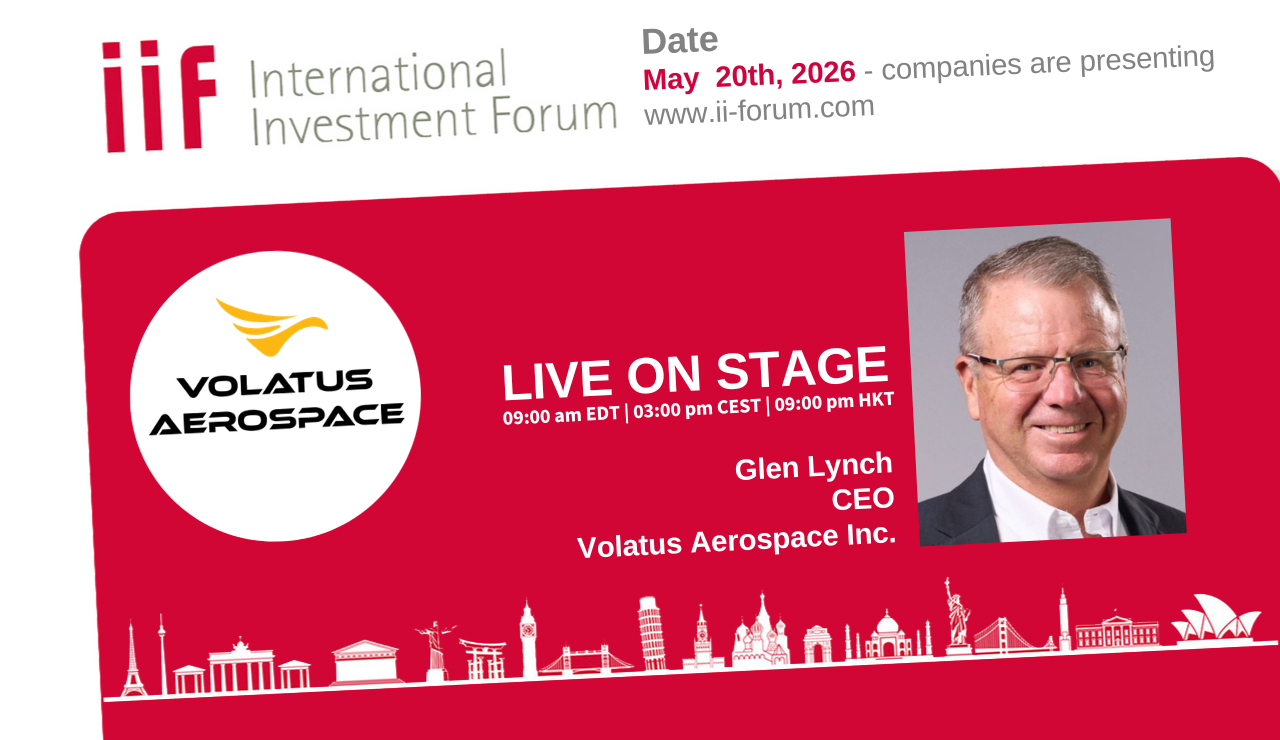
"As our first SaaS platform, SKYDRA™ represents an important milestone for Volatus and creates a recurring revenue stream from software sales as part of our defense strategy," said CEO Glen Lynch at the launch. Although the product is still in the evaluation phase, the strategic direction is clear. The goal is to reduce hardware sales in favor of more digital value creation, backed by patent applications—making it difficult to copy.
The Quiet Foundation: Recurring Revenue from Industry
While the defense division makes headlines, the commercial business delivers what every growth company needs: predictable, recurring revenue. Volatus Aerospace monitors pipelines, power lines, and offshore wind farms under long-term contracts. A current two-year contract with a major offshore wind operator calls for the use of heavy-lift delivery drones capable of transporting up to 100 kg directly to the turbine hub. If the pilot phase is successful, the customer could expand the model to its entire fleet of over 1,500 turbines.
Pipeline monitoring is another key strength. Volatus has already logged more than 75,000 flight hours in this area. Customers, energy suppliers and pipeline operators value the combination of manned and unmanned systems. With the full acquisition of Synergy Aviation, revenue from its helicopter fleets now flows directly into the company's coffers.
Insiders Are Investing Their Own Money
If you really want to understand a company's management, do not look at the presentations—look at its shareholder structure. At Volatus, the picture is clear: over 20% of the shares are held by insiders. No board member has sold shares in the past 7 years, not even during periods when the stock price rose significantly. All full-time employees participate through a stock ownership program.
This is a strong signal. Executives who invest their own wealth in the company and keep it there think in terms of years, not quarters. This continuity creates a different kind of commitment and alleviates at least some of the typical risks associated with growth companies for investors.
The stock is currently trading at CAD 0.70.
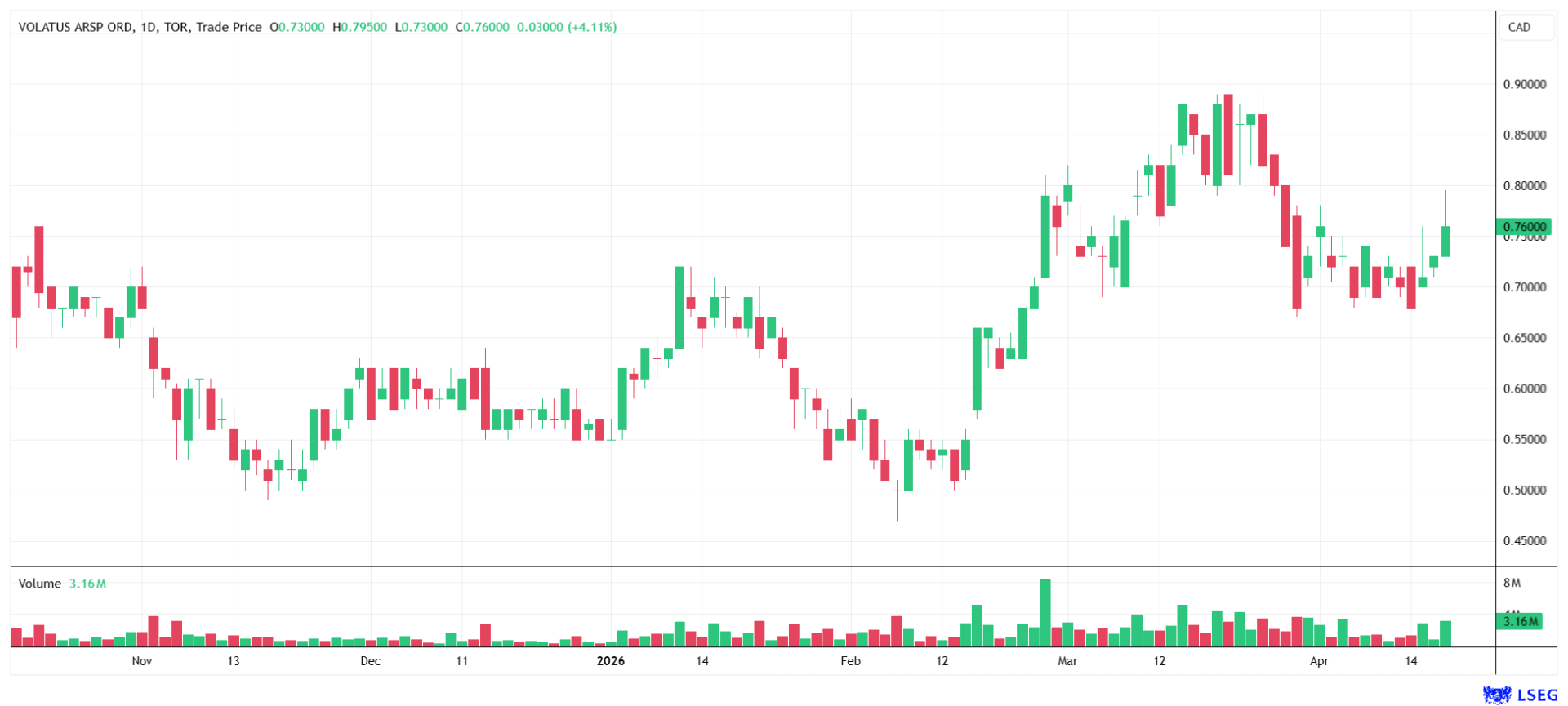
Volatus Aerospace has established its three pillars, financials are improving quarter by quarter, and the broader political landscape could not be more favorable. Insiders have invested their money and are keeping it in. Those looking to bet on the intersection of drone technology, Canadian defense expansion, and recurring software revenue will find a company here that is already delivering. The valuation gap relative to comparable players will close; the key question is how quickly.
Conflict of interest
Pursuant to §85 of the German Securities Trading Act (WpHG), we point out that Apaton Finance GmbH as well as partners, authors or employees of Apaton Finance GmbH (hereinafter referred to as "Relevant Persons") currently hold or hold shares or other financial instruments of the aforementioned companies and speculate on their price developments. In this respect, they intend to sell or acquire shares or other financial instruments of the companies (hereinafter each referred to as a "Transaction"). Transactions may thereby influence the respective price of the shares or other financial instruments of the Company.
In this respect, there is a concrete conflict of interest in the reporting on the companies.
In addition, Apaton Finance GmbH is active in the context of the preparation and publication of the reporting in paid contractual relationships.
For this reason, there is also a concrete conflict of interest.
The above information on existing conflicts of interest applies to all types and forms of publication used by Apaton Finance GmbH for publications on companies.
Risk notice
Apaton Finance GmbH offers editors, agencies and companies the opportunity to publish commentaries, interviews, summaries, news and the like on news.financial. These contents are exclusively for the information of the readers and do not represent any call to action or recommendations, neither explicitly nor implicitly they are to be understood as an assurance of possible price developments. The contents do not replace individual expert investment advice and do not constitute an offer to sell the discussed share(s) or other financial instruments, nor an invitation to buy or sell such.
The content is expressly not a financial analysis, but a journalistic or advertising text. Readers or users who make investment decisions or carry out transactions on the basis of the information provided here do so entirely at their own risk. No contractual relationship is established between Apaton Finance GmbH and its readers or the users of its offers, as our information only refers to the company and not to the investment decision of the reader or user.
The acquisition of financial instruments involves high risks, which can lead to the total loss of the invested capital. The information published by Apaton Finance GmbH and its authors is based on careful research. Nevertheless, no liability is assumed for financial losses or a content-related guarantee for the topicality, correctness, appropriateness and completeness of the content provided here. Please also note our Terms of use.