March 5th, 2026 | 08:00 CET
Buy when the cannons thunder – Is Glencore, Power Metallic Mines, or Vale next?
The war in the Middle East is shaking up the stock markets – and revealing opportunities that are hardly visible at first glance. While defense stocks are treading water, savvy investors are hunting for returns in a completely different place: the mining sector. Modern missiles, after all, rely on rare metals – and those come straight from the ground. Alongside established giants like Glencore and Vale, a Canadian exploration company with deposits in Québec is gaining attention: Power Metallic Mines. Whether as a direct beneficiary of the arms race, a partner to the green industry, or a potential takeover target, it is a stock worth watching.
time to read: 5 minutes | Author: Mario Hose
ISIN: POWER METALLIC MINES INC. | CA73929R1055 | TSXV: PNPN , OTCBB: PNPNF , GLENCORE PLC DL -_01 | JE00B4T3BW64 , VALE S.A. | BRVALEACNOR0
Table of contents:
Author

Mario Hose
Born and raised in Hannover, Lower Saxony follows social and economic developments around the globe. As a passionate entrepreneur and columnist he explains and compares the most diverse business models as well as markets for interested stock traders.
Tag cloud
Shares cloud
Defense stocks disappoint, commodities stable
"Buy when the cannons thunder." This cynical but time-tested stock market wisdom is often attributed to the legendary André Kostolany, though it likely originates with the Frankfurt banker Carl Mayer von Rothschild (1788–1855).
Since the weekend, the cannons have been thundering loudly in the Middle East. Prices on the world's stock markets are plummeting. But who would want to buy in such an environment? And above all, what? Not even the three major German defense stocks Rheinmetall, Hensoldt, and TKMS managed to gain ground at the beginning of the week. Oil stocks such as Shell and TotalEnergies have benefited the most, but what if their recent price surge proves to be a flash in the pan? The OPEC+ countries have already announced an increase in production quotas, which could quickly stabilize the oil price again, weighing on producers' shares.
Clever investors in the tradition of Kostolany or Mayer von Rothschild know that times of geopolitical upheaval reveal hidden opportunities. In a crisis, these opportunities often lie in the mining sector, particularly among suppliers of metals critical for modern warfare. The shares of companies such as Glencore, Vale, and Power Metallic Mines have remained relatively stable amid the recent stock market turmoil - and for good reason.
500 ounces of silver per missile: The hunger for raw materials for modern weapons
Due to the attack on Iran, which is responding with corresponding counterstrikes, the US and Israel are slowly running out of missiles. This affects air defense missiles, for example from the Patriot system, but also Tomahawk cruise missiles. "We are using up the missiles faster than we can replace them," a leading US military scientist warned the Wall Street Journal. Modern guided missiles such as Tomahawks require up to 500 ounces of silver per unit for electronics and batteries alone. Nickel, gold, and platinum (for engines) as well as copper and palladium (for guidance systems) are also indispensable.
All of these critical raw materials can be found in the deposits of Power Metallic Mines, one of North America's most promising junior explorers. The Toronto-based company gained attention last year after a series of strategic acquisitions in Québec, culminating in control of a 313 sq km land package, including the Nisk–Lion–Tiger Corridor, where drilling has revealed exceptionally rich ore concentrations.
Polymetallic deposits with record recovery rates in Québec
Metallurgical tests by SGS Canada show that recovery rates in the Nisk mining area are exceptionally high: nickel is already at 77.1%, while gold (85.0%), silver (88.9%), palladium (93.9%), and platinum (96.8%) exceed typical benchmarks. Copper recovery is near the physical maximum at 98.9%. This means that Power Metallic Mines not only holds these critical raw materials in its portfolio, but can also extract them at lower costs and with a higher degree of purity than most competitors. Added to this are location advantages: Canada offers political stability and is a global leader in sustainable mining, supported by extensive hydropower infrastructure for low-impact extraction.
Power Metallic Mines will not yet be involved in the urgently needed short-term replacement procurement of missile raw materials, as the company has not yet extracted anything apart from test drilling. However, this is not a major setback, as critical metals such as nickel, cobalt, and others are also needed for countless other military purposes – from cartridge cases and rifle barrels to components for radar systems. Demand will remain high for years to come due to the global arms race. Prices for strategic metals are unlikely to have peaked yet.
As the management team led by CEO Terry Lynch is committed to specific sustainability criteria, such as CO2-neutral mining, the defense industry is not expected to be the main customer when mining begins in the Lion-Tiger Corridor in 2027. Manufacturers of drive batteries for electric vehicles and suppliers of components for the wind and solar industries, in particular, feel more committed to environmentally friendly mining methods than the defense industry. There is therefore no shortage of sales markets for raw materials, which are becoming increasingly scarce due to geopolitical tensions.
Controversial mining areas
Even Power Metallic Mines' much larger competitors have not failed to notice the trend toward sustainability, if only because of supply chain control laws. The mining of copper and cobalt in the Democratic Republic of Congo is particularly controversial due to child labor, health hazards, and a lack of safety precautions. The mining company Vale ceased its activities in the country years ago and plans to focus more on its home market in Brazil – and on Canada!
Nevertheless, Vale continues to mine nickel and cobalt in Indonesia through subsidiaries and partnerships, which has considerable potential for conflict due to the massive environmental damage caused. Critical shareholders accuse Vale Indonesia of deforestation, water pollution – including with hexavalent chromium, a carcinogenic heavy metal – and the displacement of indigenous communities. At the beginning of the year, pending approvals from the Indonesian government (albeit primarily for other reasons) even led to a temporary shutdown of mines, which in turn drove up the price of nickel.
Vale's competitor Glencore has already been criticized several times for its involvement in a British nickel consortium and its close cooperation with the local Harita Nickel Group in Indonesia. On the day of last year's general meeting, protests took place at the company's headquarters in Zug, Switzerland, as well as in Johannesburg, Bogotá, Buenos Aires, London, and Amsterdam, and in front of Glencore's San Marcos copper mine in Peru. Activists have been targeting the British-Swiss mining giant for years because of its continued coal mining and allegations of human rights violations.
Partial withdrawal from Congo projects
Glencore is also the largest cobalt producer in the Western world, which, of course, has to do with mines in the Democratic Republic of Congo. In August 2024, the company was ordered to pay a total of USD 152 million due to corrupt mining deals there. Glencore sold 40% of two of its Congolese copper and cobalt mines a month ago – almost simultaneously with the end of merger talks with the multinational Rio Tinto Group.
Despite the faded merger fantasy and the outbreak of war in the Middle East, Glencore's share price remains stable, which is likely due in part to the high dividend yield of nearly 5%. Vale is spoiling shareholders with even higher distributions. More than 6% is expected for this year.
Lassonde curve and takeover speculation
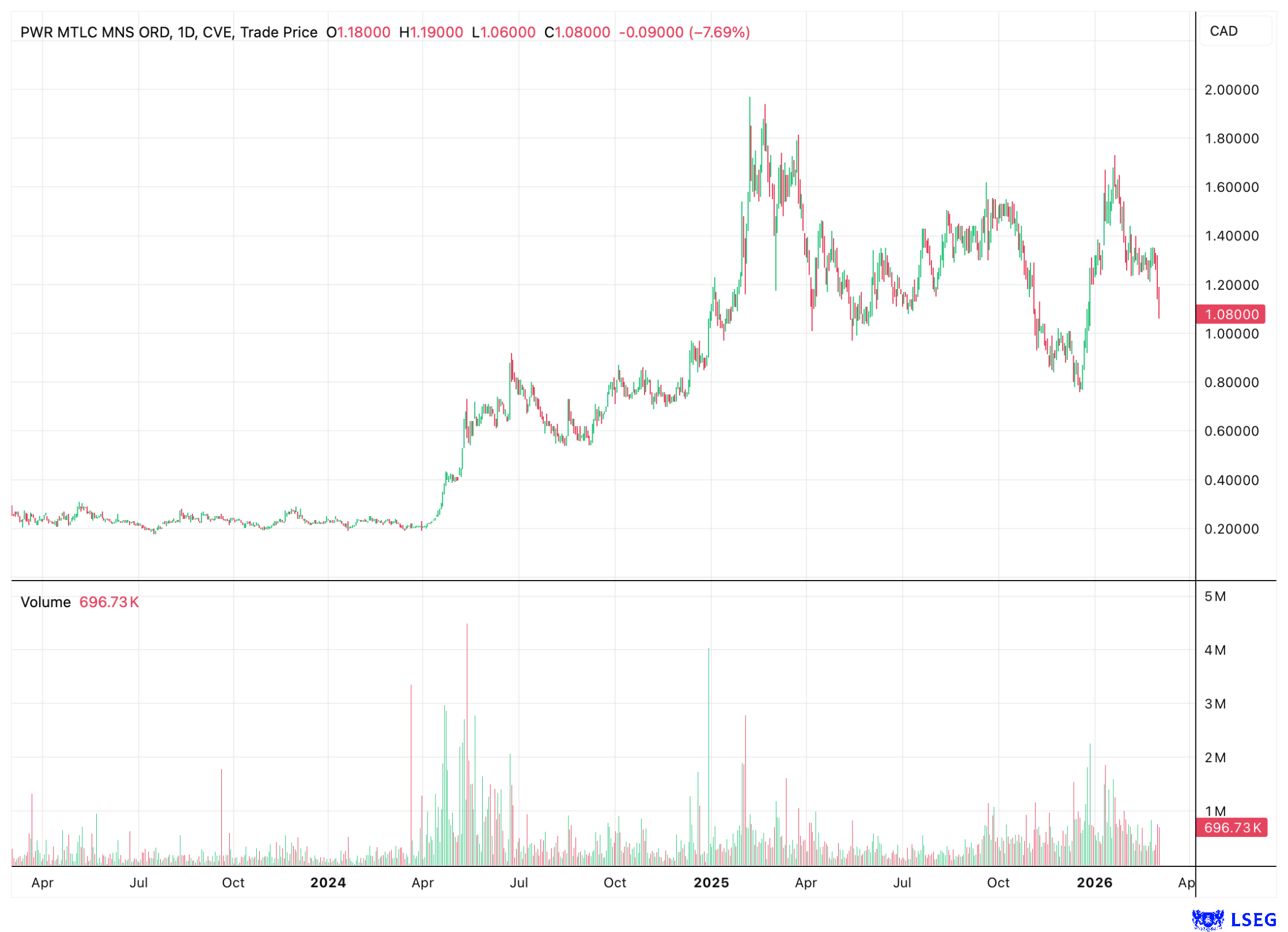
Analysts do not expect Power Metallic Mines to pay dividends for years to come. Nevertheless, the stock is interesting not only because of the so-called Lassonde curve. The theory of renowned mining investor Pierre Lassonde states that the value of a mining company rises particularly sharply when production begins. This would make the stock a hot candidate for an upward price surge by 2027 at the latest.
However, since Vale and Glencore mine the same critical metals in Québec as their smaller competitor, a takeover could happen even sooner. The two multi-billion-dollar companies could certainly afford it. Power Metallic Mines' market capitalization is just under USD 200 million – a fraction of the USD 9 billion valuation of the 40% sale of Glencore's Congo business.
Conflict of interest
Pursuant to §85 of the German Securities Trading Act (WpHG), we point out that Apaton Finance GmbH as well as partners, authors or employees of Apaton Finance GmbH (hereinafter referred to as "Relevant Persons") may hold shares or other financial instruments of the aforementioned companies in the future or may bet on rising or falling prices and thus a conflict of interest may arise in the future. The Relevant Persons reserve the right to buy or sell shares or other financial instruments of the Company at any time (hereinafter each a "Transaction"). Transactions may, under certain circumstances, influence the respective price of the shares or other financial instruments of the Company.
In addition, Apaton Finance GmbH is active in the context of the preparation and publication of the reporting in paid contractual relationships.
For this reason, there is a concrete conflict of interest.
The above information on existing conflicts of interest applies to all types and forms of publication used by Apaton Finance GmbH for publications on companies.
Risk notice
Apaton Finance GmbH offers editors, agencies and companies the opportunity to publish commentaries, interviews, summaries, news and the like on news.financial. These contents are exclusively for the information of the readers and do not represent any call to action or recommendations, neither explicitly nor implicitly they are to be understood as an assurance of possible price developments. The contents do not replace individual expert investment advice and do not constitute an offer to sell the discussed share(s) or other financial instruments, nor an invitation to buy or sell such.
The content is expressly not a financial analysis, but a journalistic or advertising text. Readers or users who make investment decisions or carry out transactions on the basis of the information provided here do so entirely at their own risk. No contractual relationship is established between Apaton Finance GmbH and its readers or the users of its offers, as our information only refers to the company and not to the investment decision of the reader or user.
The acquisition of financial instruments involves high risks, which can lead to the total loss of the invested capital. The information published by Apaton Finance GmbH and its authors is based on careful research. Nevertheless, no liability is assumed for financial losses or a content-related guarantee for the topicality, correctness, appropriateness and completeness of the content provided here. Please also note our Terms of use.