July 1st, 2026 | 07:15 CEST
Bitcoin to Zero? Lahontan Gold Remains Stable! USD 800 Million Waiting in Nevada
Three of the world's most well-known investors have never been fans of Bitcoin. One of them is now warning that the cryptocurrency could eventually fall to zero. As the digital (so-called) gold substitute comes under pressure, even traditional precious metals are currently experiencing a pronounced phase of weakness. Nevertheless, the share price of an emerging gold producer remains notably stable—and for good reason. Lahontan Gold is on the verge of a potential breakthrough and could remain highly profitable even if the price of gold were to halve. The company is backed by a management team with a proven track record.
time to read: 7 minutes | Author: Jens Castner
ISIN: LAHONTAN GOLD CORP | CA50732M1014 | TSXV: LG , OTCQB: LGCXF
Table of contents:
Author

Jens Castner
The Nuremberg native brings over three decades of capital markets experience, backed by a career shaped by deep market insight and a genuine passion for investing. His journey began in 1994 through an investment club among colleagues – a formative experience that sparked a lifelong dedication to identifying compelling investment opportunities.
Following senior editorial roles at Nürnberger Nachrichten, €uro am Sonntag, and €uro, he went on to serve as Editor-in-Chief of the renowned investor magazine Börse Online from 2014, where he played a key role in shaping high-quality financial journalism for a broad investor audience.
Tag cloud
Shares cloud
The Cassandra-like warnings are growing louder
Jeremy Grantham is not your typical doomsday prophet. The British investor and co-founder of the Boston-based asset management firm GMO has always backed up his warnings with data—and was right when it mattered. He warned of the dot-com bubble before the Nasdaq index and the Neuer Markt collapsed. He warned about the US housing market before Lehman Brothers collapsed. Now Grantham says Bitcoin will "certainly fall to zero". He describes the cryptocurrency as a "useless, speculative mechanism."
In this regard, he is in illustrious company. Investing legend Warren Buffett publicly called Bitcoin "rat poison squared." His longtime business partner, Charlie Munger, who passed away at age 99 in late 2023, was even more blunt. He found cryptocurrencies "disgusting" and said at a Berkshire Hathaway annual meeting that he wished they had never been invented. Both invested their money in line with their convictions. When new records were being set week after week on the Nasdaq tech exchange around the turn of the millennium and internet stocks were considered money-printing machines, Buffett and Munger pointedly stayed away. Instead, Buffett bought silver—about 130 million ounces. The financial press scoffed. A few years later, no one was asking sarcastically why the Berkshire Hathaway leadership duo had missed the tech rally.
Waiting for Hard Times
Buffett is also wary of the current AI hype. He has long warned of another bubble and a general overvaluation of the US stock market. That is why he has been hoarding cash like a champion for years so that he can go on a buying spree in the event of a major correction. When he stepped down as CEO of Berkshire Hathaway at the turn of the year, he left his successor, Greg Abel, with a fertile field: nearly USD 400 billion sits in the company's coffers. And as long as the "Oracle of Omaha" is alive, that money certainly will not be flowing into cryptocurrencies.
Even the core arguments used to describe Bitcoin as "digital gold" do not help here: its supply is limited, the cryptocurrency is not subject to inflation, and the network behind it is decentralized, meaning no central banks can influence its price. Yet a true store of value should exude stability precisely when sentiment shifts. Bitcoin does not. Gold has also corrected sharply from its high of USD 5,600 per ounce. But the yellow metal has a millennia-old reputation as a store of purchasing power. Central banks worldwide hold it and are actively buying more, especially as the gradual replacement of the USD as the global reserve currency is increasingly discussed. Gold has no server costs, no dependence on electricity, and no counterparty risk. Bitcoin has none of these anchors.
Stable When It Counts
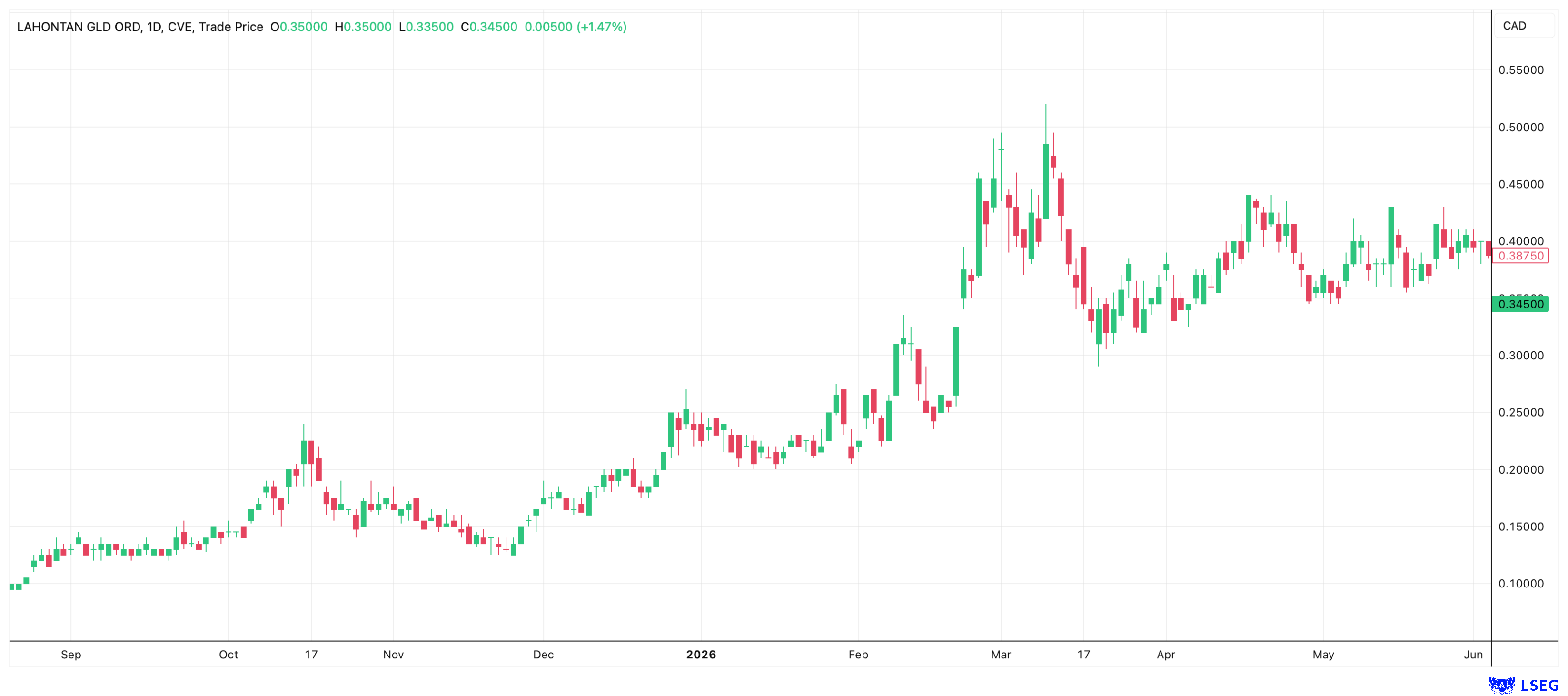
From its peak of around USD 126,000, Bitcoin has since plummeted by more than 50% and is trading at just over USD 51,000—its lowest point of the year. Meanwhile, a small Canadian company exudes remarkable calm: Lahontan Gold, listed on the Toronto Stock Exchange, aims to revive the historic Santa Fe Mine in Nevada's Walker Lane Trend, one of North America's most productive gold regions. Despite the correction in the gold price, the stock has remained fairly stable between CAD 0.30 and 0.40, even though the explorer, with a market capitalization of around CAD 150 million, is in the small-cap segment, which is considered particularly volatile. This relative strength is no coincidence.
The Santa Fe Mine's resource profile comprises approximately 1.95 million ounces of gold equivalent (AuEq). At the current gold price, this represents a revenue potential of USD 7.8 billion. Even if the gold price were to halve to USD 2,000 per ounce, the achievable revenues of USD 3.9 billion would still be enormous. Thanks to the heap leaching process commonly used in Nevada, production costs are a favourable USD 1,200 per ounce. In this process, crushed ore is piled on a sealed surface and doused with a dilute cyanide solution, which chemically leaches out the gold. The gold-bearing liquid is collected and further processed. The process has been technically proven for decades and allows for economical mining even with comparatively low gold grades in the rock.
A Mine That Produces Twice
The real highlight, however, is the 200,000 ounces simply lying around on the heap leach tailings piles. Between 1988 and 1994, the operators processed around 16 million metric tonnes of material there—with a meagre recovery rate of 70% because the technology of the time would not allow for anything better. The rest was left behind as "waste"—no surprise given the gold price at the time, which, from today's perspective, seems almost laughable at just USD 340 per ounce. New metallurgical studies show that, using modern chemistry, gold and silver recovery rates of 81% and 60%, respectively, can be achieved. The forgotten 200,000 ounces alone are worth around USD 800 million, which far exceeds Lahontan's market capitalization and could easily cover the estimated USD 135 million in construction costs to reactivate the mine (including a 20% safety reserve). And Santa Fe is just one of four major mining areas that Lahontan has its sights set on. In this context, it is worth watching the video interview with IIF host Lyndsay Malchuk and CEO Kimberly Ann, below:
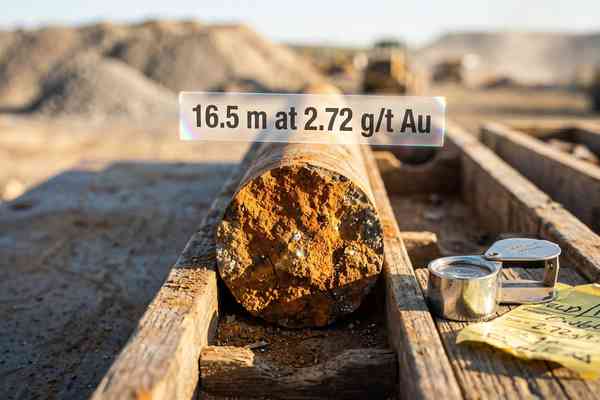
Drilling delivered spectacular results, particularly at the West Santa Fe satellite project, located just 13 km away: 36.6 m grading 3.11 g/t AuEq, including a high-grade interval of 10.7 m grading 5.75 g/t AuEq—pure oxide material directly from the surface. To put this in perspective, in Nevada, mining is considered highly profitable even at gold grades of 0.21 g/t. The 19 km² area has received little attention to date. It offers the advantage that, once production begins, the ore can be transported by truck over a short distance to the existing infrastructure of the main Santa Fe mine. The gap between market capitalization and project value would already be exceptionally large based on this alone—and this does not even account for the Redlich and Moho areas, which are also located within the Walker Lane Trend. With the latter in particular, boasting historical gold grades of up to 25 g/t gold and 300 g/t silver, it has the potential to become the next crown jewel of the portfolio.
Milestones on Schedule
For now, however, the management team led by CEO Kimberly Ann and Chief Exploration Officer Brian Maher is focusing entirely on the main Santa Fe project. Negotiations with banks are already underway, as construction costs are to be financed through loans rather than capital increases to avoid diluting shareholders. Initial letters of intent have already been received—and it is not expected that the extraction of these treasures will fail due to financing issues. Ann and Chief Exploration Officer Maher have already demonstrated their capabilities on multiple occasions. In particular, they turned the Prodigy gold project into a major success, which was sold to Argonaut Gold in 2012. For this reason, Lahontan is frequently mentioned as a potential acquisition target, though that is not the management's focus. CEO Ann would much rather be holding her first self-cast gold bars by the end of next year.
The next milestones on the way: an updated mineral resource model is expected this summer, which is likely to revise the total number of recoverable ounces upward. This will be followed in September 2026 by a revised economic study based on the new resource estimate, which is expected to show significantly higher project values. The final operating permit is expected to be granted in early 2027.
The Lesson from the Legends
For investors, this means a clearly defined milestone roadmap meets a fundamental undervaluation—while Bitcoin, the supposed digital gold competitor, is struggling to prove its worth. Bitcoin is a computational instruction on a network; gold is an element with 79 protons and 6 millennia of trading history. What unites crypto skeptics Grantham, Buffett, and Munger is their way of thinking: they do not ask what the masses currently believe, but rather what a company is actually worth. Admittedly, it is unlikely that Buffett or his successor Abel would even consider investing in Lahontan Gold. Even if Berkshire Hathaway were to buy the entire company, it would amount to only about one ten-thousandth of its total assets of USD 1,125 billion; the impact on its own stock price would be zero (and would thus correspond exactly to Grantham's Bitcoin price target). But Buffett's former mentor, Benjamin Graham, the forefather of value investing, would certainly have kept an eye out for such an opportunity. He bought gold mining stocks when Wall Street was running amok. During the Great Depression, which followed the stock market crash of 1929, he made a fortune doing so.
Conflict of interest
Pursuant to §85 of the German Securities Trading Act (WpHG), we point out that Apaton Finance GmbH as well as partners, authors or employees of Apaton Finance GmbH (hereinafter referred to as "Relevant Persons") may hold shares or other financial instruments of the aforementioned companies in the future or may bet on rising or falling prices and thus a conflict of interest may arise in the future. The Relevant Persons reserve the right to buy or sell shares or other financial instruments of the Company at any time (hereinafter each a "Transaction"). Transactions may, under certain circumstances, influence the respective price of the shares or other financial instruments of the Company.
In addition, Apaton Finance GmbH is active in the context of the preparation and publication of the reporting in paid contractual relationships.
For this reason, there is a concrete conflict of interest.
The above information on existing conflicts of interest applies to all types and forms of publication used by Apaton Finance GmbH for publications on companies.
Risk notice
Apaton Finance GmbH offers editors, agencies and companies the opportunity to publish commentaries, interviews, summaries, news and the like on news.financial. These contents are exclusively for the information of the readers and do not represent any call to action or recommendations, neither explicitly nor implicitly they are to be understood as an assurance of possible price developments. The contents do not replace individual expert investment advice and do not constitute an offer to sell the discussed share(s) or other financial instruments, nor an invitation to buy or sell such.
The content is expressly not a financial analysis, but a journalistic or advertising text. Readers or users who make investment decisions or carry out transactions on the basis of the information provided here do so entirely at their own risk. No contractual relationship is established between Apaton Finance GmbH and its readers or the users of its offers, as our information only refers to the company and not to the investment decision of the reader or user.
The acquisition of financial instruments involves high risks, which can lead to the total loss of the invested capital. The information published by Apaton Finance GmbH and its authors is based on careful research. Nevertheless, no liability is assumed for financial losses or a content-related guarantee for the topicality, correctness, appropriateness and completeness of the content provided here. Please also note our Terms of use.