June 26th, 2026 | 07:55 CEST
Battery Boom 3.0: The Future Is 100% Electric! VW, BYD, Stellantis, and HPQ Silicon at the Eye of the Storm
Things are a bit bumpy on the stock market right now. While the high-tech sector is now showing clear signs of slowing down, chip stocks—led by Micron and AMD—are really stepping on the gas again. At the heart of this are massive investments in data centers and new AI infrastructure. This is putting the spotlight on companies whose innovative ideas have the potential to disrupt an entire sector. One example is HPQ Silicon, which addresses several critical areas for future energy and industrial value creation. For VW, BYD, and Stellantis, too, the focus has long since shifted from mere market share to dominance in the global battery race. For the automotive industry, the challenges of the moment could not be greater. After all, they need reliable access to raw materials and strong end markets. Ultimately, however, success is determined by the often fickle consumer. Investors, too, have always been highly selective in their choices. We reveal a few criteria for separating the winners from the rest.
time to read: 6 minutes | Author: André Will-Laudien
ISIN: HPQ SILICON INC | CA40444L1031 | TSXV: HPQ , OTCQB: HPQFF , BYD CO. LTD H YC 1 | CNE100000296 , STELLANTIS NV | NL00150001Q9 , VOLKSWAGEN AG VZO O.N. | DE0007664039
Table of contents:
Author

André Will-Laudien
Born in Munich, he first studied economics and graduated in business administration at the Ludwig-Maximilians-University in 1995. As he was involved with the stock market at a very early stage, he now has more than 30 years of experience in the capital markets.
Tag cloud
Shares cloud
BYD: Challenges in China, Full Speed Ahead in the EU
To survive in the face of international competition, companies today must create their own sales markets. This is achieved through innovation on the one hand, but the consumer experience is also becoming a key component of success. The Chinese automaker BYD moved to the forefront of electric vehicle technology very early on and set the course about 12 years ago. Backed by substantial investments from Warren Buffett through his holding company Berkshire Hathaway, the company has achieved an unparalleled rise to the top of the global e-mobility wave. It even surpassed the pioneer Tesla in sales last year. The brand is known for its sophisticated design, reliable software, and affordable prices. In Europe, this strategic success is already reflected in hard numbers. In 2025, BYD exceeded the 1.5% market share mark for the first time and continued to increase new registrations. In Germany, registrations through May 2026 reached nearly 20,000 vehicles—a figure that could set a new record. The company's export success is bolstered by a plant opened in Hungary, which will eliminate import duties on exports to the EU in the future. The situation is different in China, where a fierce price war has broken out among the more than 100 electric vehicle manufacturers. Despite growing international success, BYD shares have been on a downward trajectory since 2025, after reaching a 10-year high of around EUR 17.5. It closed at just under EUR 8.50 yesterday. With a 2026 P/E ratio of 11, the stock has rarely been this cheap!
VW and Stellantis: Restructuring and a Fierce Price War in Europe
VW and Stellantis are under enormous pressure in Europe, and not just because of Chinese competition. After years of adjustment difficulties and obvious management mistakes, they now face a tough restructuring amid fierce competition. As a result, VW will cut around 50,000 jobs by 2030, while Stellantis will cut 30,000 worldwide. For investors, this is not just short-term noise, but a structural transformation of a market that is losing its old margin models. VW is responding with a tough cost-cutting program aimed at lower costs, leaner structures, and better plant utilization. The company reported revenue of EUR 75.7 billion and an operating profit of EUR 2.5 billion for the first quarter of 2026. At the same time, Volkswagen reduced overhead costs by EUR 1.0 billion during this period. Now, the main goal is to cut ongoing factory costs by 20%. This shows how serious the situation is, but also how determined VW is to restructure its European cost base.
Stellantis is tackling the restructuring no less rigorously, albeit with a different tone. The group reported revenue of EUR 38.1 billion for Q1 2026, net income of EUR 0.4 billion, and adjusted operating income of EUR 1.0 billion. Group-wide liquidity stood at EUR 44.1 billion, providing the group with stability for the time being despite the pressures. At the same time, Stellantis is weighing down its balance sheet with extraordinary charges of around EUR 22 billion—a figure that should only be recorded once in the company's history. This, however, underscores the drastic nature of the strategic shift. At its core, the goal is to strike a new balance between product mix, capacity, and price discipline. Especially in Europe, where demand is sensitive and competition is aggressive, every discount directly erodes margins.
VW and Stellantis are therefore not only trying to cut costs internally but also to generate political momentum for intra-European production. Both companies are advocating for a stronger "Made in Europe" approach, which is intended to favor locally manufactured vehicles and batteries. For investors, this is an important signal because it shows that the companies are not giving up on Europe as a business location despite all its weaknesses. At EUR 5.19 and EUR 77.7, respectively, the stocks of these companies are not far from their 3-year lows, and for turnaround speculators, the shares are available at a fraction of their book value as well as single-digit P/E ratios of 7.2 and 4.2, respectively, based on 2026 figures. Interesting!
HPQ Silicon: Between the Drone Boom, the Battery Revolution, and Hydrogen
Investors considering e-mobility should not overlook the battery industry, as it enables efficient energy use in an era of limited electricity. HPQ Silicon is rising to this challenge and offering innovative solutions. Strategically, the Canadian company is evolving from a traditional silicon firm into a technology provider at several key intersections of the global energy transition. The focus is on combining advanced battery materials, innovative processes for producing pyrogenic silicon dioxide, and hydrogen and energy conversion technologies. All of this is integrated into a business model that supports key megatrends in electrification.
The company is gaining prominence, particularly in the field of silicon-based batteries. Together with its French technology partner Novacium, the company recently developed battery cells with capacities exceeding 7,000 mAh, while specialized drone batteries achieved energy densities of up to 395 Wh/kg. This positions HPQ in a technology sector that, according to various market studies, could see annual growth rates of over 15% by the end of the decade. Given the current geopolitical hotspots, these estimates are likely very conservative. Silicon anodes are considered one of the most promising solutions for significantly pushing the performance limits of today's lithium-ion batteries.
President, Chairman, and CEO Bernard Tourillon outlined his strategy at the 19th International Investment Forum.
Commercialization is now underway. Initial orders from the European drone sector show that development is no longer confined to the laboratory. A memorandum of understanding signed at Eurosatory 2026 between HPQ, Novacium, and the French propulsion specialist LN Innov has recently added further momentum. The goal is to evaluate a Canadian production platform for electric drone propulsion systems, which is intended to integrate batteries, electric motors, and complete propulsion systems for the North American drone, robotics, and defense markets. With this move, HPQ is targeting a market whose strategic importance has skyrocketed in recent years and which, according to industry analysts, is expected to exceed USD 100 billion in volume by 2030. The initiative thus strikes a chord at a time when Western nations are increasingly seeking to reduce their heavy reliance on Asia for critical supply chains. LN Innov has already tested its propulsion systems with more than 20 customers across the drone, robotics, and defense sectors, resulting in over a dozen commercial orders. At the same time, production capacity in France is being expanded to up to 20,000 drone motors per month.
HPQ benefits in two ways: on the one hand, the company holds a 36.8% stake in Novacium; on the other, it holds exclusive marketing rights for numerous technologies in North America. This creates the opportunity not only to supply components but also to participate in a complete value chain for autonomous systems over the long term. In parallel, HPQ is working with support from PyroGenesis on a plasma-based process to produce fumed silica. If the technology scales as planned, energy consumption, capital expenditures, and process steps could be significantly reduced compared to conventional production methods. Since fumed silica is used in numerous industries—from batteries and electronics to specialty chemicals—this opens up another target market worth billions. HPQ's growth strategy is complemented by hydrogen and "waste-to-energy" technologies for off-grid industrial and mining applications. This elegantly rounds out the promising technology portfolio.
With a current market capitalization of only about CAD 78 million and 471 million outstanding shares, the capital markets still largely view HPQ as a development-stage company. The investment case is therefore based less on current revenue than on the successful simultaneous industrialization of several platform technologies. However, the operational momentum currently on display promises rapid success. Extremely exciting!
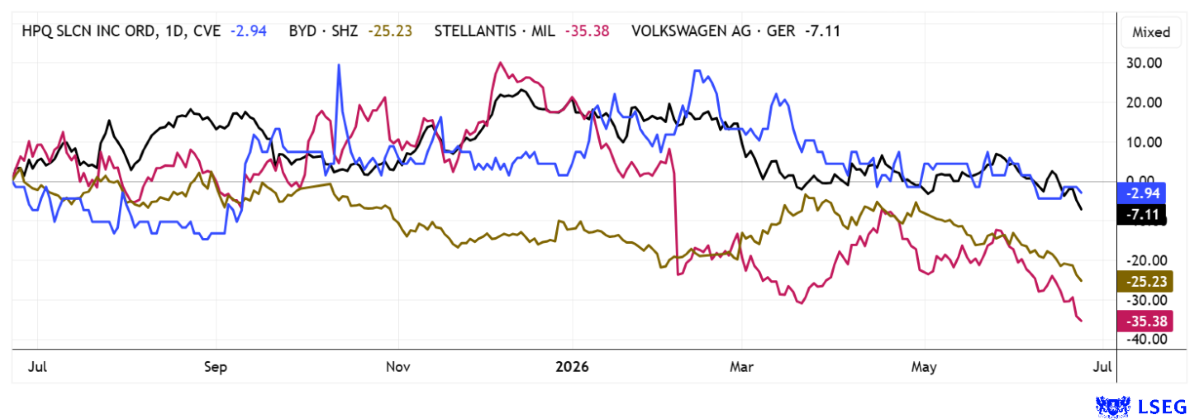
The stock markets have entered a highly volatile phase, which often occurs during the summer months following the major dividend season. Momentum continues to dominate the chip and AI infrastructure sectors, while other segments—such as the automotive sector—are going through a tough period of restructuring. With its innovative batteries, HPQ Silicon has the potential to give an entire sector a technological boost, as the Canadian company is poised for a major breakthrough!
Conflict of interest
Pursuant to §85 of the German Securities Trading Act (WpHG), we point out that Apaton Finance GmbH as well as partners, authors or employees of Apaton Finance GmbH (hereinafter referred to as "Relevant Persons") currently hold or hold shares or other financial instruments of the aforementioned companies and speculate on their price developments. In this respect, they intend to sell or acquire shares or other financial instruments of the companies (hereinafter each referred to as a "Transaction"). Transactions may thereby influence the respective price of the shares or other financial instruments of the Company.
In this respect, there is a concrete conflict of interest in the reporting on the companies.
In addition, Apaton Finance GmbH is active in the context of the preparation and publication of the reporting in paid contractual relationships.
For this reason, there is also a concrete conflict of interest.
The above information on existing conflicts of interest applies to all types and forms of publication used by Apaton Finance GmbH for publications on companies.
Risk notice
Apaton Finance GmbH offers editors, agencies and companies the opportunity to publish commentaries, interviews, summaries, news and the like on news.financial. These contents are exclusively for the information of the readers and do not represent any call to action or recommendations, neither explicitly nor implicitly they are to be understood as an assurance of possible price developments. The contents do not replace individual expert investment advice and do not constitute an offer to sell the discussed share(s) or other financial instruments, nor an invitation to buy or sell such.
The content is expressly not a financial analysis, but a journalistic or advertising text. Readers or users who make investment decisions or carry out transactions on the basis of the information provided here do so entirely at their own risk. No contractual relationship is established between Apaton Finance GmbH and its readers or the users of its offers, as our information only refers to the company and not to the investment decision of the reader or user.
The acquisition of financial instruments involves high risks, which can lead to the total loss of the invested capital. The information published by Apaton Finance GmbH and its authors is based on careful research. Nevertheless, no liability is assumed for financial losses or a content-related guarantee for the topicality, correctness, appropriateness and completeness of the content provided here. Please also note our Terms of use.