June 11th, 2026 | 07:30 CEST
Autonomous Warfare: AeroVironment and Palantir Challenged – Analysts Give Volatus Aerospace the Thumbs-Up
The war on the front lines in Ukraine has changed significantly. Large-scale coordinated drone swarms are becoming increasingly rare, as local jammers block bandwidth and slow down Starlink. The result: drones no longer function or make errors. Ukraine's defence strategy is thus forcing a shift from purely cloud-based systems to decentralized architectures with local computing power directly in the drone. Defence contractors and the military must implement these innovations quickly and remain agile. We explain which companies are perfectly positioned for this.
time to read: 3 minutes | Author: Nico Popp
ISIN: VOLATUS AEROSPACE INC | CA92865M1023 | TSXV: FLT , OTCQB: TAKOF , AEROVIRONMENT DL -_0001 | US0080731088 , PALANTIR TECHNOLOGIES INC | US69608A1088
Table of contents:
Author

Nico Popp
At home in Southern Germany, the passionate stock exchange expert has been accompanying the capital markets for about twenty years. With a soft spot for smaller companies, he is constantly on the lookout for exciting investment stories.
Tag cloud
Shares cloud
AeroVironment: Strong Order Backlog Meets Weakening Margins
The US drone specialist AeroVironment supplies military hardware and is deeply embedded in the Pentagon's procurement system. In the third quarter of fiscal year 2026, the company reported a 143% increase in revenue to USD 408.04 million, driven primarily by the acquisition of BlueHalo. The order backlog reached a record high of USD 1.1 billion in January. Despite this strong order backlog, the operational business model is experiencing margin pressure. As a result, the share price came under significant pressure. It plummeted from a 52-week high of around USD 418 to below USD 180 after the US Space Force unexpectedly halted and re-tendered the strategically important SCAR space program last March.
Palantir Technologies: Excellent Scalability as an Operations Orchestrator
As a data-driven software developer, Palantir Technologies focuses on addressing challenges faced by government agencies such as the Pentagon. The company licenses its software through multi-year subscription models, thereby generating gross margins of over 85%. In the first quarter of 2026, GAAP revenue rose by 85% to USD 1.63 billion, with net income of approximately USD 871 million. Many other key metrics are also outstanding and underscore that the data business is crucial—drones ultimately only execute what has been previously substantiated by facts. This shows that data is the starting point and, more than ever, the raw material of the 21st century.
Volatus Aerospace Stands Out With Advanced AI and an Open System Architecture
Canadian drone provider Volatus Aerospace occupies a significant strategic niche with a focus on platform-independent drone swarms. The technological heart of the platform model, which can be used for both civilian and military purposes, is the innovative autonomy operating system V-Cortex AI. Weighing less than 15 grams, this flight controller enables autonomous mission execution via optical target recognition in environments with completely blocked GPS signals. The open system architecture allows the Volatus solution to be seamlessly integrated into third-party hardware platforms.
Does This Top-Level Appointment Open Doors for Volatus?
The fact that Volatus Aerospace's strategy has a promising future is also demonstrated by support from government agencies and its alignment with NATO standards, which has already resulted in contracts. With the appointment of Catherine Loubier, the official nominee of the government fund Investissement Québec, to the Board of Directors, the company is forging close ties with Canadian industry and establishing excellent connections with the political sphere. Loubier previously served as an advisor to former Canadian Prime Minister Stephen Harper and, as a general delegate, played a key role in a USD 34 billion agreement between Hydro-Québec and the State of New York regarding energy supplies.
To establish a recurring, high-margin revenue stream in the defence sector, Volatus launched the SaaS platform SKYDRA last March. The solution enables virtual mission planning for counter-UAS operations. At its Mirabel site in Québec, the company can also manufacture long-range drones and recently raised capital for this purpose.
Large-Scale Scaling + Recurring Software Revenue = Bright Outlook?
The defence industry is shifting from isolated hardware products toward networked, vendor-neutral integrated systems. In the past, traditional defence contractors focused on developing expensive standalone systems such as fighter jets or tanks as closed units. However, given the rapid technological evolution on the battlefield, open system architectures are gaining importance. Modern defence platforms serve as software-driven links capable of controlling and coordinating a wide variety of autonomous aerial, ground, and maritime components, regardless of manufacturer. This platform-based approach allows militaries to implement technological innovations more quickly and link sensor networks with AI-powered target acquisition without being tied to rigid hardware structures.
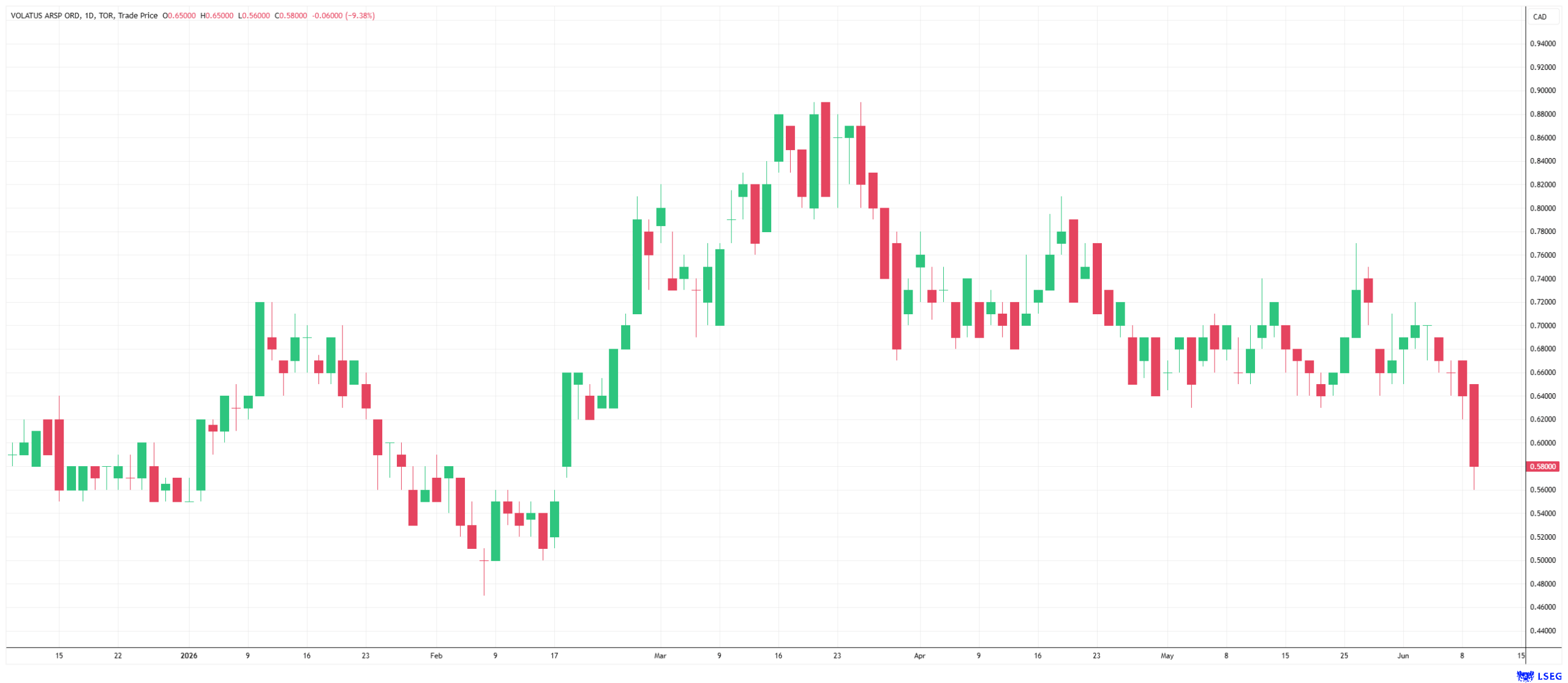
Volatus Aerospace's platform approach and its associated compatibility with other systems make the company a sought-after acquisition target. In 2025 alone, there were numerous acquisitions in the US drone market, as major defence contractors—long known for expensive tanks and aircraft—needed to catch up in the drone sector. With a market capitalization of just under CAD 425 million and its strong strategic position—underpinned by its selection for the next evaluation phase of the US Drone Dominance Program—Volatus Aerospace is a potential acquisition target. While Palantir is valued extremely ambitiously with a P/E ratio of over 140, the current sideways trend of Volatus stock offers an exciting starting point for speculative investors.
Watch YouTube videoConflict of interest
Pursuant to §85 of the German Securities Trading Act (WpHG), we point out that Apaton Finance GmbH as well as partners, authors or employees of Apaton Finance GmbH (hereinafter referred to as "Relevant Persons") currently hold or hold shares or other financial instruments of the aforementioned companies and speculate on their price developments. In this respect, they intend to sell or acquire shares or other financial instruments of the companies (hereinafter each referred to as a "Transaction"). Transactions may thereby influence the respective price of the shares or other financial instruments of the Company.
In this respect, there is a concrete conflict of interest in the reporting on the companies.
In addition, Apaton Finance GmbH is active in the context of the preparation and publication of the reporting in paid contractual relationships.
For this reason, there is also a concrete conflict of interest.
The above information on existing conflicts of interest applies to all types and forms of publication used by Apaton Finance GmbH for publications on companies.
Risk notice
Apaton Finance GmbH offers editors, agencies and companies the opportunity to publish commentaries, interviews, summaries, news and the like on news.financial. These contents are exclusively for the information of the readers and do not represent any call to action or recommendations, neither explicitly nor implicitly they are to be understood as an assurance of possible price developments. The contents do not replace individual expert investment advice and do not constitute an offer to sell the discussed share(s) or other financial instruments, nor an invitation to buy or sell such.
The content is expressly not a financial analysis, but a journalistic or advertising text. Readers or users who make investment decisions or carry out transactions on the basis of the information provided here do so entirely at their own risk. No contractual relationship is established between Apaton Finance GmbH and its readers or the users of its offers, as our information only refers to the company and not to the investment decision of the reader or user.
The acquisition of financial instruments involves high risks, which can lead to the total loss of the invested capital. The information published by Apaton Finance GmbH and its authors is based on careful research. Nevertheless, no liability is assumed for financial losses or a content-related guarantee for the topicality, correctness, appropriateness and completeness of the content provided here. Please also note our Terms of use.