April 20th, 2026 | 08:45 CEST
AMAZON, ALMONTY, AND VEOLIA ON A ROLLERCOASTER RIDE: BACK ON TRACK TO RECORD HIGHS AFTER THE CORRECTION
Fear and panic spread across the stock market in March. Even giants began to waver. But after a brief, albeit sharp, correction, the shares of the world's leading online retailer, Amazon, the commodities rebel Almonty, and the environmental pioneer Veolia are once again on the rise. A rollercoaster ride that may test your nerves, but teaches us once again: those declared dead live longer—and quality stocks often fall only to gather momentum for the next push toward their former highs.
time to read: 7 minutes | Author: Jens Castner
ISIN: ALMONTY INDUSTRIES INC. | CA0203987072 | TSX: AII , NASDAQ: ALM , ASX: AII
Table of contents:
Author

Jens Castner
The Nuremberg native brings over three decades of capital markets experience, backed by a career shaped by deep market insight and a genuine passion for investing. His journey began in 1994 through an investment club among colleagues – a formative experience that sparked a lifelong dedication to identifying compelling investment opportunities.
Following senior editorial roles at Nürnberger Nachrichten, €uro am Sonntag, and €uro, he went on to serve as Editor-in-Chief of the renowned investor magazine Börse Online from 2014, where he played a key role in shaping high-quality financial journalism for a broad investor audience.
Tag cloud
Shares cloud
AMAZON: THE USD 200 BILLION SHOCK
A state of shock prevailed in early February after Amazon released its Q4 2025 results. The e-commerce veteran reported a 14% increase in revenue to USD 213 billion and an 18% rise in operating income to nearly USD 25 billion. But another figure sent Wall Street into a tailspin. CEO Andy Jassy announced record investments of USD 200 billion for the current year. Since net income per share was also one cent below expectations at USD 1.95 due to special factors such as severance payments, litigation risks, and tax disputes, the markets reacted with panic, leading to a nine-day losing streak in which over USD 450 billion in market value was wiped out. At its peak, the stock fell by a good 20%.
Meanwhile, the stock market has come to realize that Amazon is not simply squandering the billions but is investing them wisely in the future. A large portion of this massive sum flows directly into the infrastructure of the cloud division Amazon Web Services, or AWS for short. Amazon is not only investing in data centers but is also securing indispensable energy sources by building small modular reactors and entering into long-term contracts with nuclear power plants. Since the power demands of artificial intelligence are enormous, the Seattle-based megacorporation is using this strategy to buy itself independence and capacity for the next decade. Since early April, the stock has been on the rise again, as the market has realized that AWS already generates over USD 15 billion in annual revenue from AI services alone. It is all a matter of psychology: Sentiment has since shifted; even the USD 11.57 billion acquisition of satellite communications provider Globalstar, a direct challenge to the Starlink project led by Tesla CEO Elon Musk, was received positively by the market. Although the rebound was no less dramatic than the previous plunge and the stock is now trading higher than it was in early February, the valuation, with a price-to-earnings (P/E) ratio of about 32 for the current year and 26 for 2027, is attractive, at least compared to its own history. The all-time high of USD 258.60 is just a hair's breadth away. The upcoming quarterly results on Thursday, April 23, after the US market close, will provide insight into whether further upside toward new highs is supported.
ALMONTY INDUSTRIES: THE STRATEGIC MOVE BY THE TUNGSTEN KING
The stock of Almonty Industries was hit even harder than Amazon's.
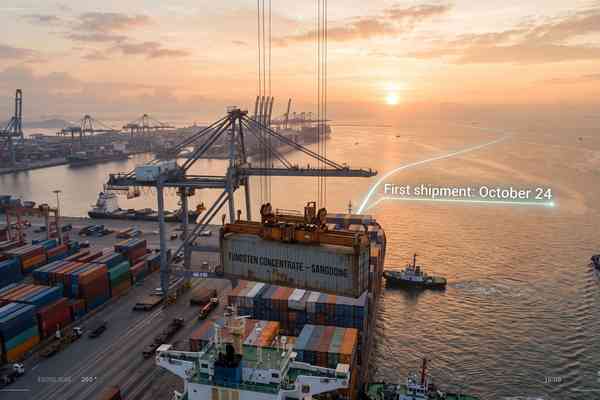
The (former) Canadians are celebrated as one of the Western world's most important tungsten suppliers. Following an unprecedented rally that took the stock from penny stock status to over CAD 31, the price plummeted by nearly 40% in the second half of March. This crash was a classic "sell on good news" reaction. Investors, as well as the major shareholder Deutsche Rohstoff AG, used the news of the Sangdong mine's commissioning in South Korea as an opportunity to take profits. This further increased selling pressure. Compounding this was the fact that the 2025 annual figures released on March 18 showed a 13% year-over-year revenue growth, but also (as expected) significantly higher losses. The net loss of CAD 162 million was nearly ten times that of the previous year. The trend reversal did not begin until late March, when the importance of the Sangdong mine for global supply security came back into focus, and the tungsten price resumed its record-breaking rally after a brief correction.
Almonty's Sangdong mine is considered one of the most significant tungsten projects worldwide and is expected to cover a substantial portion of demand outside China at full capacity. The first expansion phase is designed for an annual processing capacity of approximately 640,000 tons of ore. A second phase is expected to significantly increase production capacity once again in the future. According to Almonty CEO Lewis Black, the completion of the processing plant marks the transition from a development project to operational status. At the same time, the company is pushing ahead with its expansion in North America. The Gentung Browns Lake Tungsten project in Montana is intended to enable the resumption of US tungsten production.
ON THE WAY TO BECOMING A KEY STOCK IN THE WEST
Almonty is beginning to supply a depleted market at a time when existing inventories are only available in limited quantities. 95% of global tungsten production comes from China, Russia, and North Korea. Since the heavy metal, with its high heat resistance, is indispensable for rocket nozzles and armor-piercing ammunition, among other things, the US government needs strategic reserves within its own borders, especially as China continues to tighten export controls on critical raw materials—a tit-for-tat response to the Trump administration's tariff policy. This opens up an opportunity for Almonty to play a key role in Western supply chains. Even the biggest players are now taking notice of the stock. In a recent study, the US investment bank Morgan Stanley lists Almonty among the 60 key stocks for the aerospace industry. The report states: "Tungsten is one of the densest and highest-melting-point metals known (3,422 °C), making it exceptionally valuable in extreme thermal environments."
The relocation of the company's headquarters to Dillon, Montana, which became official a week ago, also played a decisive role in this turnaround. The company has been listed on the Nasdaq since July 2025. The company, previously based in Toronto, Canada, has thus made a clear commitment to the US market and its defense sector. Analysts are applauding: According to the latest estimates, industry experts at Texas Capital Securities now expect earnings per share of approximately USD 0.58 for 2026, which could rise to USD 1.90 by 2028, making the current valuation appear attractive, even though the interim price drop has long since been recouped. The quarterly figures and the first production report on May 20 will show just how profitable the Sangdong mine in South Korea truly is, given the increased price level for tungsten.
VEOLIA ENVIRONNEMENT: GIRL POWER AND DISTRICT HEATING
Somewhat more conservative, but no less interesting, is the stock of Veolia Environnement. Following strong results for 2025, in which revenue rose to over EUR 44 billion and earnings before interest, taxes, depreciation, and amortization (EBITDA) grew by 6.3% to EUR 7.1 billion, the stock hit new highs at the end of February. The French flagship company also experienced a sharp correction in March, though it was significantly more moderate compared to Amazon or Almonty. According to analysts, this was primarily due to market technicalities and profit-taking ahead of the upcoming annual general meeting, in addition to the outbreak of war in the Middle East.
Veolia sees itself as the global leader in ecological transformation. Its business model is based on three pillars: water/wastewater, waste management, and energy, with the company being a global leader in the circular economy. How these elements interlock is evident in the district heating ambitions of CEO Estelle Brachlianoff, one of the few women at the helm of a top European company. The energy generated from waste incineration is fed into the district heating network to minimize the use of fossil fuels, primarily coal and natural gas. By 2030, Veolia aims to be number one in the European district heating market. This is also evident in Germany: In Braunschweig, Veolia supplies over 56,000 households in collaboration with BS Energy; in Görlitz and Zgorzelec, Poland, a cross-border project called "United Heat" is underway to provide climate-neutral heating. An interesting side note: In Germany, too, a woman is calling the shots. Emmanuelle Menning has been leading the local operations since April 2, having previously served as CFO and managed Veolia Germany's finances for ten years.
The district heating model is well-received on the stock market. Following the setback in March, the share price is now on the rise again. While Veolia has not quite reached its annual high of EUR 35.90 yet, this is of secondary importance to patient investors. For them, the dividend is likely to be the priority; it was increased in 2025 by EUR 0.10 to EUR 1.50 per share compared to the previous year. It will be paid out after the annual general meeting, which will take place in Paris on April 23—incidentally, exactly the day Amazon releases its first-quarter figures. With a dividend yield of over 4% and a P/E ratio of 15 for the current year, the stock is cheap by historical standards and still has enormous potential despite the upcoming ex-dividend date, especially since the all-time high of EUR 65.80 from 2007 is still miles away.
CONCLUSION: DAYS OF DECISION
Veolia shares are the calm center of the trio. With the upcoming annual general meeting on April 23 and Amazon's quarterly results on the same day, decisive dates are just around the corner. Things will get particularly heated for Almonty in May when the first-quarter figures and the production report are released. If everything goes smoothly, the record-breaking run is likely to continue. But even if there is another round of profit-taking or even the occasional disappointment, fresh price pullbacks for this trio could present attractive entry opportunities in the medium to long term. Because in the end, quality always prevails.
Conflict of interest
Pursuant to §85 of the German Securities Trading Act (WpHG), we point out that Apaton Finance GmbH as well as partners, authors or employees of Apaton Finance GmbH (hereinafter referred to as "Relevant Persons") may hold shares or other financial instruments of the aforementioned companies in the future or may bet on rising or falling prices and thus a conflict of interest may arise in the future. The Relevant Persons reserve the right to buy or sell shares or other financial instruments of the Company at any time (hereinafter each a "Transaction"). Transactions may, under certain circumstances, influence the respective price of the shares or other financial instruments of the Company.
In addition, Apaton Finance GmbH is active in the context of the preparation and publication of the reporting in paid contractual relationships.
For this reason, there is a concrete conflict of interest.
The above information on existing conflicts of interest applies to all types and forms of publication used by Apaton Finance GmbH for publications on companies.
Risk notice
Apaton Finance GmbH offers editors, agencies and companies the opportunity to publish commentaries, interviews, summaries, news and the like on news.financial. These contents are exclusively for the information of the readers and do not represent any call to action or recommendations, neither explicitly nor implicitly they are to be understood as an assurance of possible price developments. The contents do not replace individual expert investment advice and do not constitute an offer to sell the discussed share(s) or other financial instruments, nor an invitation to buy or sell such.
The content is expressly not a financial analysis, but a journalistic or advertising text. Readers or users who make investment decisions or carry out transactions on the basis of the information provided here do so entirely at their own risk. No contractual relationship is established between Apaton Finance GmbH and its readers or the users of its offers, as our information only refers to the company and not to the investment decision of the reader or user.
The acquisition of financial instruments involves high risks, which can lead to the total loss of the invested capital. The information published by Apaton Finance GmbH and its authors is based on careful research. Nevertheless, no liability is assumed for financial losses or a content-related guarantee for the topicality, correctness, appropriateness and completeness of the content provided here. Please also note our Terms of use.