August 13th, 2026 | 08:05 CEST
AI and Software in a Super Cycle: SAP, Oracle, Strategic Resources and ServiceNow Are in the Spotlight
Another new DAX 40 high—thanks to heavyweight SAP! Thanks to artificial intelligence, the global software sector is currently transforming into an absolute growth rocket. A recent study by market research firm IDC backs up the hype: global AI spending is already set to explode to around USD 940 billion in 2026. This monumental wave is pouring massive amounts of capital directly into the coffers of the most innovative tech giants. Walldorf's pride and joy, SAP, is using AI to transform sluggish ERP systems into hyper-smart, self-thinking control centers. Meanwhile, rival Oracle is rapidly expanding its cloud capabilities to handle the gigantic volumes of data generated by modern language models. ServiceNow, the workflow king, is demonstrating how to elegantly eliminate repetitive office work through automation. Management recently underscored this success with a substantial increase in AI revenue targets for 2026. Right at the epicentre of this, Strategic Resources is securing the necessary attention for a crucial upstream stage: critical metals. Investors should take a closer look at what really matters now! We offer a few pointers.
time to read: 6 minutes | Author: André Will-Laudien
ISIN: SAP SE O.N. | DE0007164600 , ORACLE CORP. DL-_01 | US68389X1054 , STRATEGIC RESOURCES INC | CA86277X4093 | TSXV: SR , SERVICENOW INC. DL-_001 | US81762P1021
Table of contents:
Author

André Will-Laudien
Born in Munich, he first studied economics and graduated in business administration at the Ludwig-Maximilians-University in 1995. As he was involved with the stock market at a very early stage, he now has more than 30 years of experience in the capital markets.
Tag cloud
Shares cloud
SAP and ServiceNow: In Demand Like Never Before
The software penalty has simply vanished! For months, major software stocks were punished, but now the entire IT market is leaving the experimental phase behind and shifting to hard-core profitability. Investors are currently witnessing firsthand one of the most profitable sector rotations in modern economic history. Those who ride this super-cycle correctly now will secure the prime assets in tomorrow's digital ecosystem. The months-long skepticism that generative AI could render traditional software licenses obsolete is thus giving way to a rational reassessment.
This comeback is particularly evident at the Walldorf-based tech giant SAP, whose stock has been clearing all technical hurdles with flying colors since hitting a low of EUR 127.50. The German flagship company is demonstrating through its operations how deeply entrenched ERP systems are being significantly enhanced by artificial intelligence. The US workflow specialist ServiceNow is also dispelling the market's fears of disruption with impressive figures. With sustained revenue growth of over 20%, the company is cementing its undisputed position in the enterprise segment. The new platform is not acting as a casualty, but rather as an essential catalyst for the global AI transformation. Major investors are currently shifting capital noticeably from the overheated semiconductor sector to software companies, which are valued significantly more favorably.
Analysts on the LSEG platform are universally giving the thumbs-up, as established software firms hold the decisive trump card: exclusive customer data and established workflows. The current momentum clearly shows that the scaling of AI assistants in everyday office life is driving the next major wave of growth. With this fundamental tailwind, what was once a sector weakness is transforming directly into the most exciting investment narrative of the second half of the year. The consensus estimates show average 12-month price targets of EUR 206.40 for SAP and EUR 143.90 for ServiceNow. Following the sharp turnaround, that still leaves a good 20% upside for both stocks.
Oracle: Analysts Have a Problem with Debt
For Oracle, too, the aggressive push into the high-margin AI market is increasingly proving to be a double-edged sword for its balance sheet. While the tech giant's cloud infrastructure is reporting significant order growth, the financial cost of this rapid pace is burning deep holes in its capital structure. A recent creditworthiness study by the rating agency S&P Global Ratings is already sounding the alarm and has downgraded the company's credit rating from BBB to BBB-. After all, the debt-to-operating-profit ratio reached nearly 4.5 times operating profit in 2026. Wall Street analysts are watching with growing concern as capital expenditures (CAPEX)—which are skyrocketing to fund the construction of massive AI data centers—continue to soar. Oracle has surprisingly and dramatically raised its capital expenditure forecast for fiscal year 2027 to USD 90–95 billion to expand data centers and procure expensive AI chips. CEO Larry Ellison is financing this through massive bond and stock issuances in the double-digit billions. Critics point out that free cash flow has now slipped deep into negative territory due to these enormous financial demands. In direct comparison to financially strong competitors like Microsoft, Oracle can no longer fully finance this expansion from the operating profits of its traditional software business. In a desperate attempt to prop up profitability and meet Wall Street expectations, management is already responding with painful, double-digit cost-cutting measures and layoffs among internal teams. While the stock remains an attractive long-term investment, it is losing its status as a safe haven in the tech sector for the time being due to balance sheet risks. Ultimately, the conversion rate of the contractually guaranteed AI revenue will determine whether this risky debt bet pays off or results in a hard landing.
Strategic Resources: Metallic Resources for a Digitalized Future
AI infrastructure is putting pressure on building manufacturers and component suppliers alike. Due to climate change, the steel industry has been undergoing a fundamental realignment for years, and Strategic Resources is part of this shift. The company is positioning itself at one of the critical bottlenecks of this transformation: the supply of high-quality iron ore for an increasingly electrified and hydrogen-based steel production process. Rather than initially tying up enormous sums in its own mining operation, the Canadian company first plans to build a merchant pelletizing plant with an annual capacity of 4.0 million metric tonnes at the deep-water port of Port Saguenay in Québec. The concept is strategically attractive from a capital perspective because it would initially process externally sourced concentrate, thereby monetizing value-added earlier than would be possible with its own mine.
According to the pre-feasibility study, expected processing costs of just USD 16.31 per metric tonne are offset by a potential EBITDA of approximately USD 173 million. The plant is to be supplied with relatively low-carbon energy via Québec's hydroelectric grid and will be connected to a publicly supported conveyor system valued at approximately CAD 111 million. Javelin Global Commodities will serve as the supply and marketing partner and is also expected to provide a working capital line of up to USD 150 million. Also relevant is the current progress of projects in Finland, as the vanadium-rich magnetite concentrate from the Mustavaara district has been selected for the EUR 17 million FutSteel program led by the University of Oulu. The research project with SSAB, which runs through 2029, examines not only individual new furnaces but the entire industrial process chain from iron production to hot rolling, and aims to demonstrate how electric steel and hydrogen-based processes can be integrated into existing structures without compromising quality. The significance of this test extends far beyond a research project, as project data indicates that decarbonizing a single large Finnish steel mill alone could reduce national CO₂ emissions by up to 7%. This provides Mustavaara with additional technological validation and gives Strategic Resources potential access to a European value chain for fossil-free steel.
IIF host Lyndsay Malchuk speaks with CEO Sean Cleary about the upcoming construction of the production facility in Québec.
Also of great interest is the strategic role of Canadian vanadium as a key raw material for US battery solutions, particularly for military applications and heavy-duty industrial vehicles. This outlook is based on a memorandum of understanding with Tyfast Energy, which aims to drive the rapid development of an independent vanadium battery value chain. The metal is considered an indispensable raw material for long-lasting vanadium redox flow batteries, which, as large-scale stationary storage systems, balance out fluctuations in renewable energy within the power grid.
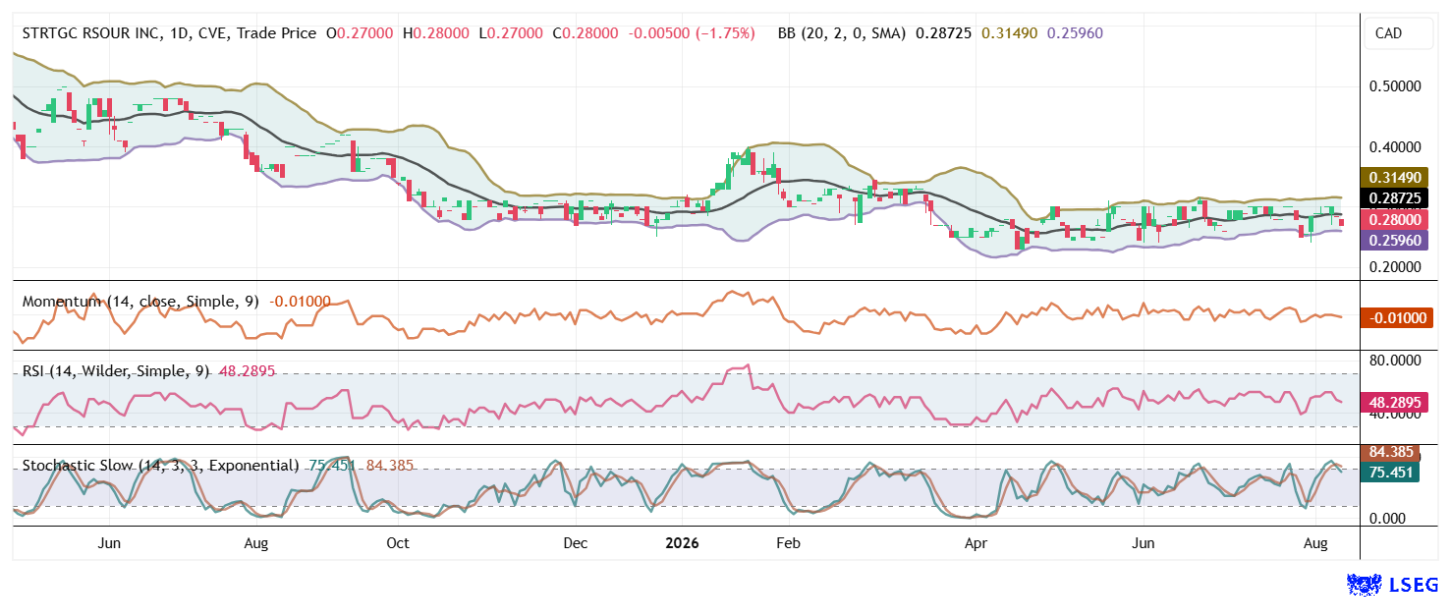
With iron, vanadium, and titanium, as well as the two locations in Québec and Finland, this creates an unusually broad raw materials portfolio ranging from steel decarbonization to critical battery materials. Given a market capitalization of only about CAD 16 million, the investment case remains highly attractive, as the implementation of even one of these pillars alone could generate many times that value. It is precisely the combination of potential processing margins, strategic partners, government-supported infrastructure, and technological validation that creates significant revaluation potential for Strategic Resources.
It is becoming clear that the current software and AI super-cycle extends far beyond Silicon Valley alone and is also taking hold at the core of traditional heavy industry. While tech giants like SAP, ServiceNow, and Oracle are revolutionizing the digital control layer with intelligent platforms, the true test of this transformation is taking place in the physical world. For forward-looking investors, this means that the winners of this cycle are no longer to be found solely within the tech sector. Ultimately, the ongoing tech boom will yield its final returns where algorithms enable the sustainable production of real goods—flawlessly and with high efficiency.
Conflict of interest
Pursuant to §85 of the German Securities Trading Act (WpHG), we point out that Apaton Finance GmbH as well as partners, authors or employees of Apaton Finance GmbH (hereinafter referred to as "Relevant Persons") currently hold or hold shares or other financial instruments of the aforementioned companies and speculate on their price developments. In this respect, they intend to sell or acquire shares or other financial instruments of the companies (hereinafter each referred to as a "Transaction"). Transactions may thereby influence the respective price of the shares or other financial instruments of the Company.
In this respect, there is a concrete conflict of interest in the reporting on the companies.
In addition, Apaton Finance GmbH is active in the context of the preparation and publication of the reporting in paid contractual relationships.
For this reason, there is also a concrete conflict of interest.
The above information on existing conflicts of interest applies to all types and forms of publication used by Apaton Finance GmbH for publications on companies.
Risk notice
Apaton Finance GmbH offers editors, agencies and companies the opportunity to publish commentaries, interviews, summaries, news and the like on news.financial. These contents are exclusively for the information of the readers and do not represent any call to action or recommendations, neither explicitly nor implicitly they are to be understood as an assurance of possible price developments. The contents do not replace individual expert investment advice and do not constitute an offer to sell the discussed share(s) or other financial instruments, nor an invitation to buy or sell such.
The content is expressly not a financial analysis, but a journalistic or advertising text. Readers or users who make investment decisions or carry out transactions on the basis of the information provided here do so entirely at their own risk. No contractual relationship is established between Apaton Finance GmbH and its readers or the users of its offers, as our information only refers to the company and not to the investment decision of the reader or user.
The acquisition of financial instruments involves high risks, which can lead to the total loss of the invested capital. The information published by Apaton Finance GmbH and its authors is based on careful research. Nevertheless, no liability is assumed for financial losses or a content-related guarantee for the topicality, correctness, appropriateness and completeness of the content provided here. Please also note our Terms of use.