June 8th, 2026 | 07:00 CEST
Will NASDAQ Shockwave Burst AI Bubble? Major Movements at Nel ASA, Oklo, dynaCERT, SpaceX, and ITM Power
It has finally happened—a 7.5% drop on the tech exchanges in just three trading days. Yet, only last Tuesday, the NASDAQ 100 index had reached a new all-time high of 30,730 points. In a sudden realization, market participants understood that the central bank's next move will be a "rate hike." After all, the new Fed Chair, Kevin Warsh, makes no secret that inflation near 4% is a disaster for the US dollar and economic stability. Although Donald Trump has repeatedly hinted in the media at an interest rate cut, the central bank governors—including former Fed Chair Jerome Powell—are unanimously leaning toward hikes to curb high inflation. In addition to economically measurable inflation, voices are growing louder that excessive price increases on Wall Street paint a picture of the economy that does not align with reality. The daily gains of billions in stock market wealth, combined with the extreme increases in long positions, harbour the potential for disappointment in the near future. Whether the initial spark of a correction was set in motion last week must therefore be closely analyzed.
time to read: 6 minutes | Author: André Will-Laudien
ISIN: DYNACERT INC. | CA26780A1084 | TSX: DYA , OTCQB: DYFSF , NEL ASA NK-_20 | NO0010081235 , ITM POWER PLC LS-_05 | GB00B0130H42 , SPACE EXPLORATION TECHNOLOGIES CORP | US000SPACEX0 , OKLO INC | US02156V1098
Table of contents:
Author

André Will-Laudien
Born in Munich, he first studied economics and graduated in business administration at the Ludwig-Maximilians-University in 1995. As he was involved with the stock market at a very early stage, he now has more than 30 years of experience in the capital markets.
Tag cloud
Shares cloud
Oklo: The Bet on Energy Supply for the AI Era
Donald Trump aims to double the share of nuclear power in the US over the next 20 years. His administration sees no alternatives to expanding nuclear power due to the high energy demands of the AI era, even though other countries, such as Germany, already cover over 50% of their electricity needs with renewable energy. One of the top players in the field of future energy generation in the US is Oklo. The stock was one of the high-flyers on the NASDAQ in 2025 and, as a revenue-less company, reached a valuation of nearly USD 30 billion. However, the initial euphoria has evaporated since October, and the stock lost 78% of its market value by March.
For risk-tolerant investors, however, the company could still be an interesting bet on the future of next-generation nuclear energy. The innovative Aurora reactor is attracting the attention of so-called hyperscalers. With these new compact nuclear plants, which could enter mass production starting in 2030, CO₂-free electricity could be supplied for many years to come, particularly to meet the rapidly growing energy needs of data centers, AI infrastructure, military sites, and remote industrial locations. Instead of selling reactors, Oklo is pursuing a model based on long-term power purchase agreements that, if successfully implemented, would enable recurring, predictable revenue. The waste management concept is also exciting, as it combines modern reactor technologies with nuclear fuel reprocessing—making nuclear waste a thing of the past. Oklo is benefiting from the global trend toward safe baseload energy and aims to become profitable by 2030. Nevertheless, the investment remains speculative, as regulatory approvals, the availability of HALEU fuel, and the economic viability of the business model have yet to be demonstrated.
dynaCERT: What Is Catching On in Asia Also Works in the West
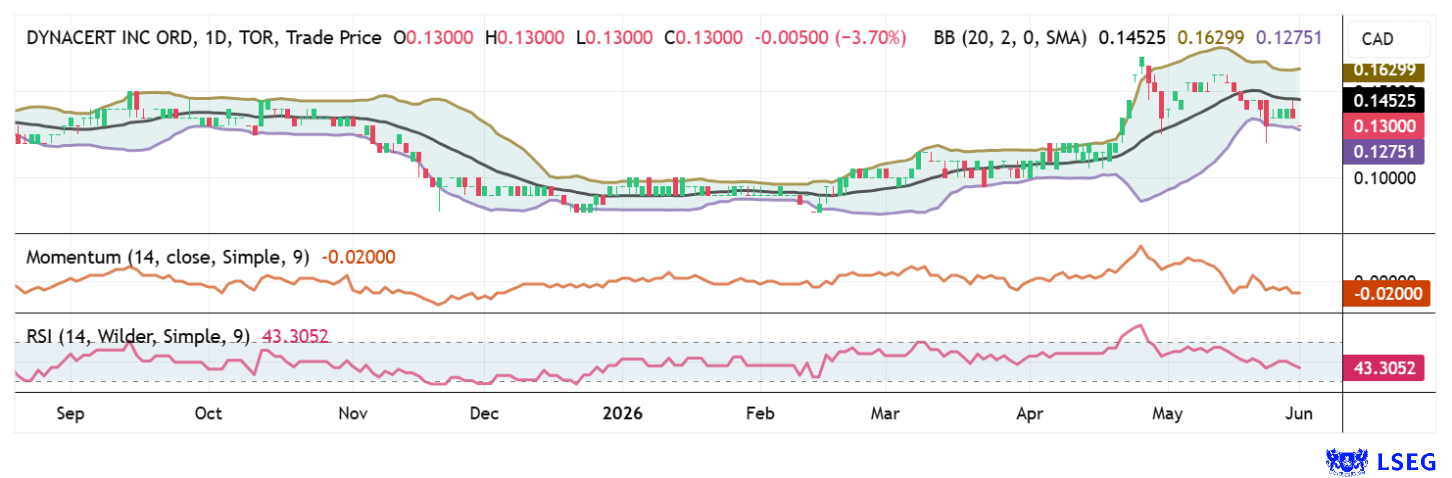
When it comes to alternative energy, attention is also turning to the Canadian company dynaCERT. After a prolonged period of sideways movement, the stock is making waves with a 70% price increase in just 6 weeks. What happened? After years of intensive development work, dynaCERT, a cleantech company, has specialized in a market niche that is gaining significant importance amid stricter climate regulations and high energy costs. Unlike the trend toward electric vehicles, the Canadians are not abandoning internal combustion engines; instead, they are making them significantly more economical and cleaner. At the heart of the business model is the HydraGEN™ technology, which generates hydrogen and oxygen directly on board during operation and feeds them into the combustion process, thereby optimizing fuel combustion, reducing both diesel consumption and emissions. The addressable market is enormous, as 75 million trucks, construction machines, mining vehicles, generators, and commercial vehicles worldwide still rely on diesel engines. Especially in a phase of geopolitical uncertainty and volatile energy prices, companies are looking for solutions that take effect immediately and ease the cost burden without requiring investments in the billions. The short payback period is important for operators. Under typical operating conditions, the investment can pay for itself in as little as seven months or after approximately 126,000 km driven. In an industry where margins are often in the low single-digit percentage range, such efficiency gains are worth their weight in gold.
At the latest International Investment Forum, President Bernd Krüper and CEO Kevin Unrath explained the company's exceptional positioning.
Operationally, there are growing signs that dynaCERT is entering a new growth phase following a lengthy development period. The company now has a production capacity of up to 36,000 HydraGEN™ units per year, providing the industrial foundation for significantly higher market penetration. The focus is on Vietnam, a market with more than 3.5 million heavy-duty commercial vehicles and construction machines. The country is pursuing ambitious climate goals and developing regulatory frameworks that could provide stronger economic incentives for future emissions reductions. Against this backdrop, dynaCERT has entered into strategic agreements with Ho Chi Minh City University of Technology (HCMUT) and a major state-owned energy company. Initial pilot projects are already underway in the key economic regions of Ho Chi Minh City, Hanoi, and Hai Phong. Shortly before the major rollout in Vietnam, financial flexibility was strengthened through a capital raise of approximately CAD 2 million. The additional funds are primarily intended to boost international sales. A significant number of systems are expected to be installed this year. This will allow international expansion to begin. Research firm GBC has calculated a price target of CAD 0.75, representing a potential gain of over 500% over 12 months. The current pullback presents an attractive buying opportunity.
ITM Power and Nel ASA: Back on the Radar of Flexible Investors
The hydrogen sector remains a prime example of high expectations, sometimes painful corrections, and initial, cautious signs of stabilization. Anyone investing in the sector should take a look at ITM Power and Nel ASA. After a long period of disappointment, ITM Power recently surprised the market with a 300% surge to EUR 2.58, before short-term profit-taking pushed the price back down to the EUR 1.60–1.70 range. From a broader perspective, the share price remains well below the highs reached during the hydrogen euphoria of 2021–2022. At the time, the still-nascent technology was viewed as highly significant in the green energy sector; however, producing green hydrogen proved far too expensive to compete with fossil fuels. As a result, both ITM Power and Nel ASA lost around 80–90% of their peak market values. Most recently, ITM Power has drawn attention for operational progress in cost reduction and a more focused project pipeline, following management's emphasis on shifting from an expansive to a more selective growth strategy. Order fulfillment in the slightly growing electrolysis business has now stabilized and, according to analysts on the LSEG platform, could lead to a revenue increase from around GBP 25 million to as much as GBP 100 million by 2028. However, profits are not yet expected in the coming years.
Nel ASA presents a similar underlying dynamic. The Norwegian electrolysis pioneer has once again highlighted the challenges of weak order intake and delayed investment decisions in large-scale plant construction in its latest corporate announcements. At the same time, measures to adjust production and the cost structure were communicated to reduce tied-up capital and increase efficiency. After a spectacular rally from EUR 0.18 to EUR 0.36, the share price fell sharply back into the EUR 0.26-0.27 range. The key factor for the coming quarters will be whether the stabilization shown actually leads to reliable growth again or whether the current movement is merely an interim phase within a longer consolidation cycle. Experts on the LSEG platform have little faith in Nel ASA, while speculators, on the other hand, are already being more generous!
Growth markets took their first breather last week. That is no big deal, as many valuations are already cause for concern. Now Elon Musk's SpaceX is entering the market with an IPO valuation of USD 2 trillion. That needs to be digested first; then the rally can continue. Good diversification across sectors and regions will protect the portfolio from major fluctuations.
Conflict of interest
Pursuant to §85 of the German Securities Trading Act (WpHG), we point out that Apaton Finance GmbH as well as partners, authors or employees of Apaton Finance GmbH (hereinafter referred to as "Relevant Persons") currently hold or hold shares or other financial instruments of the aforementioned companies and speculate on their price developments. In this respect, they intend to sell or acquire shares or other financial instruments of the companies (hereinafter each referred to as a "Transaction"). Transactions may thereby influence the respective price of the shares or other financial instruments of the Company.
In this respect, there is a concrete conflict of interest in the reporting on the companies.
In addition, Apaton Finance GmbH is active in the context of the preparation and publication of the reporting in paid contractual relationships.
For this reason, there is also a concrete conflict of interest.
The above information on existing conflicts of interest applies to all types and forms of publication used by Apaton Finance GmbH for publications on companies.
Risk notice
Apaton Finance GmbH offers editors, agencies and companies the opportunity to publish commentaries, interviews, summaries, news and the like on news.financial. These contents are exclusively for the information of the readers and do not represent any call to action or recommendations, neither explicitly nor implicitly they are to be understood as an assurance of possible price developments. The contents do not replace individual expert investment advice and do not constitute an offer to sell the discussed share(s) or other financial instruments, nor an invitation to buy or sell such.
The content is expressly not a financial analysis, but a journalistic or advertising text. Readers or users who make investment decisions or carry out transactions on the basis of the information provided here do so entirely at their own risk. No contractual relationship is established between Apaton Finance GmbH and its readers or the users of its offers, as our information only refers to the company and not to the investment decision of the reader or user.
The acquisition of financial instruments involves high risks, which can lead to the total loss of the invested capital. The information published by Apaton Finance GmbH and its authors is based on careful research. Nevertheless, no liability is assumed for financial losses or a content-related guarantee for the topicality, correctness, appropriateness and completeness of the content provided here. Please also note our Terms of use.