July 27th, 2026 | 07:15 CEST
The Drone Revolution: Palantir and Lockheed Martin Forced to Innovate—Volatus Aerospace Follows Ukraine's Lead
The days when tanks weighing several metric tons or extremely expensive fighter jets determined victory or defeat on the battlefield are over. As a look at modern warfare shows, it is now primarily the seamless interaction between hardware and software that determines actual success. Those who cannot coordinate algorithms and sensor technology in real time will fall behind. Ukraine is currently demonstrating this impressively, as it now launches more drones for counterattacks against Russia than the aggressor itself. This illustrates that, for NATO, security also means building an agile defence industry that can respond flexibly to requirements. We take a look at three companies in the industry and highlight opportunities.
time to read: 3 minutes | Author: Nico Popp
ISIN: VOLATUS AEROSPACE INC | CA92865M1023 | TSXV: FLT , OTCQB: TAKOF , PALANTIR TECHNOLOGIES INC | US69608A1088 , LOCKHEED MARTIN DL 1 | US5398301094
Table of contents:
Author

Nico Popp
At home in Southern Germany, the passionate stock exchange expert has been accompanying the capital markets for about twenty years. With a soft spot for smaller companies, he is constantly on the lookout for exciting investment stories.
Tag cloud
Shares cloud
Palantir Sets the Standard in Digital Warfare
Software specialist Palantir has profoundly transformed the industry with its data integration platforms. According to the company's latest financial results, the group reported GAAP revenue of USD 1.63 billion in the first quarter of 2026, representing 85% growth, while the gross margin stood at an impressive 85% and net income reached approximately USD 871 million. A key factor in this outstanding market position is the US Army's TITAN program, under which Palantir is building prototypes for an AI-powered ground station as the prime contractor under a USD 178.4 million contract. This system links a wide variety of sensors and utilizes both trucks and more agile light vehicles. To ensure the continuous delivery of software updates even under challenging conditions, Palantir relies on its innovative Apollo architecture.
Lockheed Martin Struggles with the Pitfalls of Complexity
At defence giant Lockheed Martin, it is becoming increasingly clear that traditional production structures are reaching their limits in the age of digital defence systems. According to reports from the Government Accountability Office, the total cost of the ambitious F-35 Block 4 modernization program rose from an initial USD 10.6 billion to more than USD 16.5 billion. Nevertheless, the program will not be completed before 2031 or 2032. Software issues led the Pentagon to refuse acceptance of new aircraft for months, forcing completed jets to be temporarily stored on Lockheed Martin's factory grounds. Ultimately, however, 191 aircraft were delivered in 2025—a record. To accelerate future update processes, the company intends to deliberately break new ground.
Volatus: A Platform-Based Approach to Drones
The Canadian company Volatus Aerospace is breaking new ground in unmanned aviation and is focusing on platform independence. With the V-Cortex AI flight controller, weighing less than 15 g, the company provides a control system that guarantees reliable navigation even in environments without a GPS signal or radio connection, thanks to integrated optical target detection. This technology is complemented by the SKYDRA SaaS model, which enables the virtual planning and execution of drone defence operations. According to official statements, the company was the only provider to receive approval from Transport Canada for the Canary system for beyond-visual-line-of-sight flight operations over populated areas. Volatus thus positions itself as a flexible system integrator that, through open architectures, is also compatible with third-party providers. The situation in Ukraine demonstrates that various components and technologies are being combined and tested there as needed. It is not uncommon for prototypes to be deployed within three days. If the technology proves successful, it goes into mass production. Thanks to its flexibility, Volatus is able to make its own control software compatible with various drone platforms.
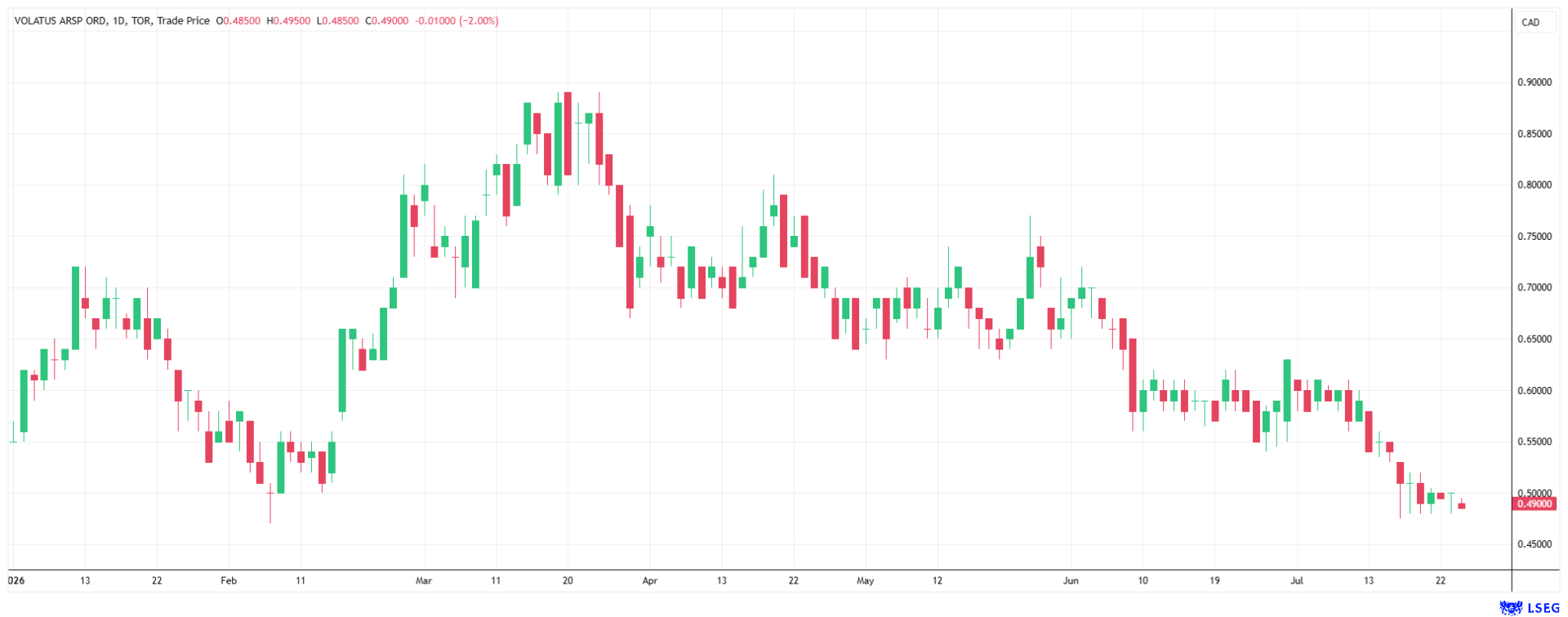
To continue scoring points with innovations in the future, Volatus is focusing on partnerships and collaborations. According to company reports, the company signed a Memorandum of Understanding with Sentinel R&D in March of this year to jointly develop Canadian interceptor drone systems based on lightweight composites and the V-Cortex platform. At the same time, testing is underway with Dufour Aerospace on runway-independent cargo drone systems for logistics missions in challenging regions such as the Arctic. The delivery of tactical reconnaissance drones worth approximately CAD 1.8 million to a NATO member state demonstrates that this strategy is also bearing fruit internationally.
The Current Status of Volatus Shares
In recent quarters, Volatus was considered one of the industry's biggest hopes. It is now becoming increasingly clear that the company's platform-based approach offers precisely the flexibility that has led to success on the battlefields of Russia and Ukraine. For Volatus, the key will be establishing its software as the industry standard, for example as part of the US "Drone Dominance Program." Other drivers of the business could include the expansion of the SKYDRA SaaS model and additional NATO supply contracts. Since Volatus was already making a name for itself with civilian drones before the outbreak of the war in Ukraine and operates a comprehensive business, the odds are good that it will be able to benefit from the current boom in the defence sector. However, Volatus, with a current valuation of around CAD 365 million, is not without competition.
Watch YouTube videoConflict of interest
Pursuant to §85 of the German Securities Trading Act (WpHG), we point out that Apaton Finance GmbH as well as partners, authors or employees of Apaton Finance GmbH (hereinafter referred to as "Relevant Persons") currently hold or hold shares or other financial instruments of the aforementioned companies and speculate on their price developments. In this respect, they intend to sell or acquire shares or other financial instruments of the companies (hereinafter each referred to as a "Transaction"). Transactions may thereby influence the respective price of the shares or other financial instruments of the Company.
In this respect, there is a concrete conflict of interest in the reporting on the companies.
In addition, Apaton Finance GmbH is active in the context of the preparation and publication of the reporting in paid contractual relationships.
For this reason, there is also a concrete conflict of interest.
The above information on existing conflicts of interest applies to all types and forms of publication used by Apaton Finance GmbH for publications on companies.
Risk notice
Apaton Finance GmbH offers editors, agencies and companies the opportunity to publish commentaries, interviews, summaries, news and the like on news.financial. These contents are exclusively for the information of the readers and do not represent any call to action or recommendations, neither explicitly nor implicitly they are to be understood as an assurance of possible price developments. The contents do not replace individual expert investment advice and do not constitute an offer to sell the discussed share(s) or other financial instruments, nor an invitation to buy or sell such.
The content is expressly not a financial analysis, but a journalistic or advertising text. Readers or users who make investment decisions or carry out transactions on the basis of the information provided here do so entirely at their own risk. No contractual relationship is established between Apaton Finance GmbH and its readers or the users of its offers, as our information only refers to the company and not to the investment decision of the reader or user.
The acquisition of financial instruments involves high risks, which can lead to the total loss of the invested capital. The information published by Apaton Finance GmbH and its authors is based on careful research. Nevertheless, no liability is assumed for financial losses or a content-related guarantee for the topicality, correctness, appropriateness and completeness of the content provided here. Please also note our Terms of use.