November 25th, 2026 | 05:31 CET
Pay dispute at Volkswagen, AI doubts at SAP and a possible chart breakout at Aspermont! Where are the opportunities and who could come out ahead?
Very different moods are prevailing in the markets these days. Nvidia is up more than 30% as its CEO, Jensen Huang, returns to the spotlight, much to the market's delight. Yet there is little reason for automakers to celebrate right now. Volkswagen is facing mounting tensions as tough cost-cutting demands collide with an angry workforce and new diesel-related lawsuits. At SAP, strong cloud figures clash with concerns over whether artificial intelligence is putting traditional software models under pressure. Finally, there is Aspermont, a specialist data and media provider for the resources sector, whose share price appears to be showing promising signs on the chart at low levels. For anyone wondering where genuine substance lies and where the risks are lurking, this article offers an assessment. Using straightforward language and hard figures, we will look first at Wolfsburg, then Walldorf and finally Australia.
time to read: 5 minutes | Author: Matthias Schomber
ISIN: Aspermont Ltd | AU000000ASP3 , SAP SE | DE0007164600 , Volkswagen AG | DE0007664039 , Volkswagen AG | DE0007664005
Table of contents:
Author

Matthias Schomber
Raised in Giessen, Hesse, Matthias Schomber discovered his passion for the financial markets as early as the 1990s—at a time when stock trading was still largely the domain of true, die-hard traders. After completing his banking apprenticeship, he worked for a private bank there and witnessed the rise and fall of the Neuer Markt firsthand on the trading floor of the Frankfurt Stock Exchange, drawing lessons from the experience that continue to shape his thinking as a trader, author, and trading system developer to this day.
Tag cloud
Shares cloud
Volkswagen: Pay dispute and diesel after-effects
A week full of flashpoints is beginning in Emden, as Volkswagen and IG Metall are back at the negotiating table. The group aims to make drastic savings at its core brand and is demanding pay freezes for 2027 and 2028. Added to this are planned cuts to allowances, a more flexible 35-hour week without pay compensation and the reduction of around 12,000 jobs in Germany in addition to the 35,000 jobs already agreed by 2030. At the same time, another criminal trial related to the diesel scandal is underway in Braunschweig, while the peace obligation expires at the end of the year and warning strikes loom from January.
Operationally, it is becoming clear just how much pressure Europe's largest automaker is actually under. In the third quarter of 2026, the group plunged deep into the red, partly affected by one-off items. Revenue fell 6.26% to EUR 75.28 billion. Following a forecast cut, management expects an operating margin of no more than 1% for 2026. Adding to this are tariffs, a weaker Chinese market, fierce competition there and in Europe, and margin pressure from the ramp-up of electric vehicle production.
On the stock exchange, the preference share is trading at around EUR 63.50, putting it well below its 52-week high of almost EUR 110 and clearly below the falling 200-day SMA at EUR 80.67. A dividend of EUR 5.26 was paid for 2025, with around EUR 4.94 expected for the current year, although there is also discussion of a possible dividend cancellation. The investment thesis remains a classic turnaround story requiring patience, caught between cost-cutting and the risk of strikes. While some analysts point to progress with the restructuring through 2030, others warn of continued volatility and a challenging environment. If the share falls back below EUR 61.50 on a sustained basis, the price target could be EUR 50.
From the long negotiating tables, we now move into the digital world of SAP, where the problems look quite different.
SAP: Strong growth meets AI scepticism
At first glance, the picture at SAP does not add up, as the business is actually running smoothly. Despite solid figures, the share has fallen sharply from its high of almost EUR 220 and is trading in the region of EUR 185 to EUR 190. The trigger for unease across the software sector is renewed concern that new AI agents could hold back traditional business models and software licences in the long term. Added to this was the announced departure of Chief Customer Officer Thomas Saueressig at the end of March 2027.
Fundamentally, however, the group is delivering good growth figures. In the third quarter of 2026, revenue climbed 13% to EUR 10.27 billion, with cloud revenue rising 26% to around EUR 6.67 billion and the cloud backlog growing 28% to EUR 24.1 billion. Adjusted operating profit rose 18% to around EUR 3 billion, and free cash flow of around EUR 10 billion is targeted for the full year. At the same time, close attention is being paid to whether the cloud gross margin comes under pressure, which is why new metrics on the AI business in January are eagerly awaited.
Following the pullback, the estimated P/E ratio for 2026 is around 26 and for 2027 about 23, following a dividend of EUR 2.50 for 2025 and an expected EUR 2.67 for 2026. For long-term investors, this creates a real tension between strong cloud fundamentals and short-term technical weakness. If the share falls further, support levels around EUR 170 come into focus, followed below by EUR 160, or EUR 145 to EUR 150, while on the upside only a recovery of levels around EUR 195 to EUR 200 is likely to restore calm.
While SAP wrestles with the high expectations of the AI era, attention now turns to a smaller but highly specialised stock in the commodities data sector.
Aspermont: Waiting for the catalyst within a technical wedge
Aspermont combines a long tradition dating back to 1835 with the Mining Journal in the commodities and mining sector, with digital subscription models and its new Mining IQ data platform. The company is gradually transforming from a traditional specialist publisher into a data-driven provider, with over 66% recurring revenue from subscriptions and net customer retention of over 100%. In the 2025 financial year, revenue stood at AUD 15.41 million, with reported EBITDA just under AUD -1 million and EBIT just under AUD -2 million; in the first half of 2025/26, revenue rose 11.3% to just under AUD 7.50 million. The quarterly trend in normalised EBITDA improved significantly from AUD -0.80 million in the first quarter to AUD -0.20 million in the second.
What is particularly interesting is the direction in which the business is moving. The landmark contract with Rio Tinto, worth AUD 550,000 for digitising old archives and AI-powered solutions, shows that large corporations are interested in the data holdings. At the same time, the company remains in a transitional phase in which investments in data products and sales have yet to translate fully into rising margins. GBC AG's analysis sees a path to positive cash generation from the third quarter of the current financial year, alongside rising revenue and margins in the coming years. However, it also cautions that the timing of larger contracts remains crucial.
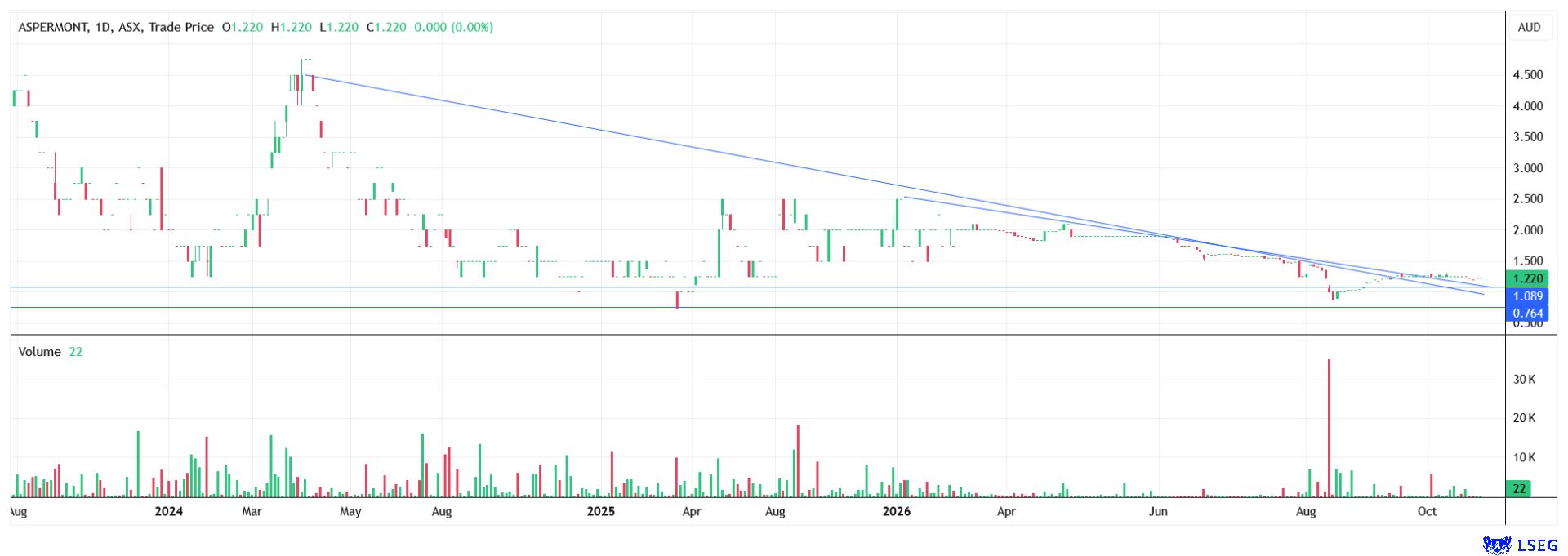
From a technical perspective, the share is still in a wedge formation around AUD 1.22, but has recently moved sideways and has already partly broken out of it. Horizontal lines support this level on the downside, while there is likely to be little major technical resistance on the upside up to AUD 1.50 or even AUD 2.00. If this sideways phase gains momentum, a faster move upward is conceivable, especially as the share sparked considerable hype a few years ago and multiplied in price in a short period. Whether it can do so again remains open, but the combination of solid base-building, growing excitement over data potential and hardly any debt makes the stock at least interesting for risk-aware investors.
Conclusion
At Volkswagen, hefty restructuring costs, collective bargaining disputes and legacy legal issues currently dominate, which is why investors should remain cautious despite low share prices. SAP offers a strong cloud and cash flow foundation, but still has to prove that AI concerns and margin questions will not push the share price even lower. Aspermont is showing encouraging progress in its operational restructuring and sits on a base with horizontal technical support on the chart, but its further upward momentum will likely depend on an initial catalyst.
Conflict of interest
Pursuant to §85 of the German Securities Trading Act (WpHG), we point out that Apaton Finance GmbH as well as partners, authors or employees of Apaton Finance GmbH (hereinafter referred to as "Relevant Persons") may hold shares or other financial instruments of the aforementioned companies in the future or may bet on rising or falling prices and thus a conflict of interest may arise in the future. The Relevant Persons reserve the right to buy or sell shares or other financial instruments of the Company at any time (hereinafter each a "Transaction"). Transactions may, under certain circumstances, influence the respective price of the shares or other financial instruments of the Company.
In addition, Apaton Finance GmbH is active in the context of the preparation and publication of the reporting in paid contractual relationships.
For this reason, there is a concrete conflict of interest.
The above information on existing conflicts of interest applies to all types and forms of publication used by Apaton Finance GmbH for publications on companies.
Risk notice
Apaton Finance GmbH offers editors, agencies and companies the opportunity to publish commentaries, interviews, summaries, news and the like on news.financial. These contents are exclusively for the information of the readers and do not represent any call to action or recommendations, neither explicitly nor implicitly they are to be understood as an assurance of possible price developments. The contents do not replace individual expert investment advice and do not constitute an offer to sell the discussed share(s) or other financial instruments, nor an invitation to buy or sell such.
The content is expressly not a financial analysis, but a journalistic or advertising text. Readers or users who make investment decisions or carry out transactions on the basis of the information provided here do so entirely at their own risk. No contractual relationship is established between Apaton Finance GmbH and its readers or the users of its offers, as our information only refers to the company and not to the investment decision of the reader or user.
The acquisition of financial instruments involves high risks, which can lead to the total loss of the invested capital. The information published by Apaton Finance GmbH and its authors is based on careful research. Nevertheless, no liability is assumed for financial losses or a content-related guarantee for the topicality, correctness, appropriateness and completeness of the content provided here. Please also note our Terms of use.