April 2nd, 2026 | 09:50 CEST
Oil Price Shock as an Opportunity: 100% Potential with Nel ASA, A.H.T. Syngas, and Plug Power
Daily updates continue to emerge on efforts to rein in Iran. President Donald Trump claims to have already achieved all war objectives. Yet, the Iranians appear surprisingly self-confident for a nation portrayed as defeated, pushing back against the media narrative surrounding their willingness to negotiate. Meanwhile, the German government has introduced a new fuel pricing law. Since April 1, a package of measures aimed at curbing price increases has come into effect. In the future, price increases will only be permitted once per day at 12:00 noon, while price reductions remain possible at any time. The law was drafted based on common practice in Austria and is intended to provide greater transparency and stability. However, the initial effect was mixed: although the Brent spot price fell by 7% at midday and the euro weakened against the US dollar, fuel prices did not decline accordingly.
time to read: 4 minutes | Author: André Will-Laudien
ISIN: NEL ASA NK-_20 | NO0010081235 , A.H.T. SYNGAS TECH. EO 1 | NL0010872388 , PLUG POWER INC. DL-_01 | US72919P2020
Table of contents:
Author

André Will-Laudien
Born in Munich, he first studied economics and graduated in business administration at the Ludwig-Maximilians-University in 1995. As he was involved with the stock market at a very early stage, he now has more than 30 years of experience in the capital markets.
Tag cloud
Shares cloud
Self-Sufficient Energy for Industry – AHT Capitalizes on Rising Gas Prices
In the current environment, a GreenTech provider from Germany is making waves. The idea is simple: using innovative technology to substitute natural gas, the company creates decentralized energy systems. The market is likely to take notice these days, as the Middle East crisis is expected to impact the bills of local energy suppliers very soon. The focus is on so-called synthesis gas. Industry studies describe this type of gas production as a highly dynamic segment that is expected to exhibit above-average growth rates compared to traditional gas demand through 2035. At the core of the technological platform is a patented gasification system capable of efficiently converting various biogenic feedstocks, such as wood residues or agricultural byproducts, into usable process gas. These plants are modular in design and enable the simultaneous provision of electricity, heat, and process energy directly at the industrial site, thereby reducing transportation costs and energy losses. A key efficiency driver lies in the standardization of plant models, which leads to shorter project durations and lower investment costs.
There is a lot going on in Overath right now. Strategically, the company is transforming from a traditional plant manufacturer to an integrated energy service provider that operates its own plants and sells energy under long-term contracts. This contracting model opens the door to stable, recurring revenue and is internally valued with target margins of up to around 19%. Demand for such solutions has been rising, particularly since the sharp increase in energy prices, which has put many medium-sized companies under significant cost pressure. Against this backdrop, the use of local waste materials as a low-cost energy source is gaining increasing economic importance.
The Polish market is developing particularly dynamically, where approximately 17 projects in various stages of development are currently being pursued in collaboration with a local partner. For the current fiscal year, it is expected that orders with a volume of up to EUR 10 million can be generated from these projects, while a cumulative project volume of more than EUR 25 million is targeted by 2029. Technologically, the company is also working on solutions for producing hydrogen from biomass, having developed a containerized process chain capable of converting wood waste into high-purity hydrogen. This segment is considered a potentially significant future market, as hydrogen plays a central role in industrial decarbonization.
The company's financial base was most recently strengthened in January through a fully placed convertible bond worth approximately EUR 2 million, which created sufficient liquidity for the pre-financing of new projects. The company is currently valued at a low EUR 7 million on the stock market—far too low given the current situation. Risk-aware investors can therefore still get on board at a favorable price, as the alternative energy market is likely to generate higher growth rates very quickly.
CEO Gero Ferges explained his strategy in detail at the 18th International Investment Forum.
Between Hope and Reality – Nel Remains Under Pressure in the Hydrogen Market
Norway’s Nel ASA also plays a key role in the EU’s alternative energy sector. While operations are somewhat constrained due to reduced EU budgets, officials in Oslo recognize that efforts to find oil alternatives are also slowing down in Helsinki. Currently, Nel still has a solid NOK 1.7 billion in the bank, which is more than enough to pre-finance the expected revenue volume of approximately NOK 972 million. Management is feeling more relaxed after several rounds of cost-cutting, yet operating losses are still rising slightly. Unfortunately, the hoped-for economies of scale have not yet been realized as planned. A key problem is the heavy reliance on large-scale projects, the implementation of which is often delayed. Analysts are currently skeptical, as no clear profit growth is yet visible and the industry as a whole is suffering from investment reluctance. As a result, many experts are merely recommending holding or even selling the stock, while clear buy recommendations are lacking. The average 12-month price target of NOK 2.05 even signals a negative return. Overall, the picture is one of a technologically well-positioned company that is, however, struggling with structural market problems and insufficient monetization of its solutions.
Plug Power – The Operational Slump Persists
Shares of the US hydrogen company Plug Power are highly volatile. Following three successful capital raises in 2025, the company achieved a positive gross profit of USD 5.5 million for the first time in the last quarter. However, these advances are fundamentally insufficient to overcome the underlying problems. As with Nel, a key risk lies in the drastically reduced order backlog, particularly in the electrolyser segment, which makes the growth targets for 2026 appear increasingly unrealistic. At the same time, the high cash burn rate is a significant burden, as the company continues to consume large amounts of capital and will again rely on external financing in 2026. This situation is further exacerbated by delays in government subsidies. Despite revenue growth of 13% to around USD 710 million in 2025, profitability remains a distant prospect, with analysts not expecting the company to break even until 2029. At least the consensus target price on the LSEG Refinitiv platform is still 17% higher than the last quoted price. The valuation range is unusually wide, spanning from very pessimistic to moderately optimistic scenarios.
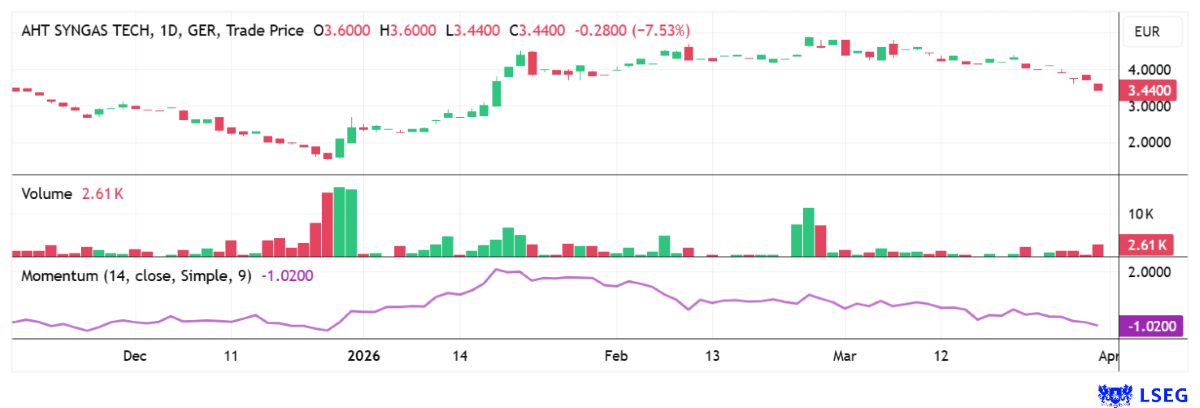
The year 2026 has not yet delivered significant gains across the board. Rather, the segments that performed well in 2025 continue to consolidate. Currently, however, oil stocks also appear somewhat exhausted, which is shifting attention back to alternatives. Investors should therefore stay on their toes and ride the expected momentum. When it comes, things will move quickly again!
Conflict of interest
Pursuant to §85 of the German Securities Trading Act (WpHG), we point out that Apaton Finance GmbH as well as partners, authors or employees of Apaton Finance GmbH (hereinafter referred to as "Relevant Persons") currently hold or hold shares or other financial instruments of the aforementioned companies and speculate on their price developments. In this respect, they intend to sell or acquire shares or other financial instruments of the companies (hereinafter each referred to as a "Transaction"). Transactions may thereby influence the respective price of the shares or other financial instruments of the Company.
In this respect, there is a concrete conflict of interest in the reporting on the companies.
In addition, Apaton Finance GmbH is active in the context of the preparation and publication of the reporting in paid contractual relationships.
For this reason, there is also a concrete conflict of interest.
The above information on existing conflicts of interest applies to all types and forms of publication used by Apaton Finance GmbH for publications on companies.
Risk notice
Apaton Finance GmbH offers editors, agencies and companies the opportunity to publish commentaries, interviews, summaries, news and the like on news.financial. These contents are exclusively for the information of the readers and do not represent any call to action or recommendations, neither explicitly nor implicitly they are to be understood as an assurance of possible price developments. The contents do not replace individual expert investment advice and do not constitute an offer to sell the discussed share(s) or other financial instruments, nor an invitation to buy or sell such.
The content is expressly not a financial analysis, but a journalistic or advertising text. Readers or users who make investment decisions or carry out transactions on the basis of the information provided here do so entirely at their own risk. No contractual relationship is established between Apaton Finance GmbH and its readers or the users of its offers, as our information only refers to the company and not to the investment decision of the reader or user.
The acquisition of financial instruments involves high risks, which can lead to the total loss of the invested capital. The information published by Apaton Finance GmbH and its authors is based on careful research. Nevertheless, no liability is assumed for financial losses or a content-related guarantee for the topicality, correctness, appropriateness and completeness of the content provided here. Please also note our Terms of use.