November 17th, 2026 | 05:26 CET
Mali's gold belt: Barrick Mining gains, B2Gold slumps and Desert Gold is on the verge of production
Created and Published on Behalf of Desert Gold Ventures Inc.
In western Mali, these weeks are revealing which companies can operate reliably in the gold business. Along the Senegal-Mali Shear Zone (SMSZ), established producers must contend with new, stricter mining laws and costly logistical hurdles. The state is securing a significantly larger share of the proceeds, forcing companies into costly compromises. In this environment, a much smaller explorer is relying on a compact processing plant and aims to produce its first gold in the immediate vicinity of Barrick Mining and B2Gold before the end of this year. Can it make the transition from explorer to producer?
time to read: 4 minutes | Author: Nico Popp
ISIN: Desert Gold Ventures Inc | CA25039N4084 , B2GOLD CORP. | CA11777Q2099 , BARRICK MINING CORPORATION | CA06849F1080
Table of contents:
Author

Nico Popp
At home in Southern Germany, the passionate stock exchange expert has been accompanying the capital markets for about twenty years. With a soft spot for smaller companies, he is constantly on the lookout for exciting investment stories.
Tag cloud
Shares cloud
Barrick Mining ramps up Loulo-Gounkoto faster than planned
With the Loulo-Gounkoto complex, Barrick Mining operates one of the region's most important facilities. Following legal disputes with Mali's government, the group is ramping up the mine faster than planned. According to Barrick Mining, the group produced 816,000 ounces of gold in the third quarter and generated a net profit of USD 1.32 billion. The Loulo-Gounkoto complex increased its production by 16% compared with the previous quarter. In November 2025, Barrick Mining agreed with Mali on a payment of around USD 430 million. In return, the government extended the mining permit for Loulo by 10 years. Barrick Mining confirms its full-year guidance of 2.90 to 3.25 million ounces. However, costs are rising: all-in sustaining costs (AISC) per ounce climbed to USD 1,911 across the group, up from USD 1,538 in the same quarter last year. For Loulo, a new feasibility study confirms reserves for six years of open-pit mining and 16 years of underground mining. The realised gold price in the third quarter was USD 4,243 per ounce.
B2Gold records production slump
B2Gold chose the path of early cooperation and quickly accepted the new mining laws. Nevertheless, B2Gold reports a 47% slump in production at the Fekola mine to 78,119 ounces of gold for the third quarter. The open pit has entered a phase involving substantial waste stripping, and the higher-grade ore from the new Menankoto area is missing because approval was delayed for months. Following final approval, preparatory work began in October. According to B2Gold, the first rock from this satellite project will not be mined and processed until early 2027. At the same time, B2Gold lowered its guidance for all-in sustaining costs (AISC) at Fekola to USD 2,350 to 2,500 per ounce sold. For the entire Fekola complex, B2Gold now expects only 390,000 to 420,000 ounces in 2026. From 2028, the new Fekola Regional area is expected to contribute more than 150,000 ounces annually.
Desert Gold: Nimble explorer ahead of production start-up
Desert Gold is taking a different approach along the same section of the shear zone. Instead of investing hundreds of millions of dollars in a large-scale mine, management is opting for a compact starter plant. According to Desert Gold, the company plans to bring its new gravity processing plant, with a capacity of 200 tonnes of rock per day, into operation at the Barani East deposit in November. The plant and a 650 kVA generator have already arrived on site. Desert Gold expects to produce its first gold from near-surface ore in the fourth quarter. The gravity processing plant operates without cyanide leaching. However, Barani East does not yet have any defined reserves or a feasibility study. Desert Gold had originally targeted commissioning for last summer. The project is part of the 440 km² SMSZ property, which covers 38 km of the shear zone. Desert Gold reports resources there of 336,800 ounces in the measured and indicated categories, plus a further 879,900 ounces in the inferred category.
Internally generated cash flow and geographical expansion
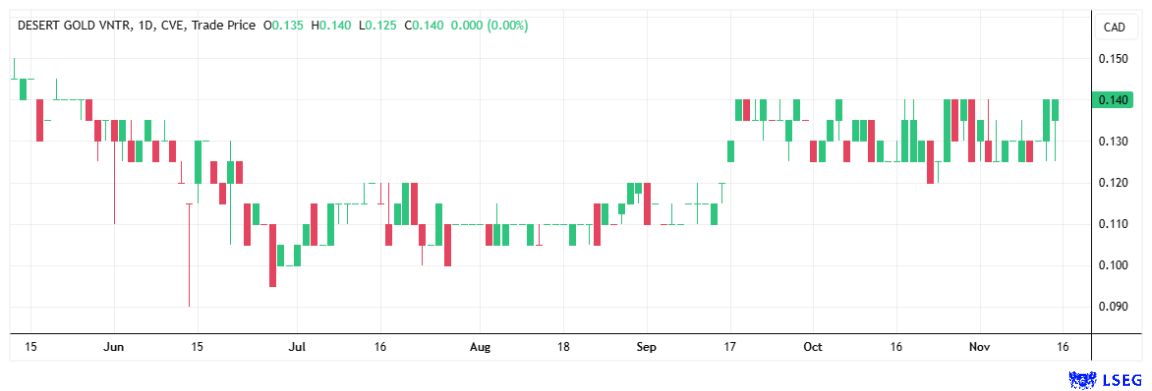
With the plant, Desert Gold aims to generate its own revenue for the first time. At a gold price of over USD 4,000 per ounce, even a plant with moderate throughput can generate its own cash flow. This could allow Desert Gold to finance future drill programmes without issuing new shares to the same extent. For shareholders with a longer-term horizon, this can make the crucial difference. In February 2026, the company had raised around CAD 7.2 million through a capital increase, partly to commission the plant. A preliminary economic assessment (PEA) from November 2025 calculates an after-tax net present value of USD 61 million for Barani and Gourbassi, albeit for a larger plant with additional cyanide leaching and at a gold price of USD 2,850 per ounce. In parallel, the company is working to broaden its geographical footprint further. To this end, Desert Gold secured an option on the Tiegba Gold project in Côte d'Ivoire, which is considered a more stable mining country. Desert Gold can acquire a 90% stake in the 297 km² project, located about 188 km west of the city of Abidjan.
Conclusion: Small plant, big step
Mining in West Africa remains risky. Barrick Mining and B2Gold must invest large sums to remain operational in Mali. Desert Gold partly avoids this pressure through its compact plant. Analysts at GBC AG give Desert Gold a Buy recommendation and a price target of EUR 0.59 through the end of 2027. Nevertheless, all three companies operate in a challenging environment. Mali's mining laws mandate state and local participation of up to 35% and impose a strict windfall profits tax. Added to this are acute security risks in the country, which repeatedly lead to fuel supply shortages. Investors must factor in these geopolitical conditions. As an explorer transitioning to a producer, Desert Gold's shares remain a speculative investment. On the positive side, however, there are significant opportunities – the market capitalisation currently stands at just around CAD 50 million.
Conflict of interest
Pursuant to §85 of the German Securities Trading Act (WpHG), we point out that Apaton Finance GmbH as well as partners, authors or employees of Apaton Finance GmbH (hereinafter referred to as "Relevant Persons") currently hold or hold shares or other financial instruments of the aforementioned companies and speculate on their price developments. In this respect, they intend to sell or acquire shares or other financial instruments of the companies (hereinafter each referred to as a "Transaction"). Transactions may thereby influence the respective price of the shares or other financial instruments of the Company.
In this respect, there is a concrete conflict of interest in the reporting on the companies.
In addition, Apaton Finance GmbH is active in the context of the preparation and publication of the reporting in paid contractual relationships.
For this reason, there is also a concrete conflict of interest.
The above information on existing conflicts of interest applies to all types and forms of publication used by Apaton Finance GmbH for publications on companies.
Risk notice
Apaton Finance GmbH offers editors, agencies and companies the opportunity to publish commentaries, interviews, summaries, news and the like on news.financial. These contents are exclusively for the information of the readers and do not represent any call to action or recommendations, neither explicitly nor implicitly they are to be understood as an assurance of possible price developments. The contents do not replace individual expert investment advice and do not constitute an offer to sell the discussed share(s) or other financial instruments, nor an invitation to buy or sell such.
The content is expressly not a financial analysis, but a journalistic or advertising text. Readers or users who make investment decisions or carry out transactions on the basis of the information provided here do so entirely at their own risk. No contractual relationship is established between Apaton Finance GmbH and its readers or the users of its offers, as our information only refers to the company and not to the investment decision of the reader or user.
The acquisition of financial instruments involves high risks, which can lead to the total loss of the invested capital. The information published by Apaton Finance GmbH and its authors is based on careful research. Nevertheless, no liability is assumed for financial losses or a content-related guarantee for the topicality, correctness, appropriateness and completeness of the content provided here. Please also note our Terms of use.