August 12th, 2026 | 08:05 CEST
Heat, Drought, and Water Shortages: A Sector-Wide Buy Signal for Environmental Specialists Bayer, MustGrow, Kraft Heinz and Unilever
Created and Published on Behalf of MustGrow Biologics Corp.
The devastating combination of persistent drought, acute water shortages, and extreme heat is creating unprecedented challenges for the global economy and food supply. As climate-related risks intensify, ESG considerations are moving into sharper focus than ever before. Amid this crisis, a potential technical and fundamental buy signal is emerging across sectors for companies capable of delivering innovative environmental solutions. Agricultural and chemical companies such as Bayer are developing advanced seed technologies designed to make crops more resilient during periods of extreme drought. At the same time, the AgriTech company MustGrow is gaining importance as its biological fertilizer and crop protection solutions are designed to protect soil health and improve water efficiency in agriculture, among other things. Food giants such as Unilever and Kraft Heinz are also responding proactively by strictly optimizing their entire supply chains to minimize water consumption and resource intensity. Investors are increasingly recognizing that sustainable business practices in modern times are no longer merely an image factor, but rather a catalyst for future returns.
time to read: 6 minutes | Author: André Will-Laudien
ISIN: MUSTGROW BIOLOGICS CORP. | CA62822A1030 | TSXV: MGRO , OTCQB: MGROF , KRAFT HEINZ CO.DL -_01 | US5007541064 , BAYER AG NA O.N. | DE000BAY0017 , UNILEVER PLC LS-_031111 | GB00B10RZP78
Table of contents:
Author

André Will-Laudien
Born in Munich, he first studied economics and graduated in business administration at the Ludwig-Maximilians-University in 1995. As he was involved with the stock market at a very early stage, he now has more than 30 years of experience in the capital markets.
Tag cloud
Shares cloud
Unilever and Kraft Heinz: ESG-Compliant Foods More in Demand Than Ever
There are certainly companies that have already woken up to this reality! A prime example is the British consumer goods giant Unilever. For years, it has been regarded as one of the most trailblazing pioneers in the field of sustainable corporate management. With its ambitious "Unilever Sustainable Living Plan," the company is pursuing the strict goal of halving its environmental footprint across the entire value chain. The company is increasingly focusing on plant-based product alternatives, the systematic elimination of plastic packaging, and the promotion of regenerative agriculture. This consistent focus on environmental and social criteria is also reflected in its performance on the capital markets. Over the past 36 months, the share has posted a solid total return of approximately 21.5%. Despite a temporarily challenging inflationary environment, investors are rewarding the high resilience of the crisis-resistant brand portfolio. Thanks to a reliable dividend yield of over 3.5%, the group's fundamental valuation remains extremely attractive for conservative investors. Analysts on the LSEG platform therefore largely view the consumer goods giant's long-term growth prospects positively. 10 out of 19 experts rate the stock a "Buy," resulting in an average 12-month upside potential of 15%.**
In direct comparison, the US-based Kraft Heinz Company is undergoing a far-reaching but promising ESG transformation process. The food company has committed to transitioning entirely to recyclable, reusable, or compostable packaging by 2025. At the same time, management is investing heavily in the sustainable sourcing of key ingredients such as tomatoes and palm oil to make supply chains more resilient to global climate change. On the stock market, however, the past year was more volatile for shareholders due to high restructuring costs and brand investments. Kraft Heinz's share has posted a negative return of approximately 31.5% over the past 36 months. Following this meagre return, the correction is likely now complete, as the lows around USD 21 have recently been successfully defended. The share is now back at around USD 25 and, incidentally, also offers a 6.6% dividend yield.
MustGrow Biologics: A New Agricultural Platform Emerges from the Mustard Plant
In the coming decades, agriculture will need to produce more food on limited land while simultaneously dealing with water scarcity, soil degradation, climate stress, and growing regulatory pressure. The innovative Canadian company MustGrow Biologics stands out in this regard with a technology platform that harnesses natural active ingredients from the mustard plant to enhance biofertility, soil health, and biological crop protection. The focus is now on the biological soil fertility product, TerraSante™, a product already available on the market that is designed to support soil biology and improve the efficiency of nutrient and water uptake. After a long development period, the sales story is slowly gaining momentum.
The development becomes even more interesting when looking at the sales outlook in the US, where TerraSante™ is now approved in 10 states and specifically targets high-value crops such as strawberries, potatoes, fruits, vegetables, nuts, and grapes. The research firm GBC therefore expects, following a transitional year in 2026 with revenue of CAD 4.50 million, an acceleration to CAD 14.05 million in 2027 and as much as CAD 31.56 million in 2028. At the same time, the gross margin is expected to improve from 23.0% to 35.0% and then to 48.0%, as better production conditions and economies of scale take effect with the increasing share of proprietary products. The real leverage thus lies less in the current revenue level than in the potential transformation of a small agtech company into a high-margin provider of proprietary biologics. GBC projects an EBITDA of CAD 8.46 million for 2028, following a loss of CAD 4.35 million in 2026, which would represent a remarkable operational turnaround within just two years.
COO Colin Bletsky presents the future of biofertilizers and their advantages over conventional methods at the IIF.
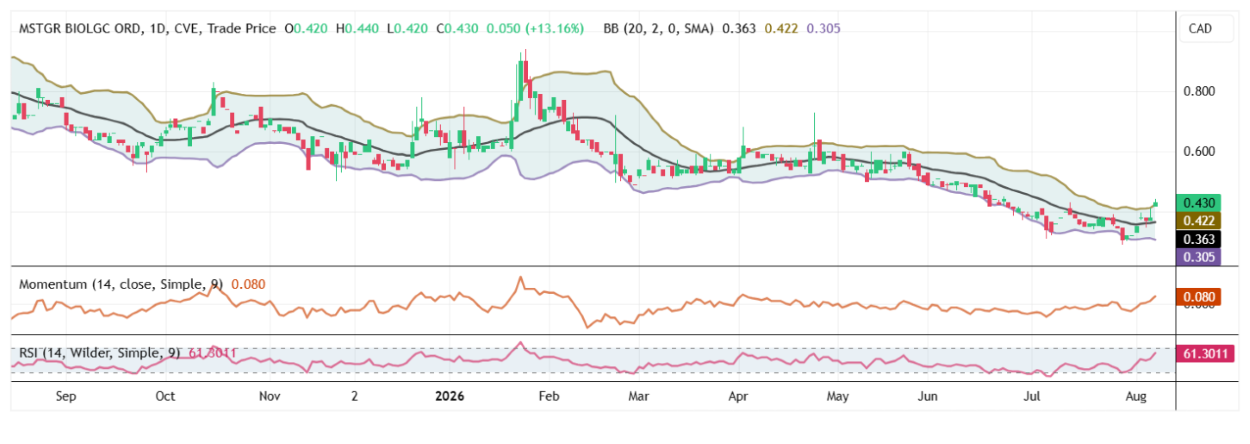
The pre-registered biopesticide candidate, TerraMG™, offers additional growth potential; it is being developed for the biological treatment of nematodes, soil-borne diseases and pests, thereby opening up a second, significantly larger long-term application area. Particularly valuable in this regard is the partnership with Bayer, through which MustGrow can have its technology developed and marketed in Europe, the Middle East, and Africa (EMEA) via a globally established partner, while Bayer covers the regulatory and marketing expenses. Added to this is a protective shield consisting of 108 granted and pending patents, which safeguards the mustard-based technology platform across various formulations, processes, and applications. Strategically, management has made a clean break by closing its Canadian marketing and distribution division, NexusBioAg, to concentrate capital and management resources on scaling TerraSante™ in the US. While this increases dependence on the success of its own products, it also makes the business model more focused and significantly increases the potential for higher margins. Finally, what is particularly interesting for investors is the discrepancy between the company's current market capitalization of around CAD 30 million and the valuation derived by GBC. The analysts rate the stock "Buy" and, based on their DCF model, estimate a fair value of CAD 2.70 (EUR 1.66) per share.
Bayer: CropScience Grows Dynamically and Sustainably
With its latest financial results, the Leverkusen-based Bayer Group impressively underscores its global leadership role in agriculture and sustainability. The company's strategic core, the Crop Science agricultural division, is proving to be a dynamic growth engine, driven by innovative seed technologies and biological crop protection solutions. In the most recent quarter, the core division posted an adjusted revenue increase of +3.5% to EUR 4.91 billion. Profitability is even more impressive, as the agricultural division's EBITDA before special items jumped by a whopping +30.2% to EUR 902 million, thanks to an improved margin of 18.4%. As part of its ambitious ESG criteria, the Group is consistently focusing on the development of climate-resilient crops that can withstand extreme weather events such as droughts and heat waves. Through digital precision technologies in "smart farming," the DAX giant also enables farmers worldwide to significantly reduce their use of water, fertilizer, and pesticides. This forward-looking focus on biological alternatives and soil conservation forms the fundamental basis for the accelerated, highly profitable growth of this division.
On the stock market, share prices reflect a noticeable turnaround in operating performance after a landmark decision by the US Supreme Court significantly mitigated the legacy liability risks in the protracted glyphosate class-action lawsuit. Following the strong Q2 results, Bayer shares posted a sharp 20% jump. This brings the 12-month investment return, including dividends, to over 90%. Leading research firms reacted immediately to the positive operational momentum and adjusted their valuation models accordingly. Investment bank JPMorgan recently raised its price target for the share from EUR 50 to EUR 61 and maintained its "Overweight" rating. The broad market consensus among analysts on the LSEG platform rates the stock as a "Buy" with an average price target of over EUR 56. Experts at Jefferies remain skeptical with a "Hold" rating and a price target of EUR 46, about EUR 3 below yesterday's closing price. After years of drought, Bayer is back in the sun!
The markets continue to twitch like an overcaffeinated day trader. What was celebrated yesterday as the "Next Big Thing" could be yesterday's news by tomorrow. Currently, the heat and the classic summer lull seem to be dominating the trading floors. But with falling energy prices, the stock market is sensing a breath of fresh air again: names like Bayer, Unilever, and Kraft Heinz are likely to benefit, and more than a few stocks are now waking up from their slumber. Given the global climate situation, the Canadian biofertilizer specialist MustGrow is attracting particular attention, as its ESG-focused business continues to gain momentum.
Conflict of interest
Pursuant to §85 of the German Securities Trading Act (WpHG), we point out that Apaton Finance GmbH as well as partners, authors or employees of Apaton Finance GmbH (hereinafter referred to as "Relevant Persons") currently hold or hold shares or other financial instruments of the aforementioned companies and speculate on their price developments. In this respect, they intend to sell or acquire shares or other financial instruments of the companies (hereinafter each referred to as a "Transaction"). Transactions may thereby influence the respective price of the shares or other financial instruments of the Company.
In this respect, there is a concrete conflict of interest in the reporting on the companies.
In addition, Apaton Finance GmbH is active in the context of the preparation and publication of the reporting in paid contractual relationships.
For this reason, there is also a concrete conflict of interest.
The above information on existing conflicts of interest applies to all types and forms of publication used by Apaton Finance GmbH for publications on companies.
Risk notice
Apaton Finance GmbH offers editors, agencies and companies the opportunity to publish commentaries, interviews, summaries, news and the like on news.financial. These contents are exclusively for the information of the readers and do not represent any call to action or recommendations, neither explicitly nor implicitly they are to be understood as an assurance of possible price developments. The contents do not replace individual expert investment advice and do not constitute an offer to sell the discussed share(s) or other financial instruments, nor an invitation to buy or sell such.
The content is expressly not a financial analysis, but a journalistic or advertising text. Readers or users who make investment decisions or carry out transactions on the basis of the information provided here do so entirely at their own risk. No contractual relationship is established between Apaton Finance GmbH and its readers or the users of its offers, as our information only refers to the company and not to the investment decision of the reader or user.
The acquisition of financial instruments involves high risks, which can lead to the total loss of the invested capital. The information published by Apaton Finance GmbH and its authors is based on careful research. Nevertheless, no liability is assumed for financial losses or a content-related guarantee for the topicality, correctness, appropriateness and completeness of the content provided here. Please also note our Terms of use.