June 29th, 2026 | 07:10 CEST
Gold, Defense, Aerospace: Sector Rotation in Full Swing – SpaceX, OHB, Desert Gold, Rheinmetall, and TKMS
Stock markets remain surprisingly resilient as the end of June approaches, but the glossy surface is starting to fade in certain segments. The bull market in aerospace is losing steam, and in the defense sector, after many months of gains, profit-taking is now becoming noticeable. As a result, valuations are gradually re-aligning with fundamentals. For rational investors, market hype is difficult to reconcile with, but one thing remains clear: stocks that become excessively overvalued tend to correct sharply when expectations are pushed to extreme levels without sufficient justification. Just as with Elon Musk's inflated initial valuation, the exit bell has likely rung quite loudly for Rheinmetall as well. In the fall, analysts had been outbidding each other with price targets around EUR 2,200; now they are painfully backtracking. Price declines of 20% in just a few trading hours for the defence sector star, and a 30% drop from its peak for SpaceX. But there are other hot candidates worth a closer look. OHB is drawing attention following a significant capital increase, while TKMS has secured a major naval contract. These developments are actively reshaping market dynamics—we break down what it means in detail.
time to read: 6 minutes | Author: André Will-Laudien
ISIN: DESERT GOLD VENTURES | CA25039N4084 | TSXV: DAU , OTCQB: DAUGF , TKMS AG & CO KGAA | DE000TKMS001 , OHB SE O.N. | DE0005936124 , SPACE EXPLORATION TECHNOLOGIES CORP | US84615Q1031 | NASDAQ: SPCX
Table of contents:
Author

André Will-Laudien
Born in Munich, he first studied economics and graduated in business administration at the Ludwig-Maximilians-University in 1995. As he was involved with the stock market at a very early stage, he now has more than 30 years of experience in the capital markets.
Tag cloud
Shares cloud
SpaceX: A Brilliant Stock Market Debut for Elon Musk
Price swings are currently the order of the day. After successfully placing 555 million shares at USD 135, SpaceX gained around 60% in the first three days to reach around USD 218. Its market capitalization hit an astonishing USD 2.83 trillion. With that, Elon Musk surpassed the 50-year-old Microsoft in value on his first try. Then the rally paused for a while; currently, the visionary blockbuster stock is trading again at around USD 150. However, the following developments surrounding the IPO are particularly noteworthy. Within two weeks of trading, Elon Musk followed up with a USD 25 billion bond offering, boosting the company's cash reserves to over USD 100 billion. xAI has been fully integrated, so the company is now focusing heavily on artificial intelligence and data center infrastructure. Management has also outlined plans to use Starlink's satellite technology to offer its own mobile service plans in the US, thereby becoming a direct competitor to traditional network operators. In 2025, SpaceX acquired radio frequency licenses for its Starlink satellite network from the telecommunications company EchoStar for approximately USD 19.6 billion. This would enable the aerospace and AI company to rapidly establish a high-performance and affordable direct service for mobile devices. What all of this could be worth—who knows? Early analysts on the LSEG platform estimate SpaceX's 12-month price target at an average of USD 255, equating to a market capitalization of USD 3.3 trillion. Well, then!
OHB: After the Price Drop, Now the Capital Increase
In Germany, investors currently have their sights set on the "Micro SpaceX," OHB, based in Bremen. With a market capitalization of EUR 6.5 billion, the European aerospace and satellite specialist is 240 times smaller than Elon Musk's marvel, yet it is already profitable. Amid the SpaceX euphoria, the share price soared to EUR 688 in May. Last week, however, a capital increase was announced, and combined with prior rumors, it sent the share price tumbling by 60% in just four weeks. With the announced rights offering, the company now aims to raise up to EUR 500 million. The subscription price for the new shares is EUR 300, with up to 1.7 million new shares to be issued. The subscription offer, on a 45:4 ratio, runs until July 8; some of the new shares will come from the capital increase, while others will come from the holdings of major shareholder KKR. The US investor plans to sell up to 1.228 million shares, reducing its stake to just over 20% after the transaction. The Fuchs founding family, however, remains the majority shareholder and intends to retain control. After all these measures, the free float will rise from 8% to approximately 26%. In a weak market environment on Friday, the price fell to around EUR 270. OHB now has plenty of cash on hand, though shareholders who recently jumped in were a bit unlucky with their timing. That is the stock market for you—it gives and takes!
TKMS: Rheinmetall Clearly Left Empty-Handed
A short update on the thyssenkrupp subsidiary TKMS. Last week, it was announced that the Ministry of Defense is halting the large F126 frigate project with Rheinmetall and instead plans to order smaller MEKO A-200 DEU-type frigates from TKMS. At approximately EUR 1.6 billion, the unit price of the significantly smaller frigate is roughly half the cost of the massive F126 frigate. The current plan calls for four ships initially, with an option for four more. TKMS has set 2029 as the target year for the first delivery. The original general contractor, the Dutch Damen shipyard, ran into significant financial and scheduling problems, triggered in part by IT difficulties with the design software. By the time the project was officially halted, approximately EUR 2.3 billion in taxpayer funds had already been invested in the project; Rheinmetall, despite recently acquiring the partner shipyard NVL to secure the program, ultimately comes away empty-handed.. The lost overall F126 contract was projected to reach a massive value of around EUR 18 billion. Analysts view the loss as a major setback for the ambitious revenue targets of Rheinmetall CEO Armin Papperger. As a result, the Düsseldorf-based group's share price fell by over 20% to around EUR 940, while TKMS shareholders briefly celebrated a nearly 20% gain. However, this gain had largely disappeared by the end of the week. Easy come, easy go!
Desert Gold: Full Speed Ahead Toward Production in West Africa
Desert Gold is delivering the exact opposite of a flop. The gold developer clearly stands out from traditional exploration companies in the West African gold sector, as its operational focus is now squarely on the upcoming start of production. The flagship SMSZ project spans approximately 440 km² along the geologically significant Senegal-Mali Shear Zone and borders directly on active mining sites operated by established companies, including Barrick Mining and B2Gold. Despite political challenges, Mali offers an established mining framework with a long history of production, which tends to expedite the permitting processes for local mining projects. Although resources have already been proven, only a fraction of the land package has been systematically explored to date, leaving significant potential for future reserve growth.
At the Barani East sub-project, infrastructure preparations for the operational site are well advanced. Areas for facilities, storage, and workshops have already been developed; the focus is now on the modular processing unit. CEO Jared Scharf comments on the progress: "Preparations at the Barani East site are progressing well. We expect the technical equipment to be delivered from the port in Dakar to the site by the end of June 2026, subject to the usual logistics and customs clearance."
IIF host Lyndsay Malchuk speaks with CEO Jared Scharf about the ongoing mine development in Mali and the opportunities in Côte d'Ivoire.
Commissioning is expected to take just a few weeks! Designed for a daily capacity of 200 to 240 metric tonnes, the plant can be expanded modularly, which limits the initial capital requirement and ensures operational flexibility when integrating additional deposits. This allows exploration to continue on other sub-areas. There, too, there should be enough mineralized surface material to be found. However, Desert Gold also holds claims in neighbouring Côte d'Ivoire, which is increasingly emerging as an attractive exploration location with improved infrastructure and growing investor interest. Work there will be intensified once initial cash flow is generated in Mali.
Important for investors: Given the self-financing opportunities on the horizon, there should be no further dilution for shareholders. With approximately 360 million shares outstanding, the current PEA indicates net present values of over USD 150 million at gold prices above the USD 4,000 mark; however, the market capitalization currently stands at only around USD 24 million. Analysts at GBC Research see significant upside potential and recently set a price target of CAD 0.93—more than 8 times higher than the current trading level of about CAD 0.11. The current volatility in the gold price creates attractive opportunities to accumulate shares!
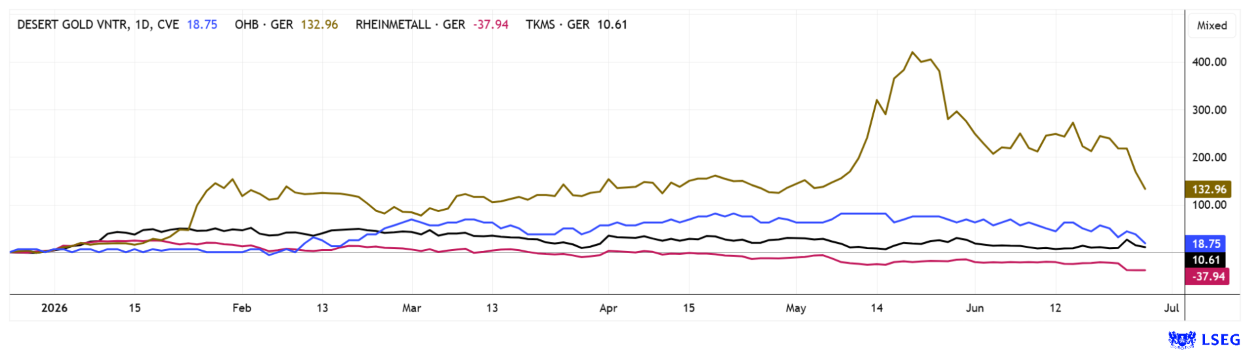
The summer rotation is increasingly taking shape on the stock market. While the high-tech sector is now being driven solely by chip stocks, AI and IT technology stocks are gradually losing ground. The commodities sector, particularly critical and precious metals, remains in the spotlight. Desert Gold, for example, is likely to really take off once production begins this summer. SpaceX, on the other hand, should come back down to earth and thus has considerable room for a price correction. In the defense sector, the party is likely over for now.
Conflict of interest
Pursuant to §85 of the German Securities Trading Act (WpHG), we point out that Apaton Finance GmbH as well as partners, authors or employees of Apaton Finance GmbH (hereinafter referred to as "Relevant Persons") currently hold or hold shares or other financial instruments of the aforementioned companies and speculate on their price developments. In this respect, they intend to sell or acquire shares or other financial instruments of the companies (hereinafter each referred to as a "Transaction"). Transactions may thereby influence the respective price of the shares or other financial instruments of the Company.
In this respect, there is a concrete conflict of interest in the reporting on the companies.
In addition, Apaton Finance GmbH is active in the context of the preparation and publication of the reporting in paid contractual relationships.
For this reason, there is also a concrete conflict of interest.
The above information on existing conflicts of interest applies to all types and forms of publication used by Apaton Finance GmbH for publications on companies.
Risk notice
Apaton Finance GmbH offers editors, agencies and companies the opportunity to publish commentaries, interviews, summaries, news and the like on news.financial. These contents are exclusively for the information of the readers and do not represent any call to action or recommendations, neither explicitly nor implicitly they are to be understood as an assurance of possible price developments. The contents do not replace individual expert investment advice and do not constitute an offer to sell the discussed share(s) or other financial instruments, nor an invitation to buy or sell such.
The content is expressly not a financial analysis, but a journalistic or advertising text. Readers or users who make investment decisions or carry out transactions on the basis of the information provided here do so entirely at their own risk. No contractual relationship is established between Apaton Finance GmbH and its readers or the users of its offers, as our information only refers to the company and not to the investment decision of the reader or user.
The acquisition of financial instruments involves high risks, which can lead to the total loss of the invested capital. The information published by Apaton Finance GmbH and its authors is based on careful research. Nevertheless, no liability is assumed for financial losses or a content-related guarantee for the topicality, correctness, appropriateness and completeness of the content provided here. Please also note our Terms of use.