May 7th, 2026 | 08:50 CEST
Following the stock rallies at Ballard Power and Nel ASA—Is HPQ Silicon Now Poised for a Breakout?
The world of renewable energy and modern energy storage is on the move again, sending investors into a frenzy. While companies like Ballard Power and Nel ASA have already delivered impressive price surges and positive analyst upgrades, a smaller technological pioneer still seems to be waiting in the wings for its big moment. We are talking about HPQ Silicon, a company that is causing a sensation with groundbreaking lab results and its first commercial orders in the field of battery technology. In this report, we examine the current momentum of established hydrogen players and analyze why the technical charts for HPQ Silicon could be set for "victory." Read on to find out whether, following the rebound of the big players, the moment has perhaps arrived for the next hidden champion to break through resistance and set its sights on new price targets.
time to read: 5 minutes
|
Author:
Mario Hose
ISIN:
HPQ SILICON INC | CA40444L1031 | TSXV: HPQ , OTCQB: HPQFF , BALLARD PWR SYS | CA0585861085 , NEL ASA NK-_20 | NO0010081235
Table of contents:
Author

Mario Hose
Born and raised in Hannover, Lower Saxony follows social and economic developments around the globe. As a passionate entrepreneur and columnist he explains and compares the most diverse business models as well as markets for interested stock traders.
Tag cloud
Shares cloud
The Established Players: Ballard Power and Nel ASA on the Rise
A fresh breeze is blowing through the green technology sector once again. For a long time, investors in hydrogen stocks had to endure a tough dry spell, but recent developments at Ballard Power and Nel ASA suggest that the worst may be over. Ballard Power recently demonstrated that fuel cell technology is once again a force to be reckoned with. An impressive price surge within just a few trading days underscored the return of investor confidence. Analysts, such as those at Lake Street, have revised their rating from "Hold" to "Buy" and see a price target of a robust USD 5. In particular, the progress in gross margin to around 14% and the focus on the bus market and stationary solutions for data centers appear to be bearing fruit. Ballard is working hard to achieve a positive cash flow, which is expected by the end of 2027.
The situation is similarly dynamic for the Norwegian electrolysis specialist Nel ASA. The company has posted growth of over 70% in the last three months, a breakthrough. Despite minor setbacks in day-to-day operations, the structural upward trend remains intact. Nel is benefiting from increasing electrification and the global push toward industrial decarbonization. Market sentiment has become significantly more optimistic here as production scaling progresses and major projects take shape worldwide. Both companies have thus already staged a remarkable rebound and proven that the clean energy sector is regaining its relevance on the stock market.
HPQ Silicon: Lying in wait
While the big names are already celebrating their first milestones, HPQ Silicon is quietly preparing a "technological sensation" in the background that has the potential to transform the entire energy storage industry. The company has released a series of announcements in recent months that, upon closer inspection, speak for themselves. The transition from the lab to commercial application is in full swing. As early as March, HPQ made a significant financial statement by successfully completing a CAD 3 million private placement. The fact that these funds came from an investor outside Canada underscores the international interest. With a warrant exercise price of CAD 0.25, a benchmark was also set that should speak to confidence in future value appreciation.
Things got particularly exciting in April when HPQ and its partner Novacium announced technical milestones that could eclipse previous industry standards. On April 15, it was announced that GEN4 silicon anode materials in 21700 battery cells had broken through the 7,000 mAh barrier. At exactly 7,030 mAh, a value was achieved that far exceeds the usual 4,800 to 5,000 mAh of conventional graphite cells. The scientific success here lies not only in the capacity but also in the stability under extreme conditions. Even when discharged to just 0.55 volts, which would destroy conventional cells, the material showed less than 2% loss in performance after 70 cycles. This opens up entirely new possibilities for high-performance applications where every bit of energy counts.
The commercial breakthrough was not long in coming. On April 22, HPQ announced its first order from a European drone manufacturer for batteries based on these GEN4 cells. This could no longer be merely a test project, but the beginning of actual commercialization. Drone manufacturers are desperately seeking ways to extend flight time without increasing weight, and this is precisely where HPQ provides the solution. Just eight days later, on April 30, the next piece of news followed: A semi-solid battery pack achieved an energy density of 395 Wh/kg at the pack level. That represents an improvement of up to 36% over conventional LiPo systems. Such figures are a real selling point in the field of unmanned aviation.
In a recent blog post from May 5, management also outlines the strategic roadmap. It is no longer just about lab records, but about integration into existing production lines. The beauty of HPQ's technology is that battery manufacturers do not have to completely overhaul their existing infrastructure. This "integration rather than reinvention" approach significantly lowers the barriers for potential partners and accelerates the path to actual revenue. By engaging Apaton Finance to increase visibility in the European market, it is also clear that HPQ is now specifically seeking the attention of local investors.
Technical Chart Outlook and Potential
Looking at the share price, HPQ Silicon currently presents an interesting picture. While Ballard and Nel have already made their initial surge, HPQ is still consolidating at a level that could appear to savvy investors as the calm before the storm. A resistance level has formed at CAD 0.22 on the chart. Should the stock manage to sustainably break through this hurdle, the path upward would be clear. The next logical target lies in the range of CAD 0.30 to 0.35, which corresponds to considerable upside potential.
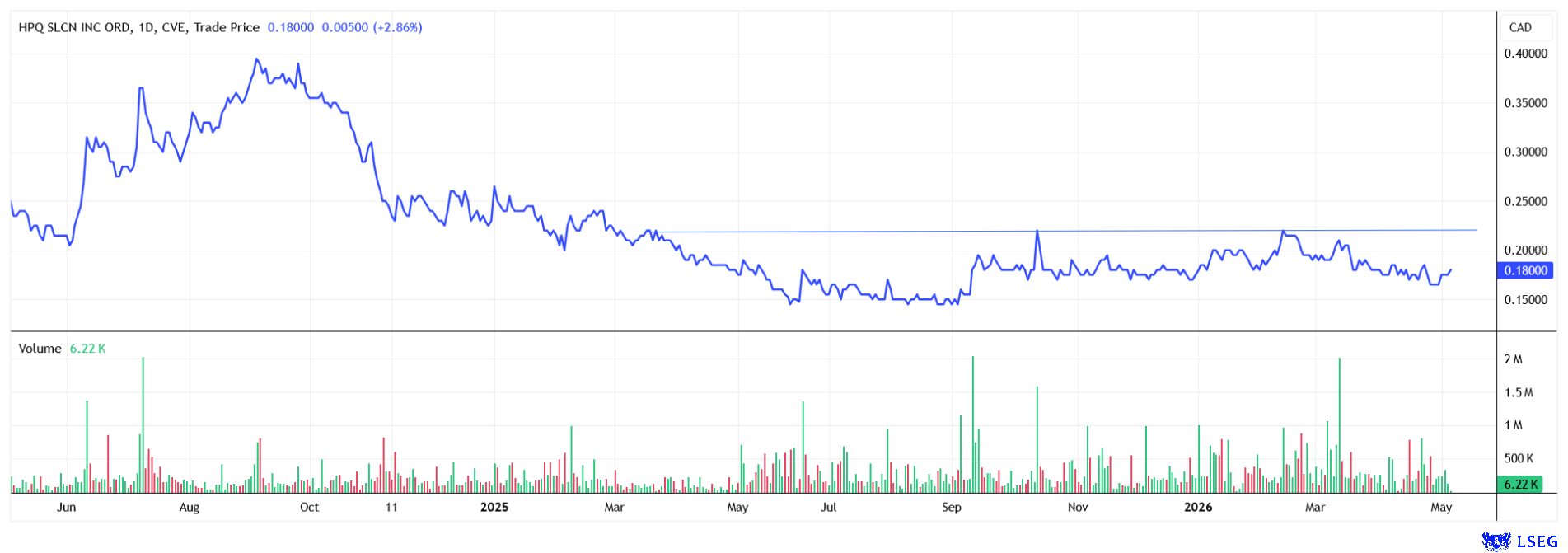
The year-to-date high of CAD 0.24 is particularly significant. A breakout above this level would generate massive momentum and could spark a rally similar to that seen in major hydrogen stocks. The technical indicators and the fundamental news landscape appear to be coming together to form a positive overall picture. Following the successful placement and technological breakthroughs, HPQ Silicon is in a stronger financial and operational position than ever before. It seems only a matter of time before the market fully prices in these advances and the stock gains momentum.
Conclusion: Three Stocks, One Direction
In summary, the future technologies sector has come back to life. Ballard Power has paved the way for fuel cells with its analyst upgrade and improved profitability, while Nel ASA impresses with its sheer market presence and strong rebound. Both stocks are attractive for core investments in this sector.
But those with an eye for the extraordinary may also find it hard to overlook HPQ Silicon. The company represents the next generation of battery technology. Recent news of record capacities and initial commercial orders shows that the company has moved beyond the research stage. Viewed objectively, HPQ Silicon is a highly interesting technology stock with a slightly optimistic outlook. If it breaks through the resistance levels on the chart, the company could soon start to pull ahead. For investors, the situation remains exciting, as the combination of established giants and agile innovators is making the market more attractive than it has been in a long time.
Conflict of interest
Pursuant to §85 of the German Securities Trading Act (WpHG), we point out that Apaton Finance GmbH as well as partners, authors or employees of Apaton Finance GmbH (hereinafter referred to as "Relevant Persons") currently hold or hold shares or other financial instruments of the aforementioned companies and speculate on their price developments. In this respect, they intend to sell or acquire shares or other financial instruments of the companies (hereinafter each referred to as a "Transaction"). Transactions may thereby influence the respective price of the shares or other financial instruments of the Company.
In this respect, there is a concrete conflict of interest in the reporting on the companies.
In addition, Apaton Finance GmbH is active in the context of the preparation and publication of the reporting in paid contractual relationships.
For this reason, there is also a concrete conflict of interest.
The above information on existing conflicts of interest applies to all types and forms of publication used by Apaton Finance GmbH for publications on companies.
Risk notice
Apaton Finance GmbH offers editors, agencies and companies the opportunity to publish commentaries, interviews, summaries, news and the like on news.financial. These contents are exclusively for the information of the readers and do not represent any call to action or recommendations, neither explicitly nor implicitly they are to be understood as an assurance of possible price developments. The contents do not replace individual expert investment advice and do not constitute an offer to sell the discussed share(s) or other financial instruments, nor an invitation to buy or sell such.
The content is expressly not a financial analysis, but a journalistic or advertising text. Readers or users who make investment decisions or carry out transactions on the basis of the information provided here do so entirely at their own risk. No contractual relationship is established between Apaton Finance GmbH and its readers or the users of its offers, as our information only refers to the company and not to the investment decision of the reader or user.
The acquisition of financial instruments involves high risks, which can lead to the total loss of the invested capital. The information published by Apaton Finance GmbH and its authors is based on careful research. Nevertheless, no liability is assumed for financial losses or a content-related guarantee for the topicality, correctness, appropriateness and completeness of the content provided here. Please also note our Terms of use.