October 13th, 2026 | 05:24 CEST
E-Mobility in Rally Mode! VW and Stellantis Face TÜV Inspections as dynaCERT, BYD and Tesla Show Steady Growth
Donald Trump's surprise diesel deal with Vladimir Putin breaches Western sanctions, but the commitment to Ukraine stands. At the same time, Houthi attacks on Riyadh's airport are driving oil prices to unpredictable heights. With Brent above USD 100 a barrel, that is reason enough to switch powertrains! Supported by the electric vehicle environmental incentive, motorists are increasingly fleeing the price spiral at the pump, with alternative technologies in greater demand than ever. The clean transition relies heavily on e-mobility and green hydrogen as the future's ultimate energy carriers. But the energy transition does not only produce winners! While the struggling giants VW and Stellantis are deep into restructuring amid shrinking margins, agile challengers from the Far East and overseas dominate the field. Pioneer Tesla is delivering good figures, but its Chinese competitor BYD has long since overtaken it. At the same time, dynaCERT is demonstrating how highly innovative hydrogen technologies can make powertrains in heavy goods transport more energy-efficient. Investors should sharpen their focus, as the automotive market is currently reinventing itself.
time to read: 5 minutes | Author: André Will-Laudien
ISIN: dynaCERT Inc | CA26780A1084 , NL00150001Q9 , VOLKSWAGEN AG ST | DE0007664005 , VOLKSWAGEN AG | DE0007664039 , BYD CO. LTD H | CNE100000296 , TESLA INC. DL -_001 | US88160R1014
Author

André Will-Laudien
Born in Munich, he first studied economics and graduated in business administration at the Ludwig-Maximilians-University in 1995. As he was involved with the stock market at a very early stage, he now has more than 30 years of experience in the capital markets.
Tag cloud
Shares cloud
VW and Stellantis: The European EV Market in Transition
The European automakers Volkswagen and Stellantis are feeling just how brutal the automotive market has become. The Volkswagen Group is sliding into an unprecedented structural crisis of massive overcapacity and eroding margins in its core European market. As demand for its expensive ID electric vehicles stagnates and China falls away as a reliable profit source, the Wolfsburg-based company is resorting to drastic cost-cutting programmes, including announced plant closures in its home country. Although the industry leader is now accelerating the launch of more affordable electric models to avert looming EU penalties, this is tearing deep holes in its already strained balance sheet. With monthly deliveries of well over 200,000 vehicles across all powertrain types, the industry giant is still managing to defend its leading position, but it is rapidly losing ground in the technological transformation of the sector. The former pride of German industry must completely reinvent itself under the tough restructuring committee to avoid being overwhelmed by its highly efficient competitors. Despite the gloom, analysts on the LSEG platform remain relatively upbeat: 12 of 25 experts give it the thumbs up and expect an average of EUR 102.50 in 12 months, implying around 50% upside potential for the Wolfsburg-based company.
Analysts remain optimistic about Stellantis and expect an average share price gain of EUR 2 from the current level of around EUR 3.95. That is noteworthy, given the mounting pressure on the group in the highly price-sensitive mass-market and small-car segments. The multi-brand giant is suffering from dangerously low capacity utilisation at its European plants, as customers have not embraced the group's electric vehicle platforms as much as hoped. To support monthly sales volumes of around 130,000 to 160,000 units, management is being forced to shift its focus to lower-margin mild hybrids. This strategic retreat exposes the company's vulnerability to competitors that can operate without the burden of costly legacy combustion-engine businesses. The struggle for survival is also evident in aggressive discounting and strict cost-cutting measures, putting the group's traditional brand diversity under severe strain.
Turnaround specialists will likely need plenty of patience with both automotive giants, but at least historically low entry prices are available.
BYD: Chinese Leader Overtakes Tesla
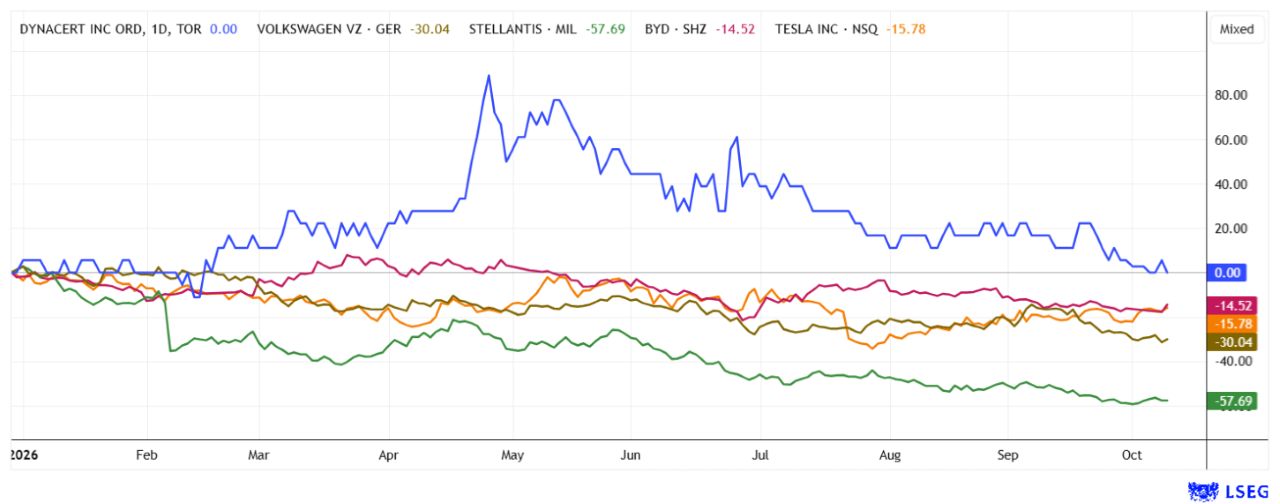
Chinese giant BYD is underpinning its dominance in the global electric vehicle segment with unprecedented momentum in the European market. In late summer 2026, the company catapulted its sales figures in the wider European region to a record level of 26,000 to just under 30,000 units per month. With this spectacular catch-up, the brand dramatically overtook long-standing rival Tesla in European registration statistics. The group is also cleverly countering the EU's punitive tariffs by increasingly focusing on advanced plug-in hybrids, which are less affected than purely electric vehicles. European production in Hungary is also set to start soon, which would then remove all punitive measures. With complete control over its battery value chain and major cost advantages, BYD is driving a brutal pace of price competition that is choking its rivals. As established Western players shrink, the Shenzhen leader is laying the groundwork to dominate Europe long term. Nevertheless, the chart shows a 3-year low at prices of around EUR 8.45. The company continues to impress on fundamentals, with analysts even calculating a 2027 P/E ratio of 9.6. The “Build Your Dreams” share has never been this cheap.
dynaCERT: The Rollout Can Now Begin
It is not just vehicle production that is seeing movement – the supplier market is also undergoing major changes. Canadian cleantech specialist in hydrogen-based combustion optimisation, dynaCERT, has recently made significant progress in two important markets: Vietnam and France. In Vietnam, the first order for series deployment from a logistics company is planned following successful field tests, while in France an existing customer has placed another order for HydraGEN™ systems. This repeat order, received in September, is an important signal of acceptance following the initial installation. Through its distribution partner IPMD, dynaCERT is also advancing further pilot projects and customer contacts in the transport, port and mining industries. At the “24 Heures Camions” truck event in Le Mans, the company showcased its technology alongside partners and a Dakar rally truck equipped with HydraGEN™. The racing results were impressive across the board.
The technological foundation is HydraGEN™. The system generates hydrogen and oxygen on demand onboard the vehicle and feeds the gases into the diesel engine's air intake system. The aim is to improve combustion efficiency, reduce fuel consumption and lower emissions. The HydraLytica telematics platform captures fuel consumption and emissions data. Verra certification of dynaCERT's methodology provides a basis for the potential monetisation of verified CO₂ savings. The retrofit concept is particularly attractive in heavy-duty transport, as existing fleets can continue operating without the need to replace entire vehicles.
dynaCERT's management explains the planned rollout in the EU and emerging markets in an interview with IIF presenter Lyndsay Malchuk.
The greatest scaling potential now lies in Southeast Asia. An estimated ten million-plus medium-duty and heavy-duty commercial vehicles are on the road there. Vietnam is dynaCERT's regional starting point: after successful pilot installations, the company received its first series order from a Vietnamese logistics company. In addition, several HydraGEN™ units were installed on trucks and container-handling equipment at one of the world's largest port operators. If deployment extends to other fleets and countries, 1% market penetration could mean around 100,000 systems; 5% would equate to approximately 500,000 units. While these are, for now, long-term scenarios rather than already secured sales forecasts, they illustrate where the Canadians could be heading in the future.
The decisive signal for the next step in growth is now repeat orders following the initial orders. If dynaCERT converts pilot projects into larger fleet orders and scales up its distribution partners, its market development could lead to a bigger leap. After years of technological development and preparation, the company could be entering a harvest phase that takes the stock to a new level. Research firm GBC has analysed the prospects and set an initial price target of CAD 0.75 – implying around 700% upside from the current share price of around CAD 0.095.
Conclusion
High interest rates, rising inflation, and soaring energy prices are shaking the capital markets. There are currently few winners outside the AI bubble. The automotive sector could now gradually become attractive, as the major markdowns are over and some stocks are already setting sail towards growth again. For risk management, broad diversification across sectors and countries is recommended.
Conflict of interest
Pursuant to §85 of the German Securities Trading Act (WpHG), we point out that Apaton Finance GmbH as well as partners, authors or employees of Apaton Finance GmbH (hereinafter referred to as "Relevant Persons") currently hold or hold shares or other financial instruments of the aforementioned companies and speculate on their price developments. In this respect, they intend to sell or acquire shares or other financial instruments of the companies (hereinafter each referred to as a "Transaction"). Transactions may thereby influence the respective price of the shares or other financial instruments of the Company.
In this respect, there is a concrete conflict of interest in the reporting on the companies.
In addition, Apaton Finance GmbH is active in the context of the preparation and publication of the reporting in paid contractual relationships.
For this reason, there is also a concrete conflict of interest.
The above information on existing conflicts of interest applies to all types and forms of publication used by Apaton Finance GmbH for publications on companies.
Risk notice
Apaton Finance GmbH offers editors, agencies and companies the opportunity to publish commentaries, interviews, summaries, news and the like on news.financial. These contents are exclusively for the information of the readers and do not represent any call to action or recommendations, neither explicitly nor implicitly they are to be understood as an assurance of possible price developments. The contents do not replace individual expert investment advice and do not constitute an offer to sell the discussed share(s) or other financial instruments, nor an invitation to buy or sell such.
The content is expressly not a financial analysis, but a journalistic or advertising text. Readers or users who make investment decisions or carry out transactions on the basis of the information provided here do so entirely at their own risk. No contractual relationship is established between Apaton Finance GmbH and its readers or the users of its offers, as our information only refers to the company and not to the investment decision of the reader or user.
The acquisition of financial instruments involves high risks, which can lead to the total loss of the invested capital. The information published by Apaton Finance GmbH and its authors is based on careful research. Nevertheless, no liability is assumed for financial losses or a content-related guarantee for the topicality, correctness, appropriateness and completeness of the content provided here. Please also note our Terms of use.