October 29th, 2026 | 05:26 CET
Audi Invests in the US – Avoiding 100% of Tariffs with VW, Mercedes, Power Metallic and Porsche AG
Created and published on behalf of Power Metallic Mines
US instead of Europe! Facing potential costs running into billions on vehicle exports, Volkswagen subsidiary Audi is now going on the offensive and announcing the construction of its own USD 4 billion SUV plant in the US state of Georgia. This is not an isolated case, as the global automotive industry is facing a fundamental crisis fuelled by collapsing sales in China, once its flagship market, and the US government's protectionist tariff policy under Donald Trump. This strategic investment, worth billions, not only secures substantial local tax breaks for the premium manufacturer but, above all, serves as a shield against Trump's import tariffs. The consequences for the entire sector are far-reaching, as pressure on European automakers to radically localise production is mounting. While competitors such as BMW and Mercedes have been manufacturing in the US for decades, Audi must now catch up at considerable financial expense. For the European home market, however, this shift in value creation is intensifying the debate over factory closures and job cuts. At the same time, weak sales in China, where German brands are increasingly losing out to local electric vehicle competitors, are forcing painful strategic changes. It is worth taking a closer look at the sector!
time to read: 5 minutes | Author: André Will-Laudien
ISIN: Power Metallic Mines Inc | CA73929R1055 , Volkswagen AG | DE0007664005 , Volkswagen AG | DE0007664039 , MERCEDES-BENZ GROUP AG | DE0007100000 , PORSCHE AG | DE000PAG9113
Table of contents:
Author

André Will-Laudien
Born in Munich, he first studied economics and graduated in business administration at the Ludwig-Maximilians-University in 1995. As he was involved with the stock market at a very early stage, he now has more than 30 years of experience in the capital markets.
Tag cloud
Shares cloud
VW and Porsche: Subsidiary Audi gives Germany the cold shoulder
The automotive sector is sputtering! The division of the world into isolated economic regions is making global platform strategies less efficient. From now on, every major market will require its own extremely capital-intensive local development and production structures. Smaller suppliers are also coming under immense pressure to adapt to this enforced geopolitical restructuring. Ultimately, the industry is responding with a massive flight of capital to North America to safeguard access to profitable US business in high-margin SUVs. This definitively marks the end of the era in which cars could be developed centrally in Europe and simply exported worldwide. By building a plant in the US, Audi is giving Europe, and Germany in particular, the cold shoulder. Our location has become too expensive; where will this all lead?
After 9 months, Porsche AG recorded a 16% decline in global sales to 178,532 vehicles, driven primarily by the persistently challenging market environment in China. Despite lower sales volumes, revenue fell only moderately, to EUR 8.05 billion, as a better model mix with more expensive vehicles partially cushioned the decline. Operating profit recovered significantly to EUR 387 million over the same period, after a massive EUR 966 million loss in the prior-year quarter, weighed down by high exceptional costs. Driven by strong net cash flow from the sale of shares in Bugatti Rimac, the sports car manufacturer looks ahead with confidence and has officially confirmed its full-year guidance. The Volkswagen Group reports its Q3 figures today. Analysts' consensus estimate is EUR 2.67 per share, and one can only hope the outlook convinces the markets and that EUR 65.90 remains the year's low.
Mercedes-Benz: Poor figures push the share price to a yearly low
The Mercedes-Benz Group has deeply disappointed investors with a sharp cut to its full-year guidance, sending its shares plunging to a new yearly low of EUR 38.89. The main reason for the severe setback is a drastic slump in sales in the immensely important Chinese market, where sales fell by almost a third in Q3. Weakness in the high-margin luxury segment centred on the S-Class and Maybach is particularly painful for the Stuttgart-based premium manufacturer. Although EBIT rose to EUR 1.77 billion thanks to the weak prior-year quarter, this was purely a mathematical effect, while underlying earnings power in the passenger car business is eroding sharply. For the full year, management now expects an adjusted return on sales of just a meagre 2 to 3% in the core Mercedes-Benz Cars division. Disappointingly low free cash flow in the industrial business and announced cost increases for the upcoming fourth quarter further weigh on the financial results. Given these fundamental problems, the shares have lost more than a third of their value since the start of the year and are now facing technical downward pressure after breaking below key support levels. Whether the company will continue to pay a 6% dividend is in doubt under the current circumstances.
From top explorer to mine developer: Power Metallic clears the next hurdle
With its NISK project in Québec, Canadian exploration company Power Metallic Mines is securing direct access to high-grade copper, nickel and platinum group metal deposits that are indispensable for the manufacture of batteries, electric motors and power electronics. In view of a looming global copper supply deficit from 2027, the specialist also offers European carmakers such as Volkswagen and BMW a medium-term opportunity to reduce their dependence on sanctioned or environmentally questionable sources of raw materials.
The AI boom adds to the broader raw-materials dilemma. It has unleashed an enormous appetite for raw materials because, without copper, data centres, power grids and the electrification of industry remain distant prospects. The International Energy Agency (IEA) highlights growing supply pressure in its Global Critical Minerals Outlook 2025: Even with accelerated recycling and additional investment, copper supply could become a structural bottleneck by 2035 because new mines require long lead times and existing deposits have increasingly lower ore grades.
Against this backdrop, Power Metallic Mines is already making decisive progress. September 2026 brought a genuine surprise with the maiden resource estimate for the Lion zone, comprising around 4.75 million tonnes at an average of just under 3.9% copper equivalent (CuEq), with more than 85% of the resource classified as indicated. What is remarkable is the combination of high metal grades and mineralisation starting at surface, opening up open-pit mining as a possible development option for at least parts of the deposit. Lion also offers metallurgical evidence beyond spectacular drill cores: Independent tests by SGS achieved copper recoveries of more than 98% and produced a copper concentrate containing over 25% copper, while also investigating recovery of valuable by-product metals.
IIF presenter Lyndsay Malchuk interviewed CEO Terry Lynch about the upcoming steps towards the PEA and the outlook for 2027.
This brings the central investor question into sharper focus: whether the geological quality can translate into a viable mining model. For this crucial stage, Power Metallic has commissioned engineering firm BBA to conduct a preliminary economic assessment (PEA), with results expected in the first half of 2027. The model is intended to assess a potential initial open-pit operation followed by underground mining and also examine how the neighbouring Nisk deposit could be integrated into a joint development. The latest deep drilling adds upside potential: at the end of September, the company reported a 5.70 m interval grading 14.00% CuEq at around 800 m depth, including 2.15 m grading 24.62%, which is not yet included in the existing resource estimate.
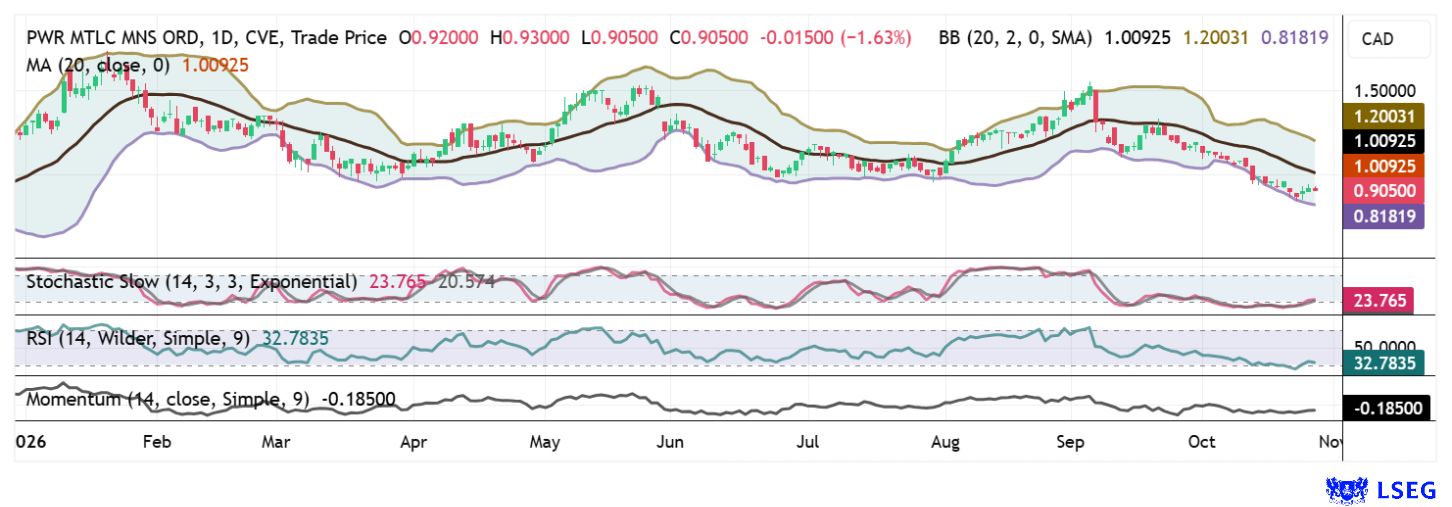
The solid CAD 28.2 million capital raise in June and the involvement of resources investor Eric Sprott give the company financial flexibility, but do not replace the subsequent capital required for potential mine construction. To be better able to fund future investments, management is pursuing a NASDAQ listing that secures access to the highly liquid US market. Analysts' price targets of CAD 2.70 at Hannam & Partners and CAD 3.00 at GBC Research signal substantial upside potential, but profit-taking and annual tax-loss selling currently prevail in Canada. Those who take the plunge now can buy at extremely attractive prices in the CAD 0.86 to 0.92 range! CEO Terry Lynch is surely raring to go!
Conclusion
Investors seeking long-term success in the critical metals market need more than a good story: projects with geological substance and genuine multi-year potential are crucial. Power Metallic Mines has a property with precisely this development potential. Opportunity-focused investors should also keep its potential takeover candidate status firmly in view. In automotive shares, the market has largely priced in the negative sentiment, which could create attractive entry opportunities again. To smooth out portfolio fluctuations, consistent diversification across themes, sectors and regions remains a key anchor of stability.
Conflict of interest
Pursuant to §85 of the German Securities Trading Act (WpHG), we point out that Apaton Finance GmbH as well as partners, authors or employees of Apaton Finance GmbH (hereinafter referred to as "Relevant Persons") currently hold or hold shares or other financial instruments of the aforementioned companies and speculate on their price developments. In this respect, they intend to sell or acquire shares or other financial instruments of the companies (hereinafter each referred to as a "Transaction"). Transactions may thereby influence the respective price of the shares or other financial instruments of the Company.
In this respect, there is a concrete conflict of interest in the reporting on the companies.
In addition, Apaton Finance GmbH is active in the context of the preparation and publication of the reporting in paid contractual relationships.
For this reason, there is also a concrete conflict of interest.
The above information on existing conflicts of interest applies to all types and forms of publication used by Apaton Finance GmbH for publications on companies.
Risk notice
Apaton Finance GmbH offers editors, agencies and companies the opportunity to publish commentaries, interviews, summaries, news and the like on news.financial. These contents are exclusively for the information of the readers and do not represent any call to action or recommendations, neither explicitly nor implicitly they are to be understood as an assurance of possible price developments. The contents do not replace individual expert investment advice and do not constitute an offer to sell the discussed share(s) or other financial instruments, nor an invitation to buy or sell such.
The content is expressly not a financial analysis, but a journalistic or advertising text. Readers or users who make investment decisions or carry out transactions on the basis of the information provided here do so entirely at their own risk. No contractual relationship is established between Apaton Finance GmbH and its readers or the users of its offers, as our information only refers to the company and not to the investment decision of the reader or user.
The acquisition of financial instruments involves high risks, which can lead to the total loss of the invested capital. The information published by Apaton Finance GmbH and its authors is based on careful research. Nevertheless, no liability is assumed for financial losses or a content-related guarantee for the topicality, correctness, appropriateness and completeness of the content provided here. Please also note our Terms of use.