March 9th, 2026 | 07:00 CET
Antimony Resources: The defense industry cannot do without antimony!
The situation in the Middle East continues to keep the world in suspense. The war in Iran has shaken global markets and once again shown how vulnerable our supply chains really are. Amid this turmoil, a raw material that has long been of little interest to anyone is increasingly coming into the spotlight: antimony. Without this metal, essential parts of the defense industry and modern energy supply would come to a standstill. This is exactly where Canadian company Antimony Resources Corp. comes in, with its Bald Hill project in New Brunswick. The stock has already doubled in 2026, but this could be just the beginning. Antimony Resources is a name every investor should keep on their radar.
time to read: 5 minutes | Author: Mario Hose
ISIN: ANTIMONY RESOURCES CORP | CA0369271014 | CSE: ATMY , OTCQB: ATMYF
Table of contents:
Author

Mario Hose
Born and raised in Hannover, Lower Saxony follows social and economic developments around the globe. As a passionate entrepreneur and columnist he explains and compares the most diverse business models as well as markets for interested stock traders.
Tag cloud
Shares cloud
Antimony – A metal in demand
Antimony is a brittle, silvery-shiny semi-metal. Many people have never heard of it. But it is indispensable in the defense industry. Infrared technology, night vision devices, precision ammunition – antimony is everywhere. The problem, as so often is the case, is that China and Russia control most of the world's production. The West is therefore hanging by a thread. The war in Iran has once again painfully highlighted this dependence. If trade routes are disrupted or if sanctions stop the flow of goods, there is a risk of a serious supply shortage. NATO countries urgently need their own reliable sources.
Many people may think that antimony is still a niche product, but that is by no means the case. Antimony is found in products we use every day without knowing it. It is contained in flame retardants in electrical appliances, cables, and textiles. Modern lead-acid batteries do not function properly without antimony. And in the emerging world of stationary energy storage for solar and wind power, antimony is increasingly being traded as a key component. Demand is therefore growing from several sides at once, while supply from the West is virtually non-existent. This is a classic scenario for rising prices for the raw material and for companies that offer a solution to the growing investor interest. Such as Antimony Resources.
To make matters worse, China already imposed export restrictions on antimony last year. This was a clear signal. Anyone who had believed until then that supply was secure was proven wrong. Since then, governments and industry in North America and Europe have been feverishly searching for alternatives and solutions.
The project and the team behind Antimony Resources
The heart of Antimony Resources is located in Queens County, New Brunswick. The location is extremely favorable for a mining project. Good road connections, a deep-sea port just 55 km away, hardly any logistical hurdles. This is not a matter of course in the mining industry, as many promising projects fail not because of geology, but simply because they are too remote. The Bald Hill project is well-positioned to avoid these logistical issues.
Drilling on site to date has confirmed mineralization over a length of 700 m and to a depth of 400 m. The deposit is still open in all directions. The grades are remarkably high by North American standards, averaging between 3 and 4% antimony. The discovery hole even yielded sections with 11.7% over more than 4 m. Such values rightly attract the attention of industry.
The claim area now covers over 2,000 hectares. The company has been very forward-looking and well-considered in ensuring that it can control the entire potential extent of the ore bodies through targeted acquisitions in the east, west, and south.
The company is headed by James R. Atkinson, former chief geologist at the Lake George antimony mine in New Brunswick, the only former antimony mine in North America. In its heyday, this mine covered around 4% of global demand. Atkinson has over 45 years of experience, has worked for industry giants such as Newmont and BHP, and knows the geology of the region like no other. He is joined by financial expert Sheryl Jones, who has been advising publicly traded companies for three decades, and investment banker Rodney Stevens. All in all, a well-assembled team with a wealth of expertise.
Here is a video featuring Antimony Resources CEO J. Atkinson:
Current drilling program
The ongoing drilling program covers 10,000 m, of which 4,000 m have already been completed. The results are quite impressive. The drills regularly encounter massive, antimony-bearing stibnite. Particularly exciting is the discovery of the so-called Marcus (West) Zone in the west of the site. It was found almost by accident when heavy machinery brought ore to surface during the construction of access roads. Initial investigations indicate that it is an independent structure running parallel to the main zone. This could significantly increase the dimensions of the entire project. A third drilling rig has already been brought to site in order to maintain the pace, or at least not to slow down, but rather to move forward more quickly.
The goal of the current drilling is to obtain an initial official resource estimate, known as the maiden resource. Once this is available, the project will be taken to a whole new level. Investors and potential strategic partners will then be able to work with concrete figures. This is an important milestone that should be reached in the coming months.
Chart analysis
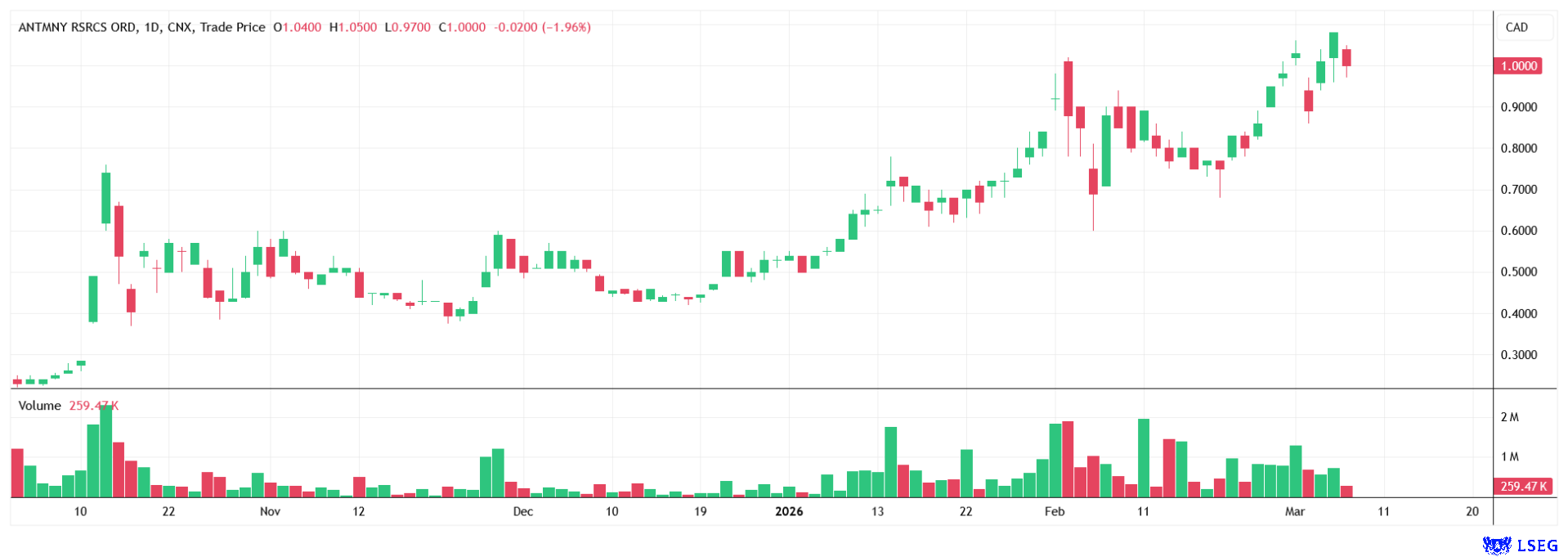
The Antimony Resources chart looks exemplary. The share price runs almost like a string from the bottom left to the top right. In 2026, the value doubled from CAD 0.50 to CAD 1.00. This shows how sought-after and coveted companies in the antimony sector are, especially Antimony Resources. Also noteworthy is the increased trading volume in 2026, which indicates increased buying interest, including from institutional investors. Since antimony deposits are important for the defense and energy industries, certain resources could become geopolitically important for certain countries, so it cannot be ruled out that governments themselves will take strategic action here, participate, or seek to secure the deposits. Even after the recent doubling of the share price, it cannot be ruled out that the price will double again. Here, the only limit is the sky.
Antimony is a raw material that is likely to gain in importance in the coming years. Geopolitical tensions are making an independent Western supply increasingly urgent, and China's export restrictions have set the clock forward once again. Antimony Resources is well-positioned in this environment. The project in New Brunswick has solid geological foundations, the team has genuine expertise, and the current drilling results are promising, which is also reflected in the share price. The discovery of the Marcus (West) Zone shows that the potential of the area may be even greater than previously thought.
There is still a long way to go before production begins. Still, the direction is right, the timing is favorable, and antimony is not going to disappear from the agenda anytime soon. Those who want to follow developments should definitely keep Antimony Resources on their radar or consider getting involved.
Conflict of interest
Pursuant to §85 of the German Securities Trading Act (WpHG), we point out that Apaton Finance GmbH as well as partners, authors or employees of Apaton Finance GmbH (hereinafter referred to as "Relevant Persons") currently hold or hold shares or other financial instruments of the aforementioned companies and speculate on their price developments. In this respect, they intend to sell or acquire shares or other financial instruments of the companies (hereinafter each referred to as a "Transaction"). Transactions may thereby influence the respective price of the shares or other financial instruments of the Company.
In this respect, there is a concrete conflict of interest in the reporting on the companies.
In addition, Apaton Finance GmbH is active in the context of the preparation and publication of the reporting in paid contractual relationships.
For this reason, there is also a concrete conflict of interest.
The above information on existing conflicts of interest applies to all types and forms of publication used by Apaton Finance GmbH for publications on companies.
Risk notice
Apaton Finance GmbH offers editors, agencies and companies the opportunity to publish commentaries, interviews, summaries, news and the like on news.financial. These contents are exclusively for the information of the readers and do not represent any call to action or recommendations, neither explicitly nor implicitly they are to be understood as an assurance of possible price developments. The contents do not replace individual expert investment advice and do not constitute an offer to sell the discussed share(s) or other financial instruments, nor an invitation to buy or sell such.
The content is expressly not a financial analysis, but a journalistic or advertising text. Readers or users who make investment decisions or carry out transactions on the basis of the information provided here do so entirely at their own risk. No contractual relationship is established between Apaton Finance GmbH and its readers or the users of its offers, as our information only refers to the company and not to the investment decision of the reader or user.
The acquisition of financial instruments involves high risks, which can lead to the total loss of the invested capital. The information published by Apaton Finance GmbH and its authors is based on careful research. Nevertheless, no liability is assumed for financial losses or a content-related guarantee for the topicality, correctness, appropriateness and completeness of the content provided here. Please also note our Terms of use.