October 30th, 2026 | 05:43 CET
Antimony Countdown: BASF Needs New Supplies as Perpetua Resources and NSJ Antimony Develop North American Sources
Created and published on behalf of NSJ Antimony
On November 27, 2026, China's suspension of its antimony export ban to the United States is due to expire. Without an extension by Beijing, US buyers risk losing access to this metalloid, which is essential for flame retardants and armaments. This was reported by industry publication Mining Weekly. According to market information provider Fastmarkets, antimony was trading at USD 18,300 to USD 19,000 per tonne in Rotterdam in mid-October. This is well below the all-time high of approximately USD 59,750 reached in summer 2025. However, the West's dependence on Chinese refineries remains unchanged.
time to read: 3 minutes | Author: Nico Popp
ISIN: NSJ Antimony Corp. | CA6293911039 , BASF SE NA | DE000BASF111 , PERPETUA RESOURCES CORP | CA7142661031
Table of contents:
Author

Nico Popp
At home in Southern Germany, the passionate stock exchange expert has been accompanying the capital markets for about twenty years. With a soft spot for smaller companies, he is constantly on the lookout for exciting investment stories.
Tag cloud
Shares cloud
BASF needs reliable supplies
Chemical groups such as BASF, which manufacture flame-retardant plastics, need reliable supplies of antimony. In plastics such as polyvinyl chloride or polyamides, antimony trioxide acts as a synergist in combination with halogenated flame retardants. In the event of a fire, the metal catalyses the release of halogen radicals, which chemically extinguish the flames. A halt in Chinese exports would hit Western industry hard, as inorganic substitutes such as aluminium hydroxide must be added in very high proportions, making the plastics brittle. To reduce its dependence on primary raw materials, BASF is establishing closed-loop systems, as shown by its Schwarzheide plant producing black mass for battery recycling, which began commercial operations in mid-2025 and has an annual capacity of 15,000 tonnes. Geopolitical pressure will likely push industry to expand this recycling infrastructure to other material classes in the coming years.
Perpetua Resources establishes US production
To reduce the United States' 91% net import dependence, Perpetua Resources is developing the Stibnite project in Idaho. The historic deposit supplied around 90% of American antimony during the Second World War and, according to the company, holds the only significant domestic reserve, estimated at 148 million pounds. Following receipt of all final federal permits in May 2025, construction work has begun on the new logistics route and worker accommodation. The company is targeting the start of production in 2028. Since late October, the US Army has supported Perpetua with up to USD 40 million to assess whether it can extract additional high-grade tungsten beneath the planned Hangar Flats pit. Recent drilling there yielded intervals such as 9.8 m grading 4.6% tungsten and 8.3% antimony.
NSJ Antimony drills in New Brunswick
While Perpetua builds mining infrastructure, NSJ Antimony focuses on exploration in New Brunswick, Canada. Its core project, Antimony 2.0, is located just 15 km from the former Lake George mine. According to the company, this historic site met up to 4% of global demand between 1970 and 1992 and was considered North America's only pure antimony producer. In late September, NSJ Antimony expanded the project area by 22 km² to 57 km² through the addition of new claims. The new areas feature the same interbedded strata that also characterise the neighbouring Lake George deposit. An initial analysis of 395 soil samples by optionor Edge Exploration had already identified three particularly robust antimony soil anomalies. In August, NSJ also completed a high-resolution airborne magnetic survey covering 258 line-kilometres. Based on these data and induced polarisation surveys, which measure the rock's electrical resistivity and chargeability, NSJ launched a 3,000 m drilling programme in September.
Capital raising and midstream expansion
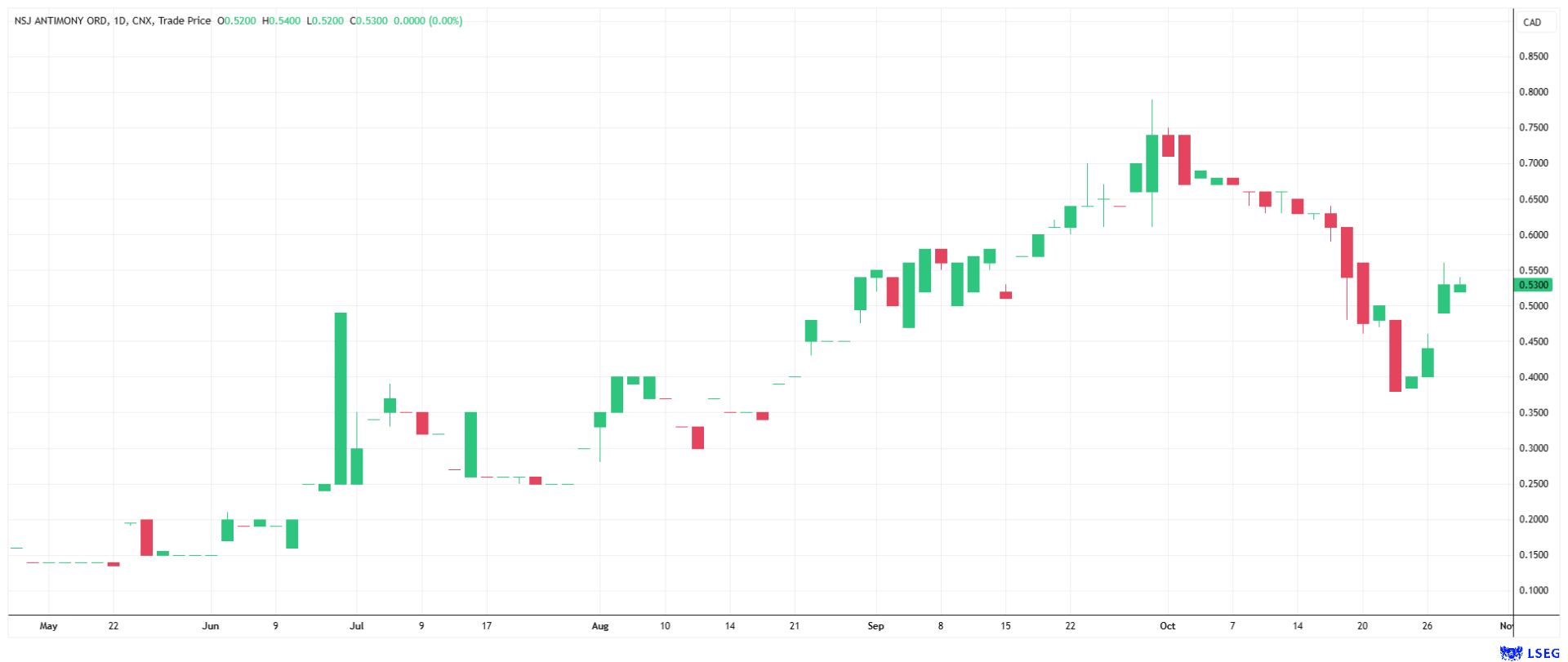
To finance its exploration work, NSJ Antimony is raising fresh capital in the Canadian market. In October, the exploration company announced a financing round of up to 1.4 million flow-through shares, which is expected to generate gross proceeds of up to CAD 924,000 at a price of CAD 0.66 per share. A flow-through round at CAD 0.30 had already been oversubscribed in September. This instrument channels private funds into early-stage exploration, while allowing investors to claim eligible exploration expenses for tax purposes. At the same time, United States Antimony Corporation is expanding domestic refining capacity in the midstream sector. The company is increasing its smelter capacity in Thompson Falls, Montana, to over 300 tonnes per month. The Defense Logistics Agency had previously fuelled this expansion with an exclusive contract worth up to USD 245 million to replenish strategic US antimony reserves.
Conclusion: The clock is ticking – will NSJ benefit?
The end of November could mark a sharp turning point for the global critical raw materials market. If Beijing lets the date pass, the civilian US market will face a supply shock likely to drive prices up again and increase pressure on buyers such as BASF. A permanent embargo is likely to accelerate market decoupling and increase interest in Western raw materials projects such as NSJ's Antimony 2.0. However, investors in exploration companies at this stage must factor in dilution and drilling risks before a project reaches commercial production readiness. The stock remains speculative, but it also offers considerable opportunities. The stock therefore remains a speculative investment, but conversely, one that also offers great potential.
Conflict of interest
Pursuant to §85 of the German Securities Trading Act (WpHG), we point out that Apaton Finance GmbH as well as partners, authors or employees of Apaton Finance GmbH (hereinafter referred to as "Relevant Persons") may hold shares or other financial instruments of the aforementioned companies in the future or may bet on rising or falling prices and thus a conflict of interest may arise in the future. The Relevant Persons reserve the right to buy or sell shares or other financial instruments of the Company at any time (hereinafter each a "Transaction"). Transactions may, under certain circumstances, influence the respective price of the shares or other financial instruments of the Company.
In addition, Apaton Finance GmbH is active in the context of the preparation and publication of the reporting in paid contractual relationships.
For this reason, there is a concrete conflict of interest.
The above information on existing conflicts of interest applies to all types and forms of publication used by Apaton Finance GmbH for publications on companies.
Risk notice
Apaton Finance GmbH offers editors, agencies and companies the opportunity to publish commentaries, interviews, summaries, news and the like on news.financial. These contents are exclusively for the information of the readers and do not represent any call to action or recommendations, neither explicitly nor implicitly they are to be understood as an assurance of possible price developments. The contents do not replace individual expert investment advice and do not constitute an offer to sell the discussed share(s) or other financial instruments, nor an invitation to buy or sell such.
The content is expressly not a financial analysis, but a journalistic or advertising text. Readers or users who make investment decisions or carry out transactions on the basis of the information provided here do so entirely at their own risk. No contractual relationship is established between Apaton Finance GmbH and its readers or the users of its offers, as our information only refers to the company and not to the investment decision of the reader or user.
The acquisition of financial instruments involves high risks, which can lead to the total loss of the invested capital. The information published by Apaton Finance GmbH and its authors is based on careful research. Nevertheless, no liability is assumed for financial losses or a content-related guarantee for the topicality, correctness, appropriateness and completeness of the content provided here. Please also note our Terms of use.